

Quick answer
- FSSC 22000 combines ISO 22000, sector-specific ISO 22002-x prerequisite programmes, and FSSC’s own extra requirements into one GFSI-recognised food safety scheme.
- Version 7 replaced Version 6 in May 2026. Auditors may still run V6 audits through 30 April 2027, but every certificate has to sit on V7 by 30 April 2028.
- In Iraq, IAS issues the certificate itself while holding UQAS accreditation for the scheme. That accreditation is what gives the certificate standing with buyers outside the country.
- EAS delivers the Lead Auditor and Internal Auditor courses that support Iraqi teams. Those courses run apart from the audit team, to keep the certification decision impartial.
Iraq’s food sector has been building export capacity fast, with date processors, dairies, and bottled-water and drinks bottlers among them. A growing share of that output is aimed at buyers in the Gulf, Europe, and beyond who will not place an order without a GFSI-recognised food safety certificate on file. FSSC 22000 is the certificate most of those buyers ask for by name. IAS certifies Iraqi food businesses to FSSC 22000, working from local site visits rather than a fly-in-once model. This page walks through what the scheme actually requires, what changed with the May 2026 move to Version 7, which Iraqi operators typically need it, and how the audit itself unfolds from first enquiry to certificate.
What Is FSSC 22000 Certification?
Despite the name, FSSC 22000 is not a single standard you can read cover to cover. It’s a certification scheme assembled from three parts. The base is ISO 22000, the international food safety management system standard. Layered on top of that are the ISO 22002-x prerequisite programmes. These set out the hygiene and operational controls specific to your part of the food chain — manufacturing, packaging, storage, and so on. The third layer is a set of FSSC Additional Requirements covering things ISO 22000 leaves thin, notably food fraud, food defence, allergen management, and product labelling. The Foundation for Food Safety Certification owns the scheme, and it is fully benchmarked against the Global Food Safety Initiative. Most international retailers and food brand owners treat an FSSC 22000 certificate as sufficient proof of food safety competence without further scrutiny — which matters a great deal for an Iraqi exporter trying to open a new market.
FSSC 22000 V6 vs. V7: What Actually Changed
FSSC released Version 7 in May 2026 as a direct replacement for Version 6. A transition period runs to 30 April 2028, so certified sites are not forced into an overnight rewrite. The underlying architecture — ISO 22000 plus prerequisite programmes plus HACCP-based hazard analysis plus the Additional Requirements — carries over unchanged. The table below sets out what moved.
| Area | FSSC 22000 V6 | FSSC 22000 V7 |
|---|---|---|
| Prerequisite programmes | ISO/TS 22002-x series | New ISO 22002-x:2025 series |
| GFSI benchmarking | Aligned to GFSI Benchmarking Requirements v2020 | Realigned to GFSI Benchmarking Requirements v2024 |
| Food-chain categories | Broader category groupings | More granular category & subcategory structure |
| Culture requirements | Food safety & quality culture required | Strengthened — clearer evidence of senior-management involvement expected |
| Sustainability | Limited, indirect coverage | Formal SDG-aligned requirements: food loss & waste, resource efficiency, packaging design |
| Additional Requirements | Baseline coverage | Strengthened supplier approval, allergen management, food defence, food fraud, equipment management |
Source: FSSC 22000 Version 7 update, Foundation for Food Safety Certification (fssc.com), May 2026.
None of this means starting the FSMS over. Sites already certified to V6 mostly re-point existing documents and records at the new structure. Hazard analysis does not need rebuilding from scratch.
Who Should Certify to FSSC 22000?
FSSC 22000 fits a wider slice of Iraq’s food economy than manufacturers alone. IAS certifies businesses across categories that include:
- Date processing, sorting, and packing operations, including facilities exporting to Gulf and European buyers.
- Dairy processors and bottling plants, where cold-chain control is central to the food safety case.
- Bottled water and soft-drink or beverage bottlers, where source water testing and line hygiene carry particular weight.
- Bakery, confectionery, and other food manufacturers supplying retail and food-service customers.
- Food import, storage, and distribution operators, including cold-chain logistics providers.
- Catering and food-service businesses supplying institutional or retail customers.
Transitioning from V6 to V7: Key Dates
| Milestone | Date |
|---|---|
| FSSC 22000 V7 published | May 2026 |
| Last date V6 audits are permitted | 30 April 2027 |
| V7 upgrade audit window | 1 May 2027 – 30 April 2028 |
| Deadline: every certificate must be on V7 | 30 April 2028 |
A V6 certificate does not stop working the day V7 is published — it simply has a shelf life now. IAS’s advice to Iraqi clients is to run a gap review against V7 and the 2025 prerequisite programmes early, rather than treating the deadline as distant. Date-processing and dairy operations often have narrow production-season windows, and a full records rewrite is hard to schedule inside one of those.
The IAS Iraq Certification Process, Start to Finish
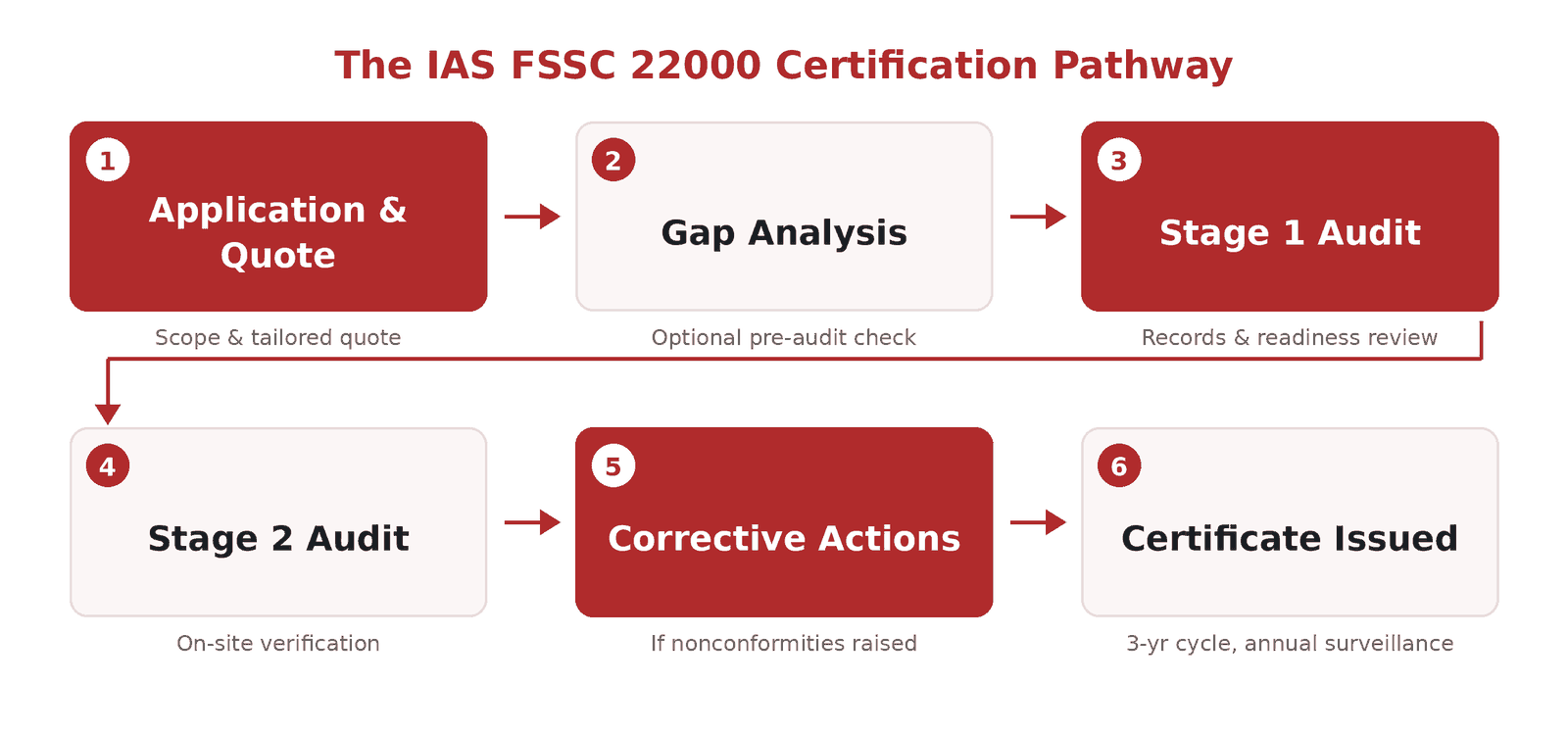
- Application and quote — IAS reviews the site’s product category, scale, and risk profile and returns a tailored quote.
- Gap analysis (optional) — a pre-audit check against FSSC 22000 V7 that flags gaps before they become findings.
- Stage 1 audit — a records and readiness review confirming the FSMS is fit to be audited on site.
- Stage 2 audit — the on-site audit itself: monitoring records, HACCP verification, prerequisite programmes, traceability, and the Additional Requirements are all checked against actual practice.
- Corrective actions (where raised) — nonconformities need to be closed out and evidenced before a certificate is issued.
- Certificate issued — valid for a three-year cycle, with surveillance keeping it current (see ‘After Certification’ below).
“In date-processing and bottled-water plants especially, the traceability exercise is where Stage 2 either goes smoothly or stalls,” says Adekoya Oluwatosin, FSSC 22000 v6 Lead Auditor. “Run a mock recall on an actual batch code before the auditor asks for one — it exposes gaps in record-keeping that no policy document will show you.”
Timelines vary with how mature the FSMS already is. A dairy or drinks plant with an established quality system can often reach certification within a few months of application. An operation building its FSMS from a standing start should plan for longer. Rather than name a fixed number of weeks upfront, IAS settles on a realistic timeline only after the gap-analysis findings are in hand.
Documentation You’ll Need for Certification
- A food safety policy that top management has formally signed off on.
- HACCP plan and prerequisite programmes mapped to the ISO 22002-x:2025 series.
- Food defence and food fraud vulnerability assessments, with mitigation plans.
- Allergen management plan, including cross-contact controls for shared production lines.
- Traceability and recall procedures, backed by actual test records — not just the written procedure.
- Source water testing records for bottled water and beverage operations, where applicable.
- Monitoring, verification, internal audit, and management-review records covering the period since the last audit.
- Food safety and quality culture plan — an area V7 pushes harder on.
Benefits of FSSC 22000 Certification
- Export access — GCC, European, and other international buyers commonly require a GFSI-recognised certificate before they will place a first order.
- Fewer rejected shipments — structured hazard control at the plant catches contamination and labelling issues before goods leave the site.
- Regulatory standing — a documented FSMS makes it far easier to answer questions from Iraqi regulators and from customs authorities in destination markets.
- Supply-chain trust — certification gives Iraqi date, dairy, and beverage exporters a recognised credential to show buyers who have never visited the site.
- Sustainability evidence — V7’s food loss and waste requirements give exporters something concrete to hand to buyers who ask about their own sustainability reporting.
Accreditation and Training at a Glance
FSSC and GFSI both expect a certification body to hold its audit function and its training function apart. IAS structures itself accordingly. Iraqi teams preparing for audit can go straight to the FSSC 22000 Lead Auditor Training in Iraq and Internal Auditor Training in Iraq pages, both delivered by EAS.
| Activity | Delivered by | Accredited / Approved by |
|---|---|---|
| FSSC 22000 certification audit | IAS (Integrated Assessment Services) | UQAS (Universal Quality Accreditation Service) |
| FSSC 22000 Lead Auditor training (Iraq) | EAS (Empowering Assurance Systems) — IAS’s technical training partner | CQI-IRCA (Approved Training Partner) |
| FSSC 22000 Internal Auditor training (Iraq) | EAS — IAS’s technical training partner | EAS’s own in-house training curriculum (CQI-IRCA approval applies to the Lead Auditor course only) |
Verified against IAS’s published accreditation page and EAS’s published accreditation page, August 2026.
After Certification: Keeping a Certificate Current in Iraq
Once IAS issues the certificate, the clock starts on a three-year cycle, not a one-time result. Annual surveillance visits check that the FSMS is still doing what it says on paper. At least one of those visits in the cycle arrives unannounced. A recertification audit — run to the same depth as the original Stage 2 — is scheduled with enough lead time to finish before the three years are up.
- Date-processing sites should flag their harvest-season production window to IAS when booking surveillance. A visit that lands mid-harvest sees the operation at its busiest and its tightest scheduling — often exactly when a surveillance audit is most useful, but it needs planning on both sides.
- Bottled-water and drinks bottlers that add a new production line, a new source, or a new SKU should notify IAS promptly. An extension audit may be needed to bring the change under certification, rather than waiting for the next scheduled visit.
- Dairy operators expanding cold-chain capacity or adding a distribution point mid-cycle face the same notification rule, since cold-chain integrity is central to how the certificate is scoped in the first place.
- An unannounced audit can land without warning at any point in the cycle. The FSMS needs to hold up on an ordinary production day, not just on a day the plant has prepared for.
Why Certify with IAS?
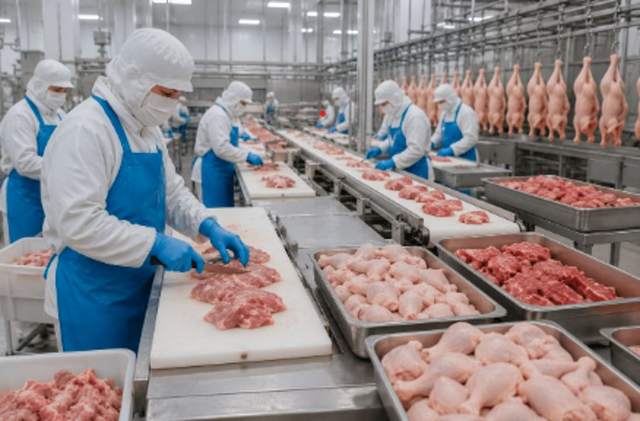
IAS auditors bring practical exposure to date processing, dairy, and drinks bottling operations. The audit reads real production risk, not a generic checklist copied from another sector. IAS also certifies related standards, including ISO 22000, ISO 9001, and HACCP. A combined audit can cover more than one scheme in a single site visit, which matters for exporters juggling multiple buyer requirements at once. For Lead Auditor and Internal Auditor training, IAS works with EAS, whose Lead Auditor course carries CQI-IRCA approval.
About the reviewer
Food safety is Adekoya Oluwatosin’s trade on three fronts: she consults, she trains, and she audits. She holds v6 Lead Auditor status under the FSSC 22000 scheme after eight-plus years working across catering sites, packaging lines, manufacturing floors, and storage-and-distribution operations. Twenty-two-plus internal audits sit on her record, spanning FSSC 22000 and ISO 9001:2015 work. She has carried more than ten businesses from QMS and FSMS groundwork through to certification, and her Highfield-accredited Food Safety and HACCP courses have reached upwards of 200 delegates.
Explore More
- FSSC 22000 Lead Auditor Training in Iraq — CQI-IRCA approved, delivered by EAS
- FSSC 22000 Internal Auditor Training in Iraq — EAS’s in-house curriculum
- ISO 22000 Certification — the base standard FSSC 22000 is built on
- ISO 9001 Certification — for a combined audit with FSSC 22000
- HACCP Certification — hazard analysis and critical control points
- IAS Accreditation — IAS’s global UQAS accreditation scope
- EAS — IAS’s training partner for Lead Auditor and Internal Auditor courses
Get Started with FSSC 22000 Certification in Iraq
Reach out to IAS for a tailored FSSC 22000 V7 quote, or to plan the upgrade of an existing V6 certificate ahead of the 30 April 2028 deadline. If your team also needs Lead Auditor or Internal Auditor training, EAS can set up a combined pathway alongside the certification work.
Phone: +971 52 873 2160
Contact page: iasiso-gulf.com/contact-us/
Frequently Asked Questions
Does an Iraqi exporter need FSSC 22000, or is a national food safety licence enough?
A national licence covers legal operation inside Iraq. It doesn’t carry the same weight with GCC or European buyers. Most of them specifically ask for a GFSI-recognised certificate such as FSSC 22000 before they will place an order.
My date processing plant is already ISO 22000 certified — do I need to start over for FSSC 22000?
No. ISO 22000 is the base of the FSSC 22000 scheme, so an existing ISO 22000 system is a running start, not a restart. You add the ISO 22002-x prerequisite programme and the Additional Requirements on top of what’s already in place.
Is a V6 certificate still valid for a bottled water or drinks plant in Iraq?
Yes, until it’s upgraded. V6 audits remain permitted through 30 April 2027, and every certificate needs to be on V7 by 30 April 2028.
Should a first-time applicant in Iraq go straight for V7?
Yes. Certifying directly to the current version avoids the extra step of upgrading a V6 certificate soon after it’s issued.
How does IAS handle site visits for Iraqi facilities?
IAS schedules Stage 1 and Stage 2 audits on-site, working around each operation’s production calendar — date-processing seasonality and drinks bottling schedules included.
What does FSSC 22000 certification typically cost for an Iraqi food business?
There’s no fixed published fee. Cost depends on site count, product category, and risk profile, and IAS puts together a tailored quote only after the application has been reviewed.
Can a dairy processor combine an FSSC 22000 audit with an ISO 9001 audit?
Yes — ask IAS to align the audit dates so a single site visit covers both schemes rather than scheduling two separate visits.
Who accredits IAS to issue FSSC 22000 certificates?
UQAS (Universal Quality Accreditation Service). Its public register can be checked independently to verify IAS’s accreditation status.
Where does Lead Auditor and Internal Auditor training for Iraqi teams come from?
EAS, IAS’s technical training partner, running the courses linked above specifically for Iraq. The Lead Auditor course is CQI-IRCA approved; the Internal Auditor course is EAS’s own in-house curriculum.
How long does certification usually take for a date or dairy processor in Iraq?
It depends heavily on how developed the FSMS already is — IAS would rather review the gap-analysis results first and give an honest estimate than quote a one-size-fits-all timeframe.
