

Independent third-party cGMP certification for manufacturers rebuilding and expanding capacity in Iraq — scoped to your products, audited against the applicable GMP scheme, and backed by a fixed written quotation. Pharmaceuticals, food, cosmetics, construction chemicals, or another category entirely: IAS scopes the audit to fit.
- UQAS-accredited certification body
- Fixed written quotation, no surprise fees
- Nearly two decades of assessment experience
- Open to every industry, not just pharma
Ready to scope your certification? Describe your site and product range and receive a fixed written quotation — contact IAS today.
cGMP certification in Iraq at a glance
- Scope: the scheme that applies to your product category sets what the audit examines; nothing generic is applied.
- Eligible industries: pharmaceuticals, food, cosmetics, medical devices, construction chemicals, packaging, and any other manufactured product category.
- Certification cycle: application and scoping, on-site assessment, certificate, annual surveillance, recertification.
- Pricing: one fixed written quotation after scope is confirmed — no published price bands, no surprise fees.
- Accreditation: IAS is accredited by UQAS for the certification work described here.

Rebuilding Iraq’s manufacturing base, and why quality evidence now matters
Iraq’s manufacturing sector is being rebuilt from the ground up. Reconstruction investment and renewed private capital have pushed local production of pharmaceuticals, packaged food, and construction-adjacent chemicals from a marginal share of the market toward a genuine domestic base. New production lines are coming online across Baghdad, Basra, Erbil, and the industrial zones around Anbar and Najaf.
- A foundational investment, not an afterthought. Manufacturers who build documented, repeatable quality practices into a new or rebuilt line from the outset find it far easier to satisfy tender evaluators, hospital procurement teams and export partners. Those who retrofit quality systems later face a harder task.
- Buyer expectations have shifted. A government tender, hospital procurement office, supermarket chain or foreign distributor increasingly wants documented, independently verified evidence of a working quality system. A finished product and a manufacturing licence are no longer enough.
- What cGMP certification answers. A structured, third-party assessment of how consistently a facility controls its production, testing and documentation, issued against a named GMP scheme and scope.
cGMP certification sits alongside, not in place of, Iraq’s own regulatory system. IAS, working through its ISO certification services and dedicated management-system schemes, supports Iraqi manufacturers rebuilding or expanding capacity who need that independent layer of quality evidence for local tenders and export-facing buyers alike.
Who regulates what in Iraq
Iraq does not have a single body responsible for both licensing manufacturers and issuing voluntary quality certificates. These are two different functions carried out by different organisations.
| Body | Role | Issues cGMP certificates? |
|---|---|---|
| Ministry of Health / Board of Pharmacy | Registers pharmaceutical products and licenses drug manufacturing facilities operating in Iraq | No — licensing authority, not a certification body |
| Central Organization for Standardization and Quality Control (COSQC) | Sets and enforces national product standards and conformity requirements across broader industrial and consumer categories | No — standards and conformity body, not a GMP certifier |
| World Health Organization (WHO) | Publishes WHO-GMP guidelines used as a reference framework across Iraq’s pharmaceutical sector | No — standard-setter only, never a regulator or certifier |
| US FDA | Regulates the United States market only | No — issues no certificates through third parties, anywhere |
| IAS | Independent third-party certification body | Yes — under its UQAS accreditation, against the applicable GMP scheme and scope |
- Not Ministry approval or FDA clearance. An IAS cGMP certificate is never presented as Ministry of Health approval, COSQC endorsement, or FDA clearance.
- Not a substitute for any Iraqi licence. It never replaces any Iraqi manufacturing licence, drug registration or product approval — it complements those obligations with an independently verified statement about the facility’s quality management system.
- Targeting the US market? Review the FDA certification in Iraq page separately, since FDA requirements sit entirely outside the cGMP certification scope described here.
Not sure which scheme applies to your products? Ask IAS for a free scoping conversation — the certification process page sets out what happens at each stage.
cGMP meaning: GMP vs cGMP, clarified
GMP and cGMP describe the same underlying discipline: systematic control of manufacturing quality. cGMP emphasises that methods, equipment and controls must stay current rather than fixed at a single point in time.
Neither term refers to one single worldwide certificate. In everyday use across Iraq’s pharmaceutical and food sectors the two are frequently used interchangeably, and both point back to the same family of underlying schemes: most often WHO-GMP guidelines locally, alongside PIC/S GMP or national codes depending on export destination.
| Aspect | GMP | cGMP |
|---|---|---|
| Core focus | Documented, repeatable manufacturing controls | Same controls, kept aligned with current methods and technology |
| Typical Iraqi usage | General reference in local regulatory language | Common shorthand in pharma sector conversation and tenders |
| Underlying frameworks | WHO-GMP, national codes, ISO 22716 (cosmetics), PIC/S | Same frameworks — the “c” is an emphasis, not a separate rulebook |
| What a certificate states | Scheme and scope named on the certificate | Scheme and scope named on the certificate |
No single rulebook: cGMP requirements by product category
A pharmaceutical tablet line, a bottled-juice plant, a cosmetics workshop and a medical-device assembly facility are not held to one identical checklist. Each draws on a different reference framework, and IAS certifies against whichever scheme applies to the facility’s actual products and scope — stated clearly on the certificate itself.
| Product category | Commonly referenced framework(s) | Typical Iraqi context |
|---|---|---|
| Pharmaceuticals | WHO-GMP guidelines; PIC/S GMP guide; national pharma codes | Ministry of Health / Board of Pharmacy licensing runs alongside |
| Food and beverage | National food-safety codes; Codex-aligned GMP principles; ISO 22000 where a full food-safety system is certified | Growing local processing capacity |
| Cosmetics and personal care | ISO 22716 | Emerging local production for regional distribution |
| Medical devices | Device-specific GMP/QMS requirements distinct from drug GMP, commonly alongside ISO 13485 | Assembly and packaging operations expanding |
| Other industries (chemicals, packaging, contract packing, feed, warehousing) | Scheme selected to match the specific product and process | Open to any manufacturer, not limited to the categories above |
cGMP certification is open to every industry with a quality-sensitive manufacturing, packaging or storage process, not only pharmaceuticals, food, cosmetics and devices. Construction-chemical producers, packaging converters, animal-feed manufacturers, contract packers and warehousing operators across Iraq’s reconstruction economy can equally apply, scoped to what they actually produce.
Areas an IAS assessment typically looks at
Because the applicable scheme varies by product category, the exact checklist an auditor uses varies too. In general an assessment reviews how consistently a facility can demonstrate control over the following, as applicable to the scheme and category:
- Facility layout, environmental controls and equipment maintenance
- Raw material sourcing, incoming inspection and traceability records
- Production process controls and in-process checks
- Quality control testing and release procedures
- Documentation practices, including batch or production records
- Change control, deviation handling and corrective action processes
- Staff training records and hygiene or safety practices relevant to the product
- Complaint handling, recall readiness and data integrity practices
Who in Iraq is applying for cGMP certification
Demand is broadening well beyond the pharmaceutical sector that first popularised the term locally:
| Sector | Typical driver in Iraq |
|---|---|
| Pharmaceutical manufacturers | Buyer and tender confidence alongside Ministry of Health licensing |
| Food and beverage processors | Retail chain and government procurement quality requirements |
| Cosmetics and personal-care producers | Regional distribution and export credibility |
| Construction-chemical and building-material input makers | Reconstruction-project specification and contractor requirements |
| Packaging manufacturers and converters | Downstream client requirements for controlled production |
| Contract packers and toll manufacturers | Multiple brand-owner clients demanding documented quality systems |
Facilities that also run training programmes for staff can pair certification with cGMP internal auditor training in Iraq, or with the broader internal auditor training and ISO lead auditor training courses, to build in-house audit capability. Upcoming sessions are listed on the training schedule page.
The IAS certification journey
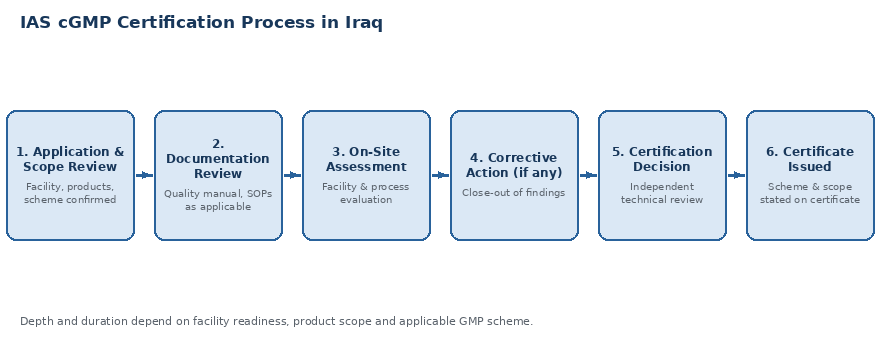
The process follows a consistent sequence regardless of product category or facility size, with the depth of review scaled to scope:
- Application and scope confirmation — facility, product families and applicable scheme are agreed upfront; the IAS application form linked alongside this page starts the process.
- Documentation review — quality manual, SOPs and records as applicable to the scheme and category.
- On-site assessment — auditors evaluate the facility and processes against the confirmed scope.
- Corrective action — where nonconformities are identified, with evidence submitted for close-out.
- Independent certification decision — made separately from the audit team.
- Certificate issued — stating the scheme, scope and facility covered.
What happens after certification: the ongoing lifecycle
Certification is not a single event. It is maintained through a recurring cycle of review that keeps the certificate meaningful over time. Rather than quoting fixed timeframes in weeks or months, IAS scopes each engagement around the determinants that actually drive duration:
- Facility readiness — how mature existing quality documentation and controls already are.
- Scope — number of product families, processing lines and sites included.
- Product category — the applicable GMP scheme and its associated depth of review.
A certificate remains valid for a defined period, is kept active through annual surveillance visits, and is renewed through a full recertification assessment before it lapses. Surveillance visits are typically narrower in scope than the initial audit: they confirm that the practices demonstrated at certification are still being followed day to day, and review any changes made to the facility, product range or processes since the last visit.
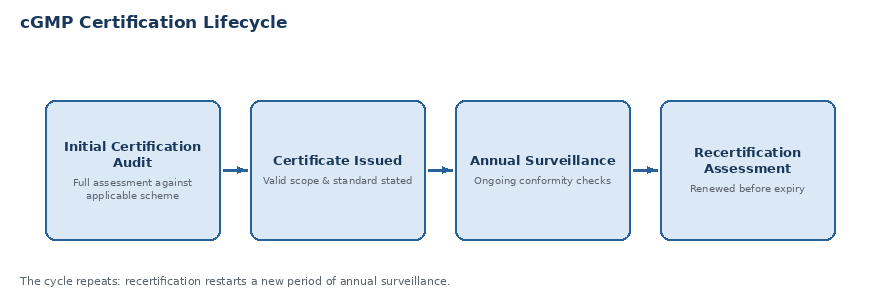
Facilities that treat surveillance as a routine check-in rather than a one-off event to prepare for tend to move through recertification with far fewer surprises. Keeping documentation current between visits — updated SOPs, training records and change logs as applicable to the certified scheme — is generally the single biggest factor in a smooth ongoing lifecycle.
What drives the cost of cGMP certification in Iraq
GMP certification cost in Iraq is quoted per facility. IAS does not publish fixed prices, because no two facilities present the same scope of work. A defined set of drivers shapes the cost instead, and every applicant receives a fixed, written quotation before any assessment work begins. There are no surprise fees once the engagement is under way.
| Cost driver | Why it matters |
|---|---|
| Facility size and number of production lines | More lines and larger footprints require more on-site assessment time |
| Number of product categories in scope | Multiple GMP schemes in one certificate increase review complexity |
| Current state of documentation and controls | Facilities starting closer to the requirements need less preparatory support |
| Number of sites covered under one certificate | Multi-site scope adds assessment days |
| Corrective action follow-up required | Additional review cycles for unresolved nonconformities add time |
Reconstruction-era facilities in Iraq vary widely, from a single new production line to a multi-site group supplying several product categories. IAS therefore avoids publishing indicative price bands that would not reflect an individual facility’s actual scope. Every applicant receives a fixed, written quotation prepared after scope is confirmed, so budgeting decisions are made against a firm number rather than an estimate.
Want a real number, not a range? Download the cGMP brochure from the panel alongside this page for an overview, then ask IAS for your fixed written quotation.
Why manufacturers in Iraq choose IAS
IAS brings nearly two decades of assessment experience to facilities across the Gulf and Middle East region, and provides certification services under its UQAS accreditation. Our assessors understand Iraq’s mixed regulatory landscape — Ministry of Health pharma licensing, COSQC product standards, and the WHO-GMP reference points widely used in local pharma practice — and scope each assessment to the scheme that actually applies to your products.
- Assessment scoped to your product category and applicable GMP scheme, never a generic checklist
- Certification services delivered under UQAS accreditation
- Clear, fixed written quotations before any assessment work begins
- Support across pharmaceuticals, food, cosmetics, devices and any other manufacturing scope
We work with facilities at every stage of Iraq’s reconstruction cycle: operations restarting production after upgrades, entirely new lines newly commissioned, and established exporters formalising quality systems for the first time. In every case the objective is the same — an assessment that reflects what the facility actually produces, delivered by assessors who understand both the applicable GMP scheme and the practical realities of manufacturing in Iraq today.
Quick definitions
- GMP: Good Manufacturing Practice — the broad term covering manufacturing quality rules.
- cGMP: Current Good Manufacturing Practice — the same discipline with an explicit “stay current” emphasis, common shorthand in Iraq’s pharma sector.
- Scheme and scope: the specific framework and product range an audit is measured against, fixed at application and stated on the certificate.
- Surveillance visit: a narrower annual check confirming the certified system is still being followed.
- Recertification: the whole system reassessed once the certificate’s validity period ends.
Your next step toward cGMP certification in Iraq
Whether you are commissioning a newly rebuilt production line or formalising quality systems at an established facility, IAS can confirm the right GMP scheme and scope for your operation. General queries about IAS assessment are answered on the frequently asked questions page.
- No obligation to proceed after scoping
- Written quotation covers the full assessment, surveillance included
- Support at every stage of Iraq’s reconstruction cycle — new lines, restarted operations, or established exporters
Frequently asked questions
Do Iraqi authorities require a cGMP certificate before manufacturing can begin?
No. Manufacturing licensing in Iraq is granted by the Ministry of Health / Board of Pharmacy for pharmaceuticals and, for wider product conformity, by the Central Organization for Standardization and Quality Control (COSQC). An IAS cGMP certificate is a voluntary, independent addition that demonstrates your quality system meets a recognised GMP scheme; it does not replace either body’s licence or approval.
We already hold a Ministry of Health manufacturing licence. Why also seek IAS cGMP certification?
A Ministry of Health licence confirms you meet Iraq’s own regulatory conditions to operate. An IAS certificate is a separate statement, assessed against a named GMP scheme, that many overseas buyers, distributors and tender evaluators ask for before they will accept a supplier’s quality system as independently verified.
Does an IAS cGMP certificate mean COSQC or the Ministry of Health has approved our products?
No. IAS is an independent third-party certification body, not a government regulator. A certificate confirms that your quality management system was assessed against the applicable GMP scheme and scope. It is never presented as regulatory approval, product registration, or a substitute for any Iraqi licensing requirement.
Can a facility still rebuilding or recently established after reconstruction apply?
Yes. Newly established or recently modernised facilities can apply once core production, quality control and documentation processes are functioning and available for review. IAS scopes the assessment to what the facility actually produces at the time of the audit.
What happens if IAS auditors identify nonconformities during the assessment?
Findings are documented by category and the facility is given a defined period to submit corrective action evidence. Certification proceeds once the applicable nonconformities are closed out to the auditor’s satisfaction; unresolved major findings will delay the certification decision.
How is the scope of an Iraqi facility’s cGMP certificate decided?
Scope is agreed during the application stage based on the product families, processing lines and sites the facility wants covered. It is stated on the certificate itself, so buyers and regulators can see exactly which products and locations the certification applies to.
How long does an IAS cGMP certificate remain valid, and what keeps it active?
Certificates are issued for a defined validity period and are kept active through annual surveillance visits that confirm continued conformity, followed by a full recertification assessment before expiry. A lapsed surveillance or recertification cycle can result in suspension or withdrawal of the certificate.
