


Iraq Certification Bodies Must Now Govern Their Use of AI — Here’s Why
FSSC 22000 Version 7 introduces a new requirement that any use of artificial intelligence (AI) in certification-related activity be covered by an ethical, fair and compliant governance framework — a clause that did not exist under FSSC 22000 Version 6. For certified companies and certification bodies operating in Iraq, this means that if AI tools are used anywhere in certification-related processes, there must be documented governance ensuring that use is ethical, fair and compliant. This is one of the newest and least-covered changes in the Version 6 to Version 7 update, and Iraqi food businesses have an early opportunity to understand it before it becomes common knowledge.
Key Changes at a Glance
- Version 7 requires any AI use in certification-related activity to sit under a documented governance framework.
- The framework must ensure AI use is ethical, fair and compliant, not simply functional.
- This is a genuinely new clause; there is no equivalent requirement under Version 6.
- It applies to certification bodies, auditors and certified organisations’ certification-related activity.
- Sites with no AI use in certification-related processes face limited immediate practical impact.
- FSSC 22000 Version 6 certificates remain valid and auditable throughout the official transition window.
- Already-certified Iraqi sites are assessed on this clause at their next scheduled audit.
What the New AI Governance Requirement Actually Says
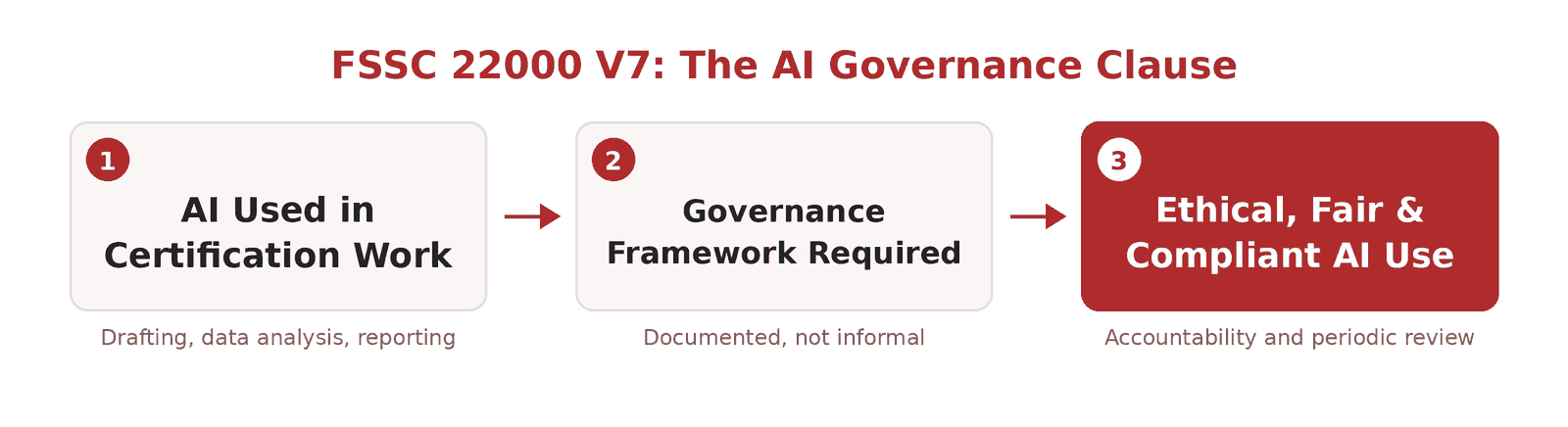
FSSC 22000 Version 7 requires that any use of AI in certification-related activity be governed by a framework that is ethical, fair and compliant. In practical terms, this applies to how AI tools are used within the certification process itself — whether by certification bodies, auditors, or certified organisations in activity connected to their certification — and requires that such use be documented and governed rather than left informal.
This is a genuinely new clause introduced in Version 7, reflecting how quickly AI tools have become part of business processes generally, including in food safety documentation, record-keeping and audit preparation. Because it did not exist under Version 6, there is no equivalent requirement for Iraqi sites to compare it against — it is simply a new expectation to plan for.
The requirement is deliberately framed around governance principles — ethics, fairness and compliance — rather than naming specific AI tools or technologies, which means it is designed to stay relevant as AI use evolves rather than becoming outdated as soon as new tools appear. This principles-based framing also means there is no single checklist of approved or banned tools. Instead, an Iraqi certification body or certified organisation needs to be able to explain how it decided to use a given AI tool, what safeguards exist around its outputs, and how it checks that use remains fair and compliant over time.
Why This Matters for Certified Companies in Iraq
As Iraqi food manufacturers and exporters increasingly adopt digital tools — including AI-assisted systems for documentation, quality monitoring, or supply chain data — the new AI governance clause in FSSC 22000 Version 7 gives those tools a formal place in the certification conversation for the first time. Because FSSC 22000 is a GFSI-recognised scheme built on the ISO 22000 food safety management system standard, adding an AI governance expectation signals that certification bodies and certified sites alike are expected to keep pace with how technology is used in food safety and certification work.
For most Iraqi sites, this will not mean building something from scratch if AI is not currently used in certification-related activity. But for organisations that do use AI tools — for example in document management, data analysis, or communications tied to certification — it means putting a clear, documented governance framework in place covering how that use remains ethical, fair and compliant.
For a wider view of how this AI governance clause fits alongside the other Version 7 changes — PRP standards, auditor qualification, sustainability and the transition timeline — our FSSC 22000 certification page for Iraq covers the full scope in one place.
Preparing Your Iraq Site for the AI Governance Clause
Start by identifying whether AI tools are used anywhere in your certification-related activity — this can be broader than expected once document generation, data analysis and reporting tools are considered. Where AI is in use, draft a simple governance statement covering how the tool is used, who is accountable for its outputs, and how fairness and compliance are checked, so the framework is ready to show an auditor.
Because certified sites in Iraq move to Version 7 through their next scheduled surveillance or recertification audit, and FSSC 22000 Version 6 certificates remain valid and auditable in the meantime, there is time to build this governance framework properly rather than rushing it. Given how new this requirement is, and how little guidance currently exists on it, getting your internal audit team trained early is a real advantage.
A practical governance statement does not need to be lengthy: naming the tools in use, describing their purpose, assigning a responsible owner, and setting a simple review process is usually enough to demonstrate a genuine, functioning framework rather than a token document. Iraqi sites that already maintain a document control procedure can often extend that same structure to cover AI governance without building an entirely separate system.
Common Misconceptions About the AI Governance Clause
A common misconception is assuming this requirement only applies to advanced or specialised AI systems. In practice, tools as ordinary as AI-assisted document drafting, data analysis spreadsheets with embedded AI features, or automated reporting software can fall within scope if they touch certification-related activity, so Iraqi sites should look broadly rather than narrowly when scoping their review.
Another misconception is that certified companies with no AI use need to do nothing at all. While the practical burden is lower, it is still worth documenting that AI is not currently used in certification-related activity, since this gives a clear, auditable answer rather than an assumption that could be challenged during the visit.
Some businesses also assume this clause is primarily a certification-body responsibility. While certification bodies do have their own governance obligations around AI use in auditing and reporting, certified organisations are separately expected to govern any AI use of their own that touches certification-related activity.
A final misconception is treating this as a one-time exercise. Because AI tools and how they are used tend to change over time, an Iraqi site’s governance framework should include a simple, periodic review rather than a document written once and never revisited.
How IAS Gulf Prepares Your Team for the AI Governance Requirement
Because this clause is so new, few Iraqi businesses currently have established practice to draw on, which makes early, structured guidance especially valuable rather than waiting to see how other sites handle it.
IAS Gulf works with certified organisations across Iraq to translate this and the other Version 7 changes into practical, auditable steps rather than abstract scheme language. Our FSSC 22000 Lead Auditor and Internal Auditor Training programmes cover the AI governance requirement alongside the rest of the Version 7 update, so your team is not caught off guard at the next audit.
Being among the first Iraqi sites to have a clear, documented AI governance approach is a genuine advantage during this transition window, both for audit readiness and for demonstrating a forward-looking food safety culture to buyers and partners across the wider Gulf region.
FSSC 22000 Version 6 vs Version 7: AI Governance Requirement at a Glance
| Aspect | Version 6 | Version 7 |
|---|---|---|
| AI governance clause | Not present in the scheme | New requirement: ethical, fair and compliant governance framework |
| Who it applies to | Not applicable | Certification bodies, auditors and certified organisations’ related activity |
| Documentation needed | Not applicable | Governance statement covering tool use, accountability and review |
| Impact if no AI is used | Not applicable | Limited practical burden, but worth documenting the absence of use |
| Certificate validity in the interim | Baseline scheme version | V6 certificates remain valid and auditable during transition |
| Assessment point | Not applicable | Next scheduled surveillance or recertification audit |
Note: exact FSSC 22000 Version 6 to Version 7 transition and cascade dates should be confirmed directly with your certification body.
About the author
Dr. C.D. Mohana Priya is a molecular geneticist, Associate Professor (Research) at Sri Ramachandra Institute of Higher Education and Research, Chennai, and an ISO 22000:2018 Lead Auditor, ISO 9001:2015 Lead Auditor and ISO 15189:2022 Internal Auditor. With 15+ years spanning laboratory quality management, food-safety systems and management-system training, she brings a scientific, standards-based rigour to FSSC 22000 auditor education.
Frequently Asked Questions
What is the new AI governance requirement in FSSC 22000 Version 7?
It requires that any use of AI in certification-related activity be covered by a governance framework that is ethical, fair and compliant — a new requirement that did not exist under FSSC 22000 Version 6.
Does my Iraq site need an AI policy even if we don’t use AI tools?
If AI is not used anywhere in your certification-related activity, the governance framework requirement has limited practical impact for now, but it is worth confirming this with your certification body during your next audit planning.
Is FSSC 22000 Version 6 still valid in Iraq during the transition?
Yes. Version 6 certificates remain valid and auditable during the official transition window, giving Iraqi companies time to prepare for new Version 7 requirements such as AI governance.
When will my Iraq site be assessed against the AI governance requirement?
Already-certified sites are typically assessed against the full set of Version 7 requirements, including AI governance, at their next scheduled surveillance or recertification audit.
What counts as “AI use” for the purposes of this new clause?
It can include anything from AI-assisted document drafting to data analysis or reporting tools with embedded AI features, so Iraqi sites should review broadly rather than assuming only advanced systems are in scope.
Does the AI governance clause require Iraqi organisations to stop using AI tools?
No — it does not ban AI use. It requires that any AI used in certification-related activity in Iraq be governed by an ethical, fair and compliant framework, not that AI be avoided altogether.


About Post Author

