

The Sustainability Crossroads – ISO 14001:2026 Is Shaping the Next Phase of Business
Sustainability is no longer a future consideration—it is becoming a present-day necessity that defines operational stability, efficiency, and global competitiveness. With the introduction of ISO 14001:2026, organizations are being pushed to rethink how they manage environmental impact and transition toward systems that are real-time, predictive, and performance-driven.
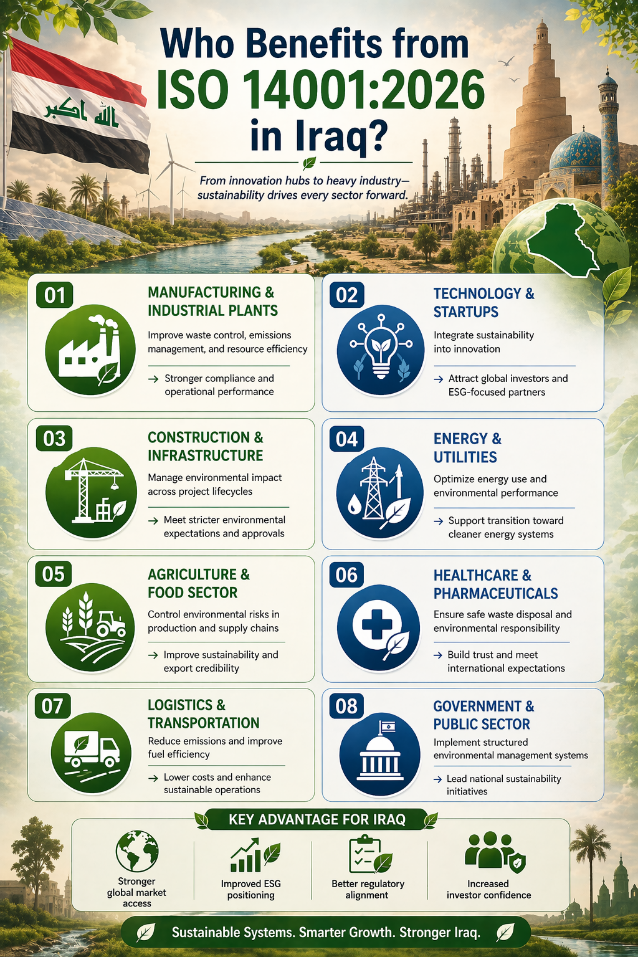
In Iraq, where industries such as oil & gas, construction, energy, and infrastructure play a vital role in economic development, environmental expectations are steadily increasing. Businesses are now expected to demonstrate measurable environmental performance, transparency, and continuous improvement, rather than relying on traditional compliance practices.
ISO 14001:2026 is not just a revision—it is a strategic transformation, redefining how organizations operate and compete in a sustainability-focused global environment.
The Rising Need for Environmental Accountability
Environmental challenges, regulatory developments, and global market expectations are driving a new level of urgency. Businesses are no longer judged solely on policies—they are evaluated based on real-time performance, accountability, and measurable outcomes.
For organizations in Iraq, this shift is particularly significant due to increasing international partnerships and investments. Companies that fail to adapt risk losing opportunities, while those that act early position themselves as resilient and forward-looking.
From Traditional Compliance to Continuous Environmental Control
ISO 14001:2026 introduces a major shift—from static compliance systems to continuous environmental control.
- Real-time monitoring of environmental metrics – Organizations must continuously track emissions, energy usage, and waste to maintain accuracy and control.
- Immediate detection of environmental deviations – Systems must identify issues instantly to enable faster response.
- Rapid corrective actions – Quick intervention helps prevent escalation and reduces environmental impact.
This transformation ensures environmental management becomes dynamic, responsive, and reliable.
Predictive Management: Moving Ahead of Risks
The new standard emphasizes a shift from reactive responses to predictive environmental management.
- Early identification of risks – Data-driven insights help detect potential environmental challenges before they occur.
- Improved operational continuity – Predictive systems reduce disruptions and improve efficiency.
- Better strategic planning – Organizations can align sustainability with long-term objectives.
This approach strengthens both resilience and performance.
Technology as the Driving Force
Technology plays a central role in enabling organizations to meet the expectations of ISO 14001:2026.
- Automated data collection and reporting – Reduces manual effort and ensures consistent monitoring.
- Improved accuracy and reliability – Digital tools minimize human error in environmental assessments.
- Continuous improvement through insights – Data-driven systems support ongoing optimization.
With AI integration, businesses can build intelligent and scalable environmental management systems.
The Implementation Challenge
While the benefits of ISO 14001:2026 are clear, implementation requires more than tools—it demands organizational alignment and execution. Many businesses underestimate the effort needed to integrate environmental practices into daily operations.
Challenges such as limited expertise, resource constraints, and lack of coordination can slow progress. Success depends on leadership commitment, structured planning, and consistent execution.
Industries Facing the Greatest Transformation
High-impact sectors such as oil & gas, construction, energy, and infrastructure will experience the most significant changes. These industries must adopt advanced monitoring systems and strengthen environmental risk management.
Service sectors will also need to improve transparency and reporting. Across all industries, the focus will shift toward continuous performance and measurable sustainability outcomes.
- Stricter regulatory alignment becomes essential – Businesses must continuously meet evolving environmental requirements and maintain compliance in real time.
- Supply chain accountability increases significantly – Organizations must ensure sustainability standards are followed across partners and suppliers.
- Resource efficiency becomes critical – Optimizing energy and material usage reduces costs and environmental impact.
- Investment in digital systems becomes necessary – Advanced tools are required to meet monitoring and reporting expectations.
- Stakeholder expectations become more demanding – Transparent reporting builds trust and credibility.
- Operational resilience becomes a priority – Strong risk management ensures stability in changing conditions.
How Businesses Can Prepare?
- Conduct a gap analysis of existing systems – Identify improvement areas and define a clear roadmap.
- Invest in real-time monitoring tools – Enable continuous tracking and faster decision-making.
- Train teams on modern environmental practices – Build internal capability for effective implementation.
- Align sustainability with business strategy – Ensure environmental goals support long-term growth.
- Strengthen leadership involvement – Drive accountability and consistent execution.
The Advantage of Early Adoption
Organizations that act early gain significant benefits. Improved efficiency leads to cost savings, while proactive risk management reduces disruptions.
Transparent environmental performance also enhances credibility, helping businesses build trust with stakeholders. For companies in Iraq, early adoption supports stronger positioning and sustainable growth.
The Real Business Impact
- Improved operational efficiency – Streamlined processes reduce waste and enhance productivity.
- Cost savings – Optimized resource usage lowers operational expenses.
- Stronger compliance readiness – Continuous monitoring ensures alignment with requirements.
- Enhanced reputation – Transparent performance builds credibility and trust.
- Increased resilience – Proactive systems reduce risks and improve stability.
Investment or Opportunity? A Strategic Perspective
Implementing ISO 14001:2026 requires investment in systems, training, and process improvements. However, the long-term benefits make it a strategic decision.
Organizations can achieve cost savings, improve efficiency, and strengthen their market position. Businesses that treat ISO 14001:2026 as an investment are more likely to achieve long-term resilience and success.
- Improved access to global markets – Strong environmental practices attract international clients and partnerships.
- Better regulatory readiness – Proactive systems reduce compliance risks.
- Enhanced innovation and agility – Continuous improvement drives smarter operations.
What Leaders Need to Focus On?
Leadership plays a critical role in ensuring successful adoption. Organizations must prioritize strategic alignment, resource allocation, and cultural transformation.
Leaders must ensure sustainability is embedded into business strategy and supported by the right tools and processes. Strong leadership ensures that ISO 14001:2026 delivers measurable and lasting results
Final Thought
ISO 14001:2026 is not just a compliance requirement – it is a business transformation catalyst.
Organizations that embrace this shift will unlock efficiency, resilience, and growth, while those that delay risk falling behind in an increasingly sustainability-driven global economy.


About Post Author

