


Course Aim – ISO 14001 Internal Auditor Training
ISO 14001:2026 is the international standard that specifies the requirements for an effective environmental management system (EMS). The aim of this ISO 14001 internal auditor training course is to enable participants to develop the necessary skills and knowledge to conduct internal audits of environmental management systems against the requirements of ISO 14001, in order to enable them to contribute to their organization’s continual improvement.
IAS offers ISO 14001:2026 Internal Auditor Training in Saudi Arabia which aids candidates to learn the principles and practices of environmental auditing, the types of audits, and the steps in conducting an audit. It also includes case studies and group exercises to give participants practical experience in conducting an audit.
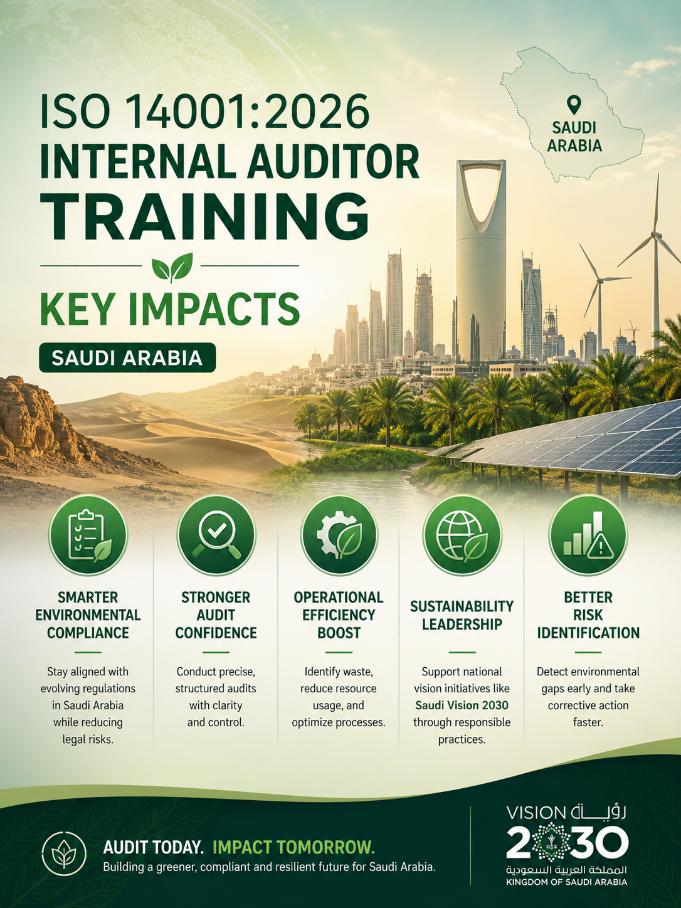
Why ISO 14001 Internal Auditor Training in Saudi Arabia?
As an environmental management system, ISO 14001 provides a framework that organizations can follow to set up an effective environmental management system. Internal auditors play a key role in ensuring that the organization’s EMS is functioning properly and compliant with ISO 14001:2026 requirements.
Internal auditor training is important because it helps ensure that auditors are able to properly assess their organization’s compliance with ISO 14001 requirements. Auditors who have received ISO 14001 internal auditor training are better equipped to identify EMS non-conformities and make recommendations for corrective action. They are also better able to communicate audit findings and recommend improvements to their organization’s EMS.
Benefits of ISO 14001 Internal Auditor Training in Saudi Arabia
Our ISO 14001 internal auditor training in Saudi Arabia provides you with the following benefits:
- Helps ensure your organization is compliant with ISO 14001 standards
- Teaches you how to effectively audit your organization’s environmental management system
- Shows you how to identify non-conformities and potential improvements in your EMS
- Trains you to properly communicate audit results to management
- Enables you to develop action plans to address findings from audits
- Helps you verify that corrective actions are effective in addressing identified problems
- Provides a structured approach for auditing your EMS on a regular basis
What Does an ISO 14001:2026 Internal Auditor Do and Why Does It Matter in Saudi Arabia?
A question frequently searched by EHS professionals and compliance officers in Saudi Arabia is what the internal auditor role actually involves and why it is so critical to an organisation’s EMS. Understanding this helps professionals see the full value of the training before they enrol.
- Conducts planned internal EMS audits— The internal auditor follows a structured audit programme to assess whether the organisation’s EMS is operating in line with ISO 14001:2026 requirements, covering all relevant clauses, processes, and departments within the defined scope.
- Identifies nonconformities and improvement opportunities— By reviewing documents, observing processes, and interviewing staff, the internal auditor identifies gaps between current practice and ISO 14001:2026 requirements, raising nonconformities and flagging areas where performance can be strengthened.
- Supports corrective action implementation— After the audit, the internal auditor verifies that corrective actions have been properly implemented and that root causes of nonconformities have been effectively addressed — not just patched over.
- Prepares the organisation for external certification audits— A well-conducted internal audit cycle is one of the most effective ways to prepare for a third-party certification audit. Internal auditors help close gaps before the certification body arrives, reducing the risk of major nonconformities.
- Drives continual improvement across the EMS— Internal auditors are not just checkers — they are a key driver of environmental performance improvement. By consistently identifying and reporting findings, they help the organisation strengthen its EMS over time.
- Supports ISO 14001:2026 transition readiness— With the three-year transition period now active, trained internal auditors help Saudi organisations assess their readiness against the updated 2026 requirements and complete at least one internal audit cycle under the new standard before migration.
Who Can Attend?
The course is designed for personnel who will be involved in conducting internal audits of environmental management systems against the requirements of ISO 14001, as well as those who wish to develop the necessary skills and knowledge to contribute to their organization’s continual improvement. This includes:
- Environmental managers
- Quality managers
- Operational managers
Pre-Requisites
Candidates who wish to undertake our ISO 14001 internal auditor training in Saudi Arabia should have a basic knowledge of ISO 14001 and the audit process. It will be beneficial if you have prior experience working in the EMS field.
Course Delivery Modes
Self-Learning Mode (30 days): Employees who work full-time would benefit the most from this approach of training. The ISO 14001:2026 Internal Auditor Course may be completed using our cutting-edge self-paced learning method at your own pace and you will get 30 days of online access to the course materials.
Tutor-led Virtual Classes: Candidates will participate in an ISO 14001 Internal Auditor training in Saudi Arabia via a virtual learning environment. Attendees will participate in a two-day (16-hour) training session using Zoom meetings, which will be led by our experienced trainers and will include lectures, group discussions, and practical activities.
How ISO 14001:2026 Internal Auditor Training Prepares Saudi Organisations for the 2026 Transition?
With ISO 14001:2026 published and the three-year transition period now underway, organisations in Saudi Arabia are actively searching for practical guidance on how to prepare. Trained internal auditors are at the centre of a successful transition.
- Closes gaps identified in the 2026 clause updates— ISO 14001:2026 introduces stronger expectations around climate change, lifecycle thinking, and leadership accountability. A trained internal auditor can assess how well the organisation’s existing EMS addresses these areas and identify what needs to be updated before the migration audit.
- Updates internal audit checklists and programmes— The internal auditor is responsible for revising audit tools to reference the ISO 14001:2026 clause structure, ensuring that future internal audits are conducted against the right requirements and deliver findings that are relevant to the updated standard.
- Completes the required pre-migration audit cycle— Certification bodies expect organisations to have completed at least one full internal audit cycle under ISO 14001:2026 before the migration certification audit takes place. Having a trained internal auditor in-house makes this achievable within the transition timeline.
- Builds awareness across departments— As part of audit preparation, the internal auditor communicates updated ISO 14001:2026 requirements to department managers and operational staff, helping the entire organisation understand what has changed and what is now expected of them.
- Reduces reliance on external support— Saudi organisations with a qualified internal auditor can manage a significant portion of their transition work in-house, reducing costs and maintaining tighter control over the pace and quality of their EMS updates.
Assessment and Course Certification
At the end of the course, each student must pass an online exam to receive their ISO 14001 Internal Auditor certificate. To get a certificate of completion, students must score at least 70 percent on the online exam.
Career Value of ISO 14001:2026 Internal Auditor Certification for Professionals in Saudi Arabia
Professionals in Saudi Arabia frequently search for the long-term career benefits of completing this certification. ISO 14001:2026 Internal Auditor training delivers both immediate workplace impact and meaningful professional development.
- Directly applicable from day one— The skills gained from this course can be put to use immediately within your organisation — from updating audit checklists to conducting your next internal audit cycle under the ISO 14001:2026 framework.
- Recognised across Saudi Arabia’s key industries— Whether you work in manufacturing, construction, energy, logistics, or government, ISO 14001:2026 Internal Auditor certification is valued by employers across Saudi Arabia’s most active and regulated sectors.
- Stepping stone to Lead Auditor qualification— Completing the internal auditor course is the recommended pathway toward the ISO 14001:2026 Lead Auditor training, which qualifies professionals to lead third-party certification audits and opens senior-level career opportunities.
- Strengthens your EHS and sustainability profile— As Saudi organisations face growing pressure to demonstrate environmental accountability under Vision 2030 and evolving regulatory frameworks, professionals holding ISO 14001:2026 auditing credentials are increasingly sought after.
- Supports integrated management system roles— Internal auditors familiar with ISO 14001:2026 can expand their scope to support integrated audits covering ISO 9001 and ISO 45001, increasing their value to organisations running combined management systems.
To learn more about the ISO 14001 Internal Auditor Training in Saudi Arabia, please Contact IAS!