


cGMP internal auditor training teaches employees to audit their own manufacturing operation against current Good Manufacturing Practice requirements: preparing properly, working the floor and the records together, raising findings that stand up, and following corrective actions through to a verified close.
Most people who have never run an audit imagine it as a conversation. In practice it is a day with a shape, and the shape decides how much the audit finds. Auditors who lose the first hour rarely recover it, and auditors who leave no time to draft findings end up writing them from memory a week later.
- Prepare, open, observe, examine records, draft, close
- Floor observation timed to production, not to convenience
- Findings written and classified before the closing meeting
- No prior audit experience required
Planning internal auditor training for your site in the Kingdom? Contact IAS with your location, product and group size.
cGMP internal auditor training in Saudi Arabia at a glance
- Who it is for: employees who audit, or will audit, their own GMP or cGMP quality system — QA, production, QC, engineering, warehouse, compliance and management representatives.
- Entry level: no prior audit experience required; staff already working within a GMP system progress fastest.
- Focus: the audit day — how time is structured from preparation through to the closing meeting.
- Formats: self-paced online, live virtual, classroom or in-house.
- Duration and fees: depend on the delivery route chosen and are quoted together rather than separately.
- Certificate: a certificate of completion naming the subjects covered — the record an assessor expects when checking auditor competence.

What cGMP internal auditor training prepares you for
The training equips staff to carry out first-party audits — audits of their own organisation — against GMP and cGMP requirements and the company’s documented system.
cGMP places emphasis on the word current. Procedures, training and records are expected to reflect how the plant runs today rather than how it ran when the system was written. Internal audits are the routine check that keeps those aligned, and the quality of that check depends almost entirely on how the auditor uses their time.
Three strands run through the course: enough GMP knowledge to recognise adequate control, a repeatable audit method, and the conduct expected of an auditor — independent, factual, and useful to the area rather than adversarial. Where a company also wants the site assessed by an independent body, that route is set out on the cGMP certification in Saudi Arabia page.
How an audit day is structured
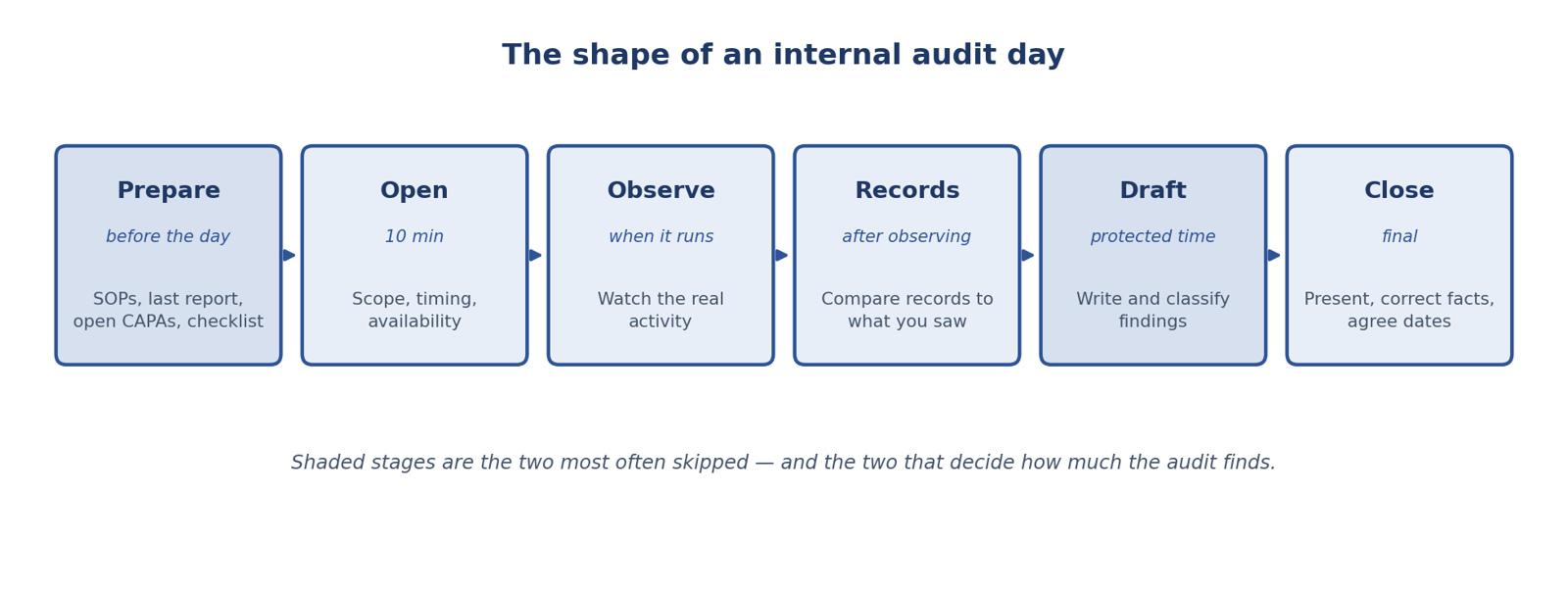
Participants work through the day as a sequence, because knowing what belongs where prevents the two most common failures: spending the morning being shown things, and running out of time before the records get examined.
Before the day, and the opening
Before the day begins the auditor has already read the relevant SOPs, the previous audit report and any open corrective actions, and has drafted the checklist. This is not optional preparation. An auditor who arrives without it spends the first two hours learning what the area does, which is time the audit does not have.
The opening meeting is short: confirm the scope, the timing, who will be available and who will accompany the auditor. Five to ten minutes. A long opening meeting is usually a sign that the scope was not communicated in advance.
Floor first, then records
Production runs to its own schedule, and a changeover or a batch start does not wait for an auditor. Observing while the activity is actually happening is the only way to see a control working, so the auditor takes the floor time when it is available and fits the record review around it.
Records are then examined against what was observed. Having watched the operation, the auditor knows what the records should say. This ordering matters: reading the records first tells you what the system claims; watching first and reading second tells you whether the claim is true.
Interviews happen throughout, not as a separate block. The best moment to ask an operator how they handle an out-of-specification result is while they are standing at the instrument, not in a meeting room afterwards.
Drafting and the close
Drafting is protected time. Findings are written, checked against the evidence and classified before the closing meeting. An auditor who skips this arrives at the closing meeting improvising, and improvised findings get renegotiated.
The closing meeting presents; it does not negotiate. Facts can be corrected. Classification is the auditor’s judgement.
What fits into the time available
| Portion of the day | What happens | Common mistake |
|---|---|---|
| Before the audit | Read SOPs, previous report and open CAPAs; draft the checklist | Treating preparation as optional and doing it on the day |
| Opening | Confirm scope, timing and availability | Letting it become a presentation about the department |
| Floor observation | Watch the activity while it is genuinely happening | Accepting a demonstration staged for the auditor |
| Record review | Compare records against what was observed | Reviewing records first, then seeing only what they predicted |
| Interviews | Short, open questions at the point of work | Interviewing only supervisors, never operators |
| Drafting | Write and classify findings against the evidence | Leaving findings until after the closing meeting |
| Closing | Present findings, correct factual errors, agree dates | Negotiating classification to keep the peace |
Want to see how a third-party assessment of the same system runs end to end? Read the IAS certification process.
Opening and closing meetings
Both meetings have a fixed purpose, and the training gives participants a working agenda for each.
The opening meeting confirms four things: what is in scope and what is not; the criteria the audit is measured against; the timing and areas to be visited; and who the auditor should approach for records and questions. It also establishes that findings will be raised against processes rather than people, which lowers the temperature for everything that follows.
The closing meeting delivers the findings, each stated as requirement, evidence and gap. Factual corrections are welcome — if the auditor read the wrong revision or missed a document, the finding is amended or withdrawn on the spot. Grading, however, is a judgement the auditor owns rather than an item for discussion. Timelines for response are agreed, and the report follows.
What the auditor is doing throughout
The underlying activity does not change: comparing what should happen against what does happen, and recording the difference with evidence.

If a procedure requires a supervisor to verify each weighing step, the auditor watches a weighing operation, then reads the weighing record, checks whether the verification signature is present, and considers whether the timing is plausible. If the signatures all appear at shift end for the whole batch, the record is complete and the control is not real. That gap is only visible to someone who watched.
Everything recorded carries references — document numbers and revisions, batch numbers, equipment identifiers, dates and shifts. This is what allows a finding to survive the closing meeting intact.
Who should attend cGMP internal auditor training
| Participant | Why the day-structure focus helps them |
|---|---|
| QA officers and managers | Plan audit schedules that actually fit production reality |
| Production supervisors | Understand what an auditor will want to see and when |
| QC and laboratory personnel | Laboratory work has its own rhythm; audits must be timed to it |
| Engineering and maintenance | Calibration and equipment checks are best observed in use |
| Warehouse and materials staff | Receipt and release activities happen on a schedule an auditor must catch |
| Compliance and regulatory staff | Add practical audit execution to requirements knowledge |
| Management representatives | Design an audit programme that people can realistically deliver |
No prior audit experience is required. Employees already working within a GMP system progress fastest, and anyone new to manufacturing quality is usually better served by a cGMP foundation course first. Teams building a wider programme also take the general internal auditor training and ISO lead auditor training courses, with dates on the training schedule page.
Capabilities participants develop
- Preparing thoroughly enough to walk in already knowing where to look
- Running a short, purposeful opening meeting
- Timing floor observation around production rather than around convenience
- Watching an activity happen instead of accepting a demonstration
- Reading records against what was observed, not the other way round
- Asking short open questions at the point of work
- Recording referenced evidence as the audit proceeds
- Protecting time to draft and classify findings before closing
- Presenting findings factually and holding a classification under pressure
- Writing a report someone who was not present can act on
What sites gain from cGMP internal auditor training
An audit that is well structured finds more in the same number of hours. That is the whole argument. The site gets earlier warning of documentation drift, calibration lapses and procedures that no longer describe the process — while those are still inexpensive to correct.
It also changes the experience of external and customer audits. A site whose own auditors work this way has already been through the same sequence, seen the same records, and closed the same gaps. The external visit stops producing surprises.
Manufacturers looking at independent assessment alongside internal capability can read the IAS guide on how to get GMP certification for how the two fit together.
Internal auditor training compared with certification
| cGMP internal auditor training | cGMP certification | |
|---|---|---|
| Applies to | People | The organisation and its site |
| Who audits | Your own trained staff, internally | An independent certification body |
| Result | Trained auditors and a training record | A certificate covering a defined scope |
| Rhythm | Ongoing, per the internal audit programme | Initial assessment, surveillance, recertification |
The two are complementary and not interchangeable. Trained internal auditors help sustain a certified system; a course does not certify a company, and a certificate does not replace internal audits. The wider range of schemes IAS assesses is listed under ISO certification, and the scope of the IAS accreditation is set out on the accreditation page.
cGMP internal auditor training in Saudi Arabia: course details
The duration of cGMP internal auditor training in Saudi Arabia depends on the delivery route chosen, and fees are quoted alongside it rather than separately. Everyone who finishes is issued a certificate of completion naming the subjects covered — the record an assessor expects when checking auditor competence.
Report writing is covered as part of the course: how to state a finding that survives challenge, and how to reach the root cause of a recurring problem without naming anyone.
- Objective. Ready staff to audit GMP and cGMP quality systems internally, from planning through reporting to follow-up.
- Coverage. GMP and cGMP fundamentals; criteria and scope; preparation and checklist development; opening and closing meetings; floor observation; record review; interviewing; objective evidence; nonconformity classification; findings and report writing; corrective-action review and verification; auditor independence and conduct.
- Outcomes. Participants should be able to prepare and run an internal audit end to end, gather referenced evidence, raise and word nonconformities, chair a closing meeting, produce a report and evaluate corrective actions.
Delivery formats
Self-paced online, live virtual, classroom or in-house. Sites running continuous production often prefer virtual cGMP training because it can be split across days, while online cGMP internal auditor training lets individuals fit study around shift patterns.
Tell IAS the site location, what you manufacture and how many auditors you want to train, and we will propose a format and dates. One clarification worth making directly: IAS trains auditors and certifies management systems. Facility licensing and product approval sit with regulators, and no training record or certificate substitutes for them.
Comparing formats across the IAS group? The full GMP internal auditor training syllabus is published on the IAS India site.
Next step: arrange training for your team
Tell IAS where the site is, what you manufacture and how many people you want to train, and you will get a format, a schedule and a written quotation. Background on the body delivering the course is on the about us page, and the wider course range is under ISO training.
Frequently asked questions
How long should an internal audit day run?
Long enough to observe the activity, review records against what was observed, interview a few people and draft the findings — with the drafting time protected rather than borrowed from everything else. Scope should be set so all of that fits. An audit scoped too widely produces a day of walking and no examination.
Can a department refuse a finding at the closing meeting?
They can and should correct factual errors — a misread revision number, a document the auditor was not shown. Once facts are agreed, the classification is the auditor’s judgement rather than a negotiation. Holding that position calmly is a specific skill, and the course treats it as one rather than assuming it comes naturally.
What if the process we need to observe is not running that day?
Move that portion of the audit to a date when it will be running, rather than settling for a walkthrough. What a staged demonstration reveals is how someone performs with an auditor watching — useful, but not the question being asked. For processes that run only rarely, the audit leans on records and conversation instead, and the report should say openly that direct observation was not possible.
Should findings be shared before the closing meeting?
Significant issues should not be a surprise. Raising them with the area as they arise gives people the chance to produce a document you were not shown, and avoids the closing meeting turning into an argument about facts. The closing meeting then confirms and formalises what has already been discussed.
Who writes the audit report, and how quickly?
The auditor writes it, promptly, while the detail is fresh and the referenced notes still make sense. Most companies set an internal target of a few working days. A report delayed by weeks loses accuracy and, more damagingly, signals that the audit was not important.
Should the same person chair the opening and closing meetings?
Normally yes — the auditor who ran the audit presents its outcome, because they are the one who can answer questions about what was examined and why. Where a team conducted the audit, the lead auditor chairs both. Handing the closing meeting to someone who was not present tends to produce findings that cannot be defended in detail.
Can someone audit the area they work in?
Not their own work. Internal auditing depends on the auditor being independent of the activity being examined, which is why most programmes cross-assign auditors between departments. Someone who audits the process they run ends up verifying their own decisions, and an external assessor will notice.
Does the certificate of completion expire?
IAS does not attach an expiry date to it — the certificate records the subjects covered and the date the course was completed. Most quality systems set their own requalification interval for internal auditors and treat continued participation in the audit programme as the evidence that competence has been maintained.