



Don’t Get Caught Off Guard: FSSC 22000 V7’s Transition Timeline for Saudi Arabia
FSSC has published an official transition timeline for organisations moving from FSSC 22000 Version 6 to Version 7, and certified companies in Saudi Arabia should use it to plan their upgrade rather than wait until the last minute. Because sources describe the exact cascade dates differently, businesses in Saudi Arabia should confirm their specific transition date directly on fssc.com or with their certification body, and should not delay reviewing what Version 7 means for their next audit. This guide focuses on what the transition actually involves and how Saudi Arabia-based teams should plan their audit calendar around it, rather than around any single unverified date.
Key Changes at a Glance
- FSSC has published an official Version 6 to Version 7 transition timeline, not a single hard cutoff.
- Sites move to Version 7 at their next scheduled surveillance or recertification audit.
- No exact cutover date should be treated as final; confirm specifics with your certification body directly.
- Version 6 certificates remain valid and auditable throughout the official transition window.
- Larger Saudi Arabia-based groups with multiple sites need more lead time to coordinate readiness.
- Version 7 brings substantive changes to PRP references, auditor qualification and sustainability rules.
- Early staff training closes the gap between knowing the timeline and actually being ready for it.
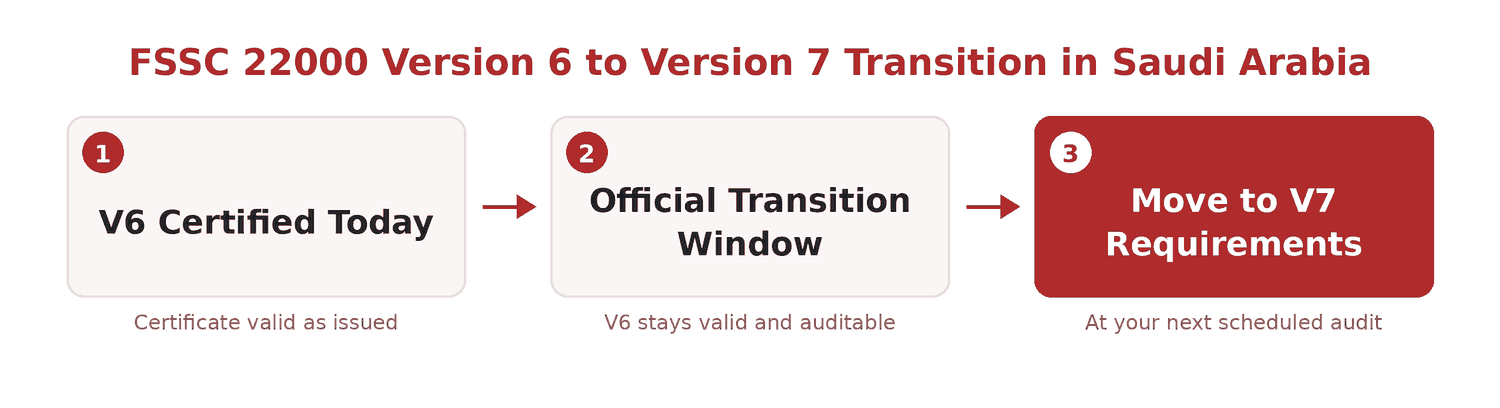
How the FSSC 22000 Version 6 to Version 7 Transition Timeline Works
Rather than a single hard cutoff where every certificate expires at once, FSSC’s transition approach moves certified organisations to Version 7 through their next scheduled audit — typically a surveillance or recertification audit — rather than requiring a brand-new certification cycle. Auditors assess the site against the Version 7 requirements at that next visit, once the certification body itself has completed its own transition to auditing under the new version. This structure is designed to spread the workload for certification bodies and certified organisations alike, rather than concentrating every Version 7 audit into a short window.
Because different sources have given conflicting specifics about exact cascade dates, the most reliable approach for a company in Saudi Arabia is not to rely on any single third-party summary. Instead, confirm your organisation’s specific transition date directly on fssc.com or by speaking with your certification body about your specific audit calendar — they can tell you precisely when your Saudi Arabia site’s audit will move to Version 7, and can flag it well in advance. Certification bodies typically notify clients proactively as their own transition date approaches, but asking directly removes any uncertainty.
This staggered approach is intentional. It avoids forcing every certified site worldwide, including the large number of manufacturers and packaging producers certified in Saudi Arabia, through Version 7 audits within the same narrow window, which would put unmanageable pressure on both certification bodies and certified organisations alike.
What Certified Companies in Saudi Arabia Should Do Now
Your existing FSSC 22000 Version 6 certificate remains valid and auditable during the official transition window, so there is no need to panic or attempt an emergency re-certification. The priority instead is proactive planning: review your next scheduled audit date, and use the time before it to understand what Version 7 changes will apply at that visit.
This is particularly relevant for larger Saudi Arabia-based food manufacturers, packaging producers and logistics operators managing multiple sites or complex audit calendars, where coordinating Version 7 readiness across several facilities takes more lead time than a single-site transition and benefits from a shared internal project plan. Assigning a single point of contact to own the transition across all sites tends to keep the process organised and prevents duplicated effort.
Even single-site businesses benefit from starting early. Reviewing PRP documentation, auditor qualification expectations, and new sustainability procedures well before your scheduled audit date reduces the risk of nonconformities being raised for the first time during the audit itself, when there is little time left to respond. A short internal gap assessment against each Version 7 change area is a practical starting point for any Saudi Arabia-based team.
What Changes Certified Companies Should Prepare For
Beyond the transition timeline itself, Version 7 brings a set of substantive updates that Saudi Arabia-based certified sites should build into their preparation: prerequisite programme references shift from the ISO/TS 22002-x series to the newer ISO 22002-x:2025 series, and auditor qualification requirements are updated to align with GFSI’s 2024 Benchmarking Requirements.
Version 7 also more clearly defines the food chain category structure used to match auditor competence to a site’s activity, and introduces new Food Loss & Waste and ‘Save Food Packaging’ sustainability requirements alongside a new AI governance requirement covering any AI used in certification-related activity.
FSSC 22000 remains a GFSI-recognised scheme built on the ISO 22000 base standard throughout this transition, so the fundamentals of your food safety management system are not being reinvented — these are targeted updates layered onto the existing framework. For a fuller breakdown of every change, our FSSC 22000 certification page for Saudi Arabia covers the complete set of Version 7 updates in one place, which is worth reviewing alongside your own audit calendar planning.
Mistakes to Avoid While Planning Your Transition
One common mistake is treating an unofficial date found online as your organisation’s confirmed transition date. Because sources have described the cascade timing differently, the only date worth planning around is the one your certification body confirms for your specific certificate, ideally in a written communication you can reference later. Relying on a forum post or a competitor’s marketing page instead of your own certification body is a common but avoidable error.
Another mistake is assuming the transition only requires attention close to your actual audit date. Given the number of substantive changes bundled into Version 7 — PRP references, auditor qualification, sustainability requirements and AI governance — starting preparation months ahead gives your team realistic time to close gaps rather than rushing through them.
A third mistake, particularly relevant for multi-site Saudi Arabia operations, is planning each facility’s transition in isolation. Coordinating training, documentation updates and audit scheduling across sites tends to be more efficient when handled as one programme rather than repeated separately at each location, and it also reduces the chance of inconsistent practices between sites.
Planning Your Saudi Arabia Audit Calendar With IAS Gulf
The single most useful step a certified company in Saudi Arabia can take right now is to contact its certification body and ask exactly when its specific site’s audit calendar moves to Version 7, rather than assuming a generic industry-wide date applies. Pairing that conversation with early staff training closes the gap between knowing the timeline and actually being ready for it.
IAS Gulf helps certified organisations across Saudi Arabia plan their Version 7 transition and prepare their audit teams for the full set of changes. Explore our FSSC 22000 Lead Auditor and Internal Auditor Training programmes to prepare your audit team before the transition window closes.
Saudi Arabia’s food manufacturing base includes some of the region’s largest certified operations, and for these organisations a coordinated, well-documented approach to Version 7 readiness tends to produce a smoother audit experience than treating the transition as a last-minute compliance exercise. Starting the conversation with your certification body today costs nothing and removes the biggest source of uncertainty in the whole process.
FSSC 22000 Version 6 vs Version 7: Transition Timeline at a Glance
| Aspect | Version 6 | Version 7 |
|---|---|---|
| Transition mechanism | Not applicable — standard certification cycle applies | Move to Version 7 happens at each site’s next scheduled surveillance or recertification audit |
| Cutover date | Fixed per certificate issue date | No single universal date; confirm cascade timing via your certification body or fssc.com |
| Certificate validity meanwhile | Valid per its own issue and expiry terms | Version 6 certificates stay valid and auditable throughout the official transition window |
| Multi-site coordination | Each site follows its own standard cycle independently | Larger groups benefit from coordinating Version 7 readiness across all sites together |
| Substantive changes bundled in | Not applicable | PRP references, auditor qualification, food chain category, sustainability and AI governance |
| Recommended action | Standard audit preparation | Confirm transition date early and begin preparing for the full set of changes now |
Note: exact FSSC 22000 Version 6 to Version 7 transition and cascade dates should be confirmed directly with your certification body.
About the author
Dr. C.D. Mohana Priya is a molecular geneticist, Associate Professor (Research) at Sri Ramachandra Institute of Higher Education and Research, Chennai, and an ISO 22000:2018 Lead Auditor, ISO 9001:2015 Lead Auditor and ISO 15189:2022 Internal Auditor. With 15+ years spanning laboratory quality management, food-safety systems and management-system training, she brings a scientific, standards-based rigour to FSSC 22000 auditor education.
Frequently Asked Questions
What is the FSSC 22000 Version 7 transition timeline?
FSSC has published an official timeline under which certified organisations move from Version 6 to Version 7 at their next scheduled surveillance or recertification audit, rather than all on one fixed date. Exact cascade timing depends on your certification body.
Is FSSC 22000 Version 6 still valid during the transition in Saudi Arabia?
Yes. Version 6 certificates remain valid and auditable during the official transition window, so certified companies do not need to re-certify immediately or pause operations.
When exactly does my Saudi Arabia site need to move to Version 7?
This depends on your certification body’s own transition schedule and your site’s next audit date. Confirm the exact date on fssc.com or directly with your certification body rather than an unofficial source.
What should certified companies in Saudi Arabia do to prepare?
Confirm your specific transition date with your certification body, review the Version 7 changes to PRPs, auditor qualification and sustainability requirements, and train your internal audit team ahead of your next scheduled audit.
Does a multi-site company need a different transition approach than a single-site business?
Not structurally, but multi-site companies in Saudi Arabia typically benefit from coordinating training and readiness across all facilities together rather than handling each site’s transition separately, saving time overall.
Who should own the Version 7 transition inside a Saudi organisation?
Naming one person to own it across every site keeps documentation updates, training and audit scheduling consistent, and gives your certification body a single point of contact to confirm dates with.


