


Independent third-party cGMP certification for manufacturers scaling local production in the Kingdom — scoped to your product category, assessed against the applicable GMP/cGMP scheme, and backed by a fixed written quotation. Pharmaceuticals, food, cosmetics, devices, or another product category entirely: IAS scopes the assessment to fit.
- UQAS-accredited certification body
- Fixed written quotation, no hidden charges
- Nearly two decades of assessment experience
- Open to every industry, not just pharma and food
Ready to scope your certification? Share your product categories and receive a fixed written quotation — contact IAS today.
cGMP certification in Saudi Arabia at a glance
- Scope: the scheme covering your product category defines what is examined — never one generic checklist.
- Eligible industries: no category is excluded; pharmaceutical, food, cosmetic and medical device makers account for most applicants.
- Certification cycle: application and scope review, assessment, certificate, surveillance, recertification.
- Pricing: one fixed written quotation once scope is confirmed — no generic scale, no hidden charges.
- Accreditation: IAS issues certificates under its UQAS accreditation.

Saudi Arabia’s growing push for certified local manufacturing
Saudi Arabia’s manufacturing sector has expanded steadily as the Kingdom diversifies away from oil revenue. Local production of pharmaceuticals, food, medical devices and cosmetics now replaces goods the Kingdom once imported. As this domestic manufacturing base scales up, buyers and procurement partners increasingly favour producers who can demonstrate credible, independently verified quality systems.
- A regulatory licence is not a supply-chain signal. An SFDA licence establishes the right to operate and place products on the market. By itself it does not give export customers, multinational partners or procurement panels independent evidence of ongoing manufacturing discipline. cGMP certification in Saudi Arabia closes that gap — layered on top of regulatory licensing rather than instead of it.
- Not limited to pharma. Food processing, medical devices, chemicals, packaging and life sciences are all showing rising interest in independent quality certification as Saudi-based production scales up to replace imports.
This page explains how cGMP certification works in the Saudi context: which bodies regulate what, how requirements differ by product category, what the IAS assessment involves, and what shapes cost and duration for a Saudi facility.
Who regulates what: SFDA, SASO, WHO, US FDA and IAS
Several distinct bodies oversee manufactured goods in Saudi Arabia, each with a separate remit. Confusing these roles — or assuming a certification body can substitute for a regulator — is the single most common misunderstanding manufacturers bring into their first enquiry.
| Body | Role |
|---|---|
| Saudi Food and Drug Authority (SFDA) | The Kingdom’s regulator for pharmaceuticals, food, cosmetics and medical devices. Issues product registrations, marketing authorisations and facility licences, and conducts its own regulatory GMP inspections, which for pharmaceuticals commonly reference PIC/S-aligned GMP requirements. |
| Saudi Standards, Metrology and Quality Organization (SASO) | Sets and enforces broader Saudi national product standards, technical regulations and conformity-assessment requirements outside the SFDA’s specific pharma, food, cosmetic and device remit — for example for many industrial, consumer and electrical goods. |
| World Health Organization (WHO) | Publishes GMP guidelines used as a reference framework by regulators and manufacturers worldwide. WHO does not regulate, license or certify any individual facility. |
| US Food and Drug Administration (US FDA) | Regulates only products placed on the United States market under 21 CFR. It has no regulatory authority in Saudi Arabia and issues no certificates through IAS or any third party. |
| IAS (Integrated Assessment Services) | An independent third-party certification body. IAS assesses a facility’s quality management system against the applicable GMP/cGMP scheme and scope and issues certification under its UQAS accreditation. It does not license, register or approve products, and does not act on behalf of the SFDA. |
- Not SFDA approval. An IAS cGMP certificate is never presented as SFDA approval, product registration, or a substitute for any SFDA licence.
- Complements, doesn’t replace. Certification complements a facility’s regulatory obligations; it does not replace them.
Not sure which scheme applies to your products? Ask IAS for a free scoping conversation — the certification process page sets out the general methodology.
No single rulebook: cGMP requirements by product category
cGMP is not one universal international certification standard. It is a general term describing good-manufacturing-practice requirements that appear, with real differences, across several distinct frameworks. Food, cosmetics, pharmaceuticals and medical devices manufactured in Saudi Arabia do not follow one identical cGMP framework — the applicable scheme depends on the product category and is always stated on the certificate.
| Product category | Frameworks commonly referenced |
|---|---|
| Pharmaceuticals | WHO GMP guidelines; PIC/S GMP guide (referenced in SFDA’s own regulatory GMP inspections); national pharmaceutical GMP codes |
| Food and beverage | Codex Alimentarius GMP/GHP principles; HACCP-aligned hygiene practice frameworks; national food-safety GMP codes |
| Cosmetics | ISO 22716 (cosmetics GMP) |
| Medical devices | ISO 13485 quality-management-system requirements incorporating device-specific GMP-type controls |
| Other industries — packaging, chemicals, feed, contract packing and warehousing | Scheme selected and scoped to the applicant’s own products and processes; cGMP certification is open to any industry, not only the four categories above |
cGMP meaning: GMP vs cGMP, clarified
cGMP simply adds the word “current” to GMP, signalling that a facility’s practices, equipment and documentation should reflect present-day standards rather than a fixed, one-time benchmark.
- Same discipline, different emphasis. Both terms describe controlled, documented, repeatable manufacturing processes. The word “current” appears where a scheme expects manufacturers to keep pace with evolving industry practice, technology and scientific understanding — the US FDA’s 21 CFR framework being the most notable such scheme.
- What actually matters. For a Saudi manufacturer it is less the letter used and more which scheme is referenced on the certificate scope, since that determines which specific requirements apply.
- Exporting into multiple markets. A pharmaceutical manufacturer may sell domestically and into neighbouring Gulf markets, find that its SFDA inspection references PIC/S-aligned expectations, and separately be asked by an export customer about WHO GMP alignment. An IAS certificate does not merge these into one standard; it states plainly which scheme and which scope the audit covered.
Areas an IAS assessment typically reviews
The exact scope of any assessment depends entirely on the applicable scheme and product category, but assessments commonly look at areas such as:
- Facility layout, hygiene design and environmental controls
- Equipment qualification, calibration and maintenance records
- Raw material handling, traceability and supplier controls
- Production and process controls, including in-process checks
- Quality control testing and release procedures
- Documentation practices, including batch or production records and data integrity, as applicable to the scheme and product category
- Corrective and preventive action (CAPA) and change-control practices
- Personnel training, hygiene practices and competence records

Scoped, not generic. Assessors review the documentation that applies to your scheme and product category — quality manuals, SOPs, validation records, batch records — rather than working through a universal checklist. A packaging converter scoped for cGMP certification is not expected to produce pharmaceutical-grade batch records that have no bearing on its own process; the assessment team confirms what is actually relevant before Stage 2 begins.
Assessors also look for evidence that people follow the documented procedures day to day rather than simply filing them. How ready a facility is before it applies has a direct bearing on how the assessment goes.
cGMP certification in Saudi Arabia: the IAS assessment journey
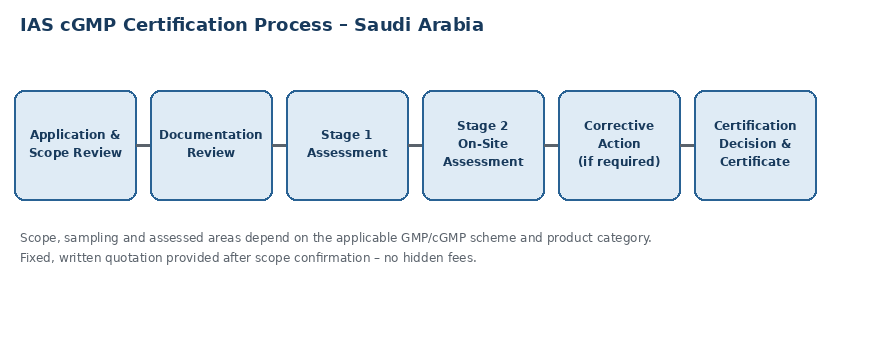
IAS follows a structured, staged assessment path. The sequence for cGMP scope follows the same staged logic used across IAS schemes:
- Application and scope review — the applicant defines the facility, product category and applicable GMP/cGMP scheme; IAS confirms this is assessable within scope.
- Documentation review — IAS reviews the facility’s quality manual, procedures and applicable records against the referenced scheme’s requirements.
- Stage 1 assessment — readiness for on-site assessment is confirmed, including any gaps that should be closed before Stage 2.
- Stage 2 on-site assessment — assessors review the facility in operation against the areas typically assessed for the applicable scheme and category.
- Corrective action, if required — any nonconformities are recorded, and the facility submits corrective action evidence within a defined period.
- Certification decision and issuance — once conformity is confirmed, IAS issues a certificate stating the scheme and scope assessed.
Certificate validity and the ongoing compliance cycle
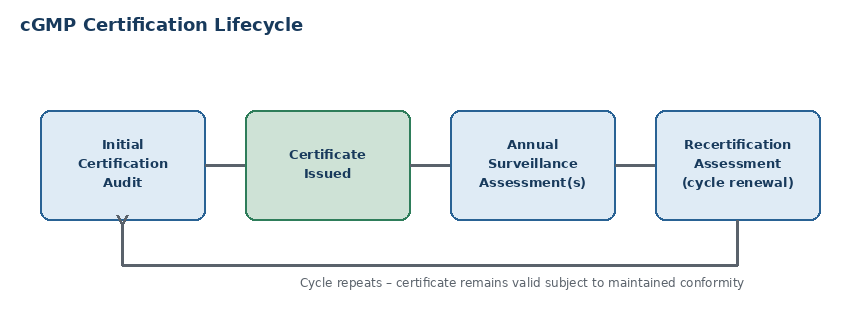
Certification is not a one-time event. Once issued, a certificate’s continued validity depends on the facility maintaining conformity through the cycle below, rather than on the certificate’s issue date alone.
- Surveillance keeps it real. Following the initial certification audit and certificate issuance, IAS conducts periodic surveillance assessments to confirm conformity is being maintained day to day, not just demonstrated once.
- Recertification renews the cycle. Before the certification cycle ends, a recertification assessment reviews the facility afresh and, where conformity continues, renews the cycle.
- Standing can change before cycle end. A lapse in surveillance or an unresolved nonconformity can affect a certificate’s standing before the cycle’s natural end.
cGMP certification in Saudi Arabia: what shapes cost and duration
GMP certification cost in Saudi Arabia is quoted per facility rather than on a generic scale, and no fixed timeline in weeks or months applies uniformly across facilities. Both cost and timeline depend on the specific factors below. Every applicant receives a fixed, written quotation once scope is confirmed, so there are no surprise charges once work begins.
| Cost / duration driver | Why it matters |
|---|---|
| Product category and applicable scheme | A pharmaceutical facility referencing WHO/PIC/S-aligned GMP typically involves a broader assessed scope than a single-line cosmetics facility referencing ISO 22716. |
| Facility size and number of production lines | More lines, buildings or process stages mean more area and documentation for assessors to review. |
| Facility readiness at application | A quality system already operating close to the applicable scheme’s requirements generally moves through Stage 1 and Stage 2 with fewer corrective-action cycles than one starting from limited documentation. |
| Number of sites in scope | Multi-site Saudi operations — for example a manufacturing plant and a separate warehouse under the same scope — require assessment coverage of each site. |
| Complexity of product families | A facility manufacturing several distinct product families under one scope typically requires more assessor time than a single product line. |
Want a real number, not a range? Download the cGMP brochure from the panel alongside this page, then ask IAS for your fixed written quotation.
Beyond pharma: industries pursuing cGMP certification
While pharmaceutical, food, cosmetic and medical device manufacturers remain the most visible applicants, cGMP certification in Saudi Arabia is open to any industry whose processes benefit from documented manufacturing controls. IAS sees interest across a widening range of sectors, including:
- Pharmaceutical and nutraceutical manufacturers scaling local production
- Food and beverage processors supplying retail chains and export markets
- Cosmetic and personal-care product manufacturers
- Medical device assemblers and manufacturers
- Packaging converters supplying regulated product categories
- Chemical and specialty-chemical producers
- Animal feed producers
- Contract manufacturers and co-packers producing for multiple brand owners
- Warehousing and logistics operators handling regulated goods within a defined scope
Many of these applicants are not household names outside Saudi Arabia, but they sit inside supply chains that are. A contract packer producing private-label supplements for several brand owners can face the same buyer due-diligence questions as the finished-goods producer at the top of the chain. So can a chemical producer supplying inputs to a larger pharmaceutical manufacturer. An independent cGMP certificate answers those questions without requiring every partner to run its own facility audit.
Related ISO certification and product certification services are frequently combined with cGMP certification, alongside category-specific options such as ISO 22000 for food-safety management.
Why Saudi manufacturers work with IAS
- Independent, third-party assessment — carried out under IAS’s UQAS accreditation, keeping the assessment separate from the facility’s own regulatory relationship with the SFDA.
- Cross-sector assessor experience — across pharmaceutical, food, cosmetic, device and general-manufacturing scopes, so scope-setting for mixed-category facilities is handled by assessors who have seen the category before.
- A single fixed, written quotation — issued once scope is confirmed, with no hidden charges added mid-assessment.
- Nearly two decades of assessment experience — built up across multiple industry sectors and geographies.
- Certification documentation formatted for buyer review — structured to support supplier qualification reviews with export customers and multinational buyers, not just filed away after issuance.
More on the assessment body itself is on the about us page. Facilities building internal audit capability alongside certification can review cGMP internal auditor training in Saudi Arabia, the broader internal auditor training courses and the wider ISO training range, with dates on the training schedule page.
Quick definitions
- GMP: Good Manufacturing Practice — the overall term for manufacturing quality requirements.
- cGMP: Current Good Manufacturing Practice — the same discipline with an explicit currency requirement, a term used mainly in US regulatory contexts.
- Scheme and scope: the named framework and the product range assessed against it, fixed at application.
- Surveillance assessment: a periodic check confirming the certified system is still being followed.
- Recertification: the full reassessment performed when the certificate’s cycle closes.
Take the next step toward cGMP certification in Saudi Arabia
Whether your facility is scaling local manufacturing in Saudi Arabia or formalising an existing quality system, IAS can confirm which GMP/cGMP scheme applies to your product category and provide a fixed, written quotation for your scope.
- No obligation to proceed after scoping
- Written quotation issued once scope is confirmed — no surprise charges
- Combine with ISO certification, product certification, HACCP or ISO 13485 under one programme if useful
Frequently asked questions
Is a cGMP certificate a precondition of operating in Saudi Arabia?
cGMP certification is a voluntary, third-party credential rather than a legal precondition to operate. Manufacturers of pharmaceuticals, food, cosmetics and medical devices must still hold the relevant SFDA licence or registration. cGMP certification is pursued voluntarily alongside that licensing, to demonstrate ongoing quality-system discipline to regulators, buyers and export partners.
Does an IAS cGMP certificate mean the SFDA has approved our facility or products?
No. An IAS cGMP certificate confirms that a facility’s quality management practices conform to the referenced GMP/cGMP scheme and scope at the time of assessment. It is not an SFDA product registration, marketing authorisation or facility licence, and it does not replace any SFDA regulatory approval.
Our facility already holds an SFDA GMP licence — why pursue IAS certification as well?
An SFDA licence confirms regulatory compliance for market access inside Saudi Arabia. An independent IAS cGMP certificate gives export customers, distributors and multinational buyers outside the Kingdom a documented reference point, named by scheme and scope, and often requested during supplier qualification and procurement reviews.
How does cGMP certification support participation in Saudi Arabia’s growing local-manufacturing sector?
Government and private-sector procurement processes in Saudi Arabia frequently favour suppliers who can evidence structured, independently verified quality systems. A cGMP certificate is one recognised way for a local manufacturer to document that capability when competing for contracts and supply agreements.
Can a facility that produces both food and cosmetic products hold a single cGMP certificate?
A single certificate can cover multiple product lines only where each line’s applicable GMP/cGMP scheme and scope are clearly defined and assessed. Because food and cosmetic products commonly reference different frameworks, IAS confirms scope coverage during the application review before issuing certification.
Is cGMP certification limited to pharmaceutical, food, cosmetic and medical device manufacturers?
No. These categories are the most commonly certified, but cGMP certification is open to any organisation whose processes benefit from documented good-manufacturing-practice controls. That includes packaging converters, chemical producers, animal feed producers, contract packers and warehousing or logistics operators, each scoped to their own products and processes.
What happens if nonconformities are identified during the assessment?
IAS records any nonconformities against the applicable scheme’s requirements and gives the facility a defined opportunity to submit corrective action evidence. Certification is issued once the assessment team confirms the corrective action adequately addresses the finding.
What is the validity period of an IAS cGMP certificate?
Once issued, the certificate remains valid for its stated cycle provided the facility maintains conformity, which is checked through periodic surveillance assessments and confirmed again at recertification. Validity is not open-ended — it depends on continued conformity, not simply the passage of time.