


What ISO 14001:2026 Means for Your Business - Are You Prepared?
Sustainability is no longer a distant goal—it is becoming a core business expectation. With the introduction of ISO 14001:2026, organizations are entering a new phase where environmental performance must be continuous, data-driven, and clearly measurable.
In a rapidly transforming economy like Saudi Arabia, where large-scale development and sustainability ambitions are progressing together, this shift carries significant importance. Businesses are now expected to go beyond compliance and demonstrate real environmental impact with transparency, accountability, and consistency.
ISO 14001:2026 is not just an update—it is a strategic transformation that redefines how organizations manage environmental responsibilities across operations, decision-making, and long-term planning.
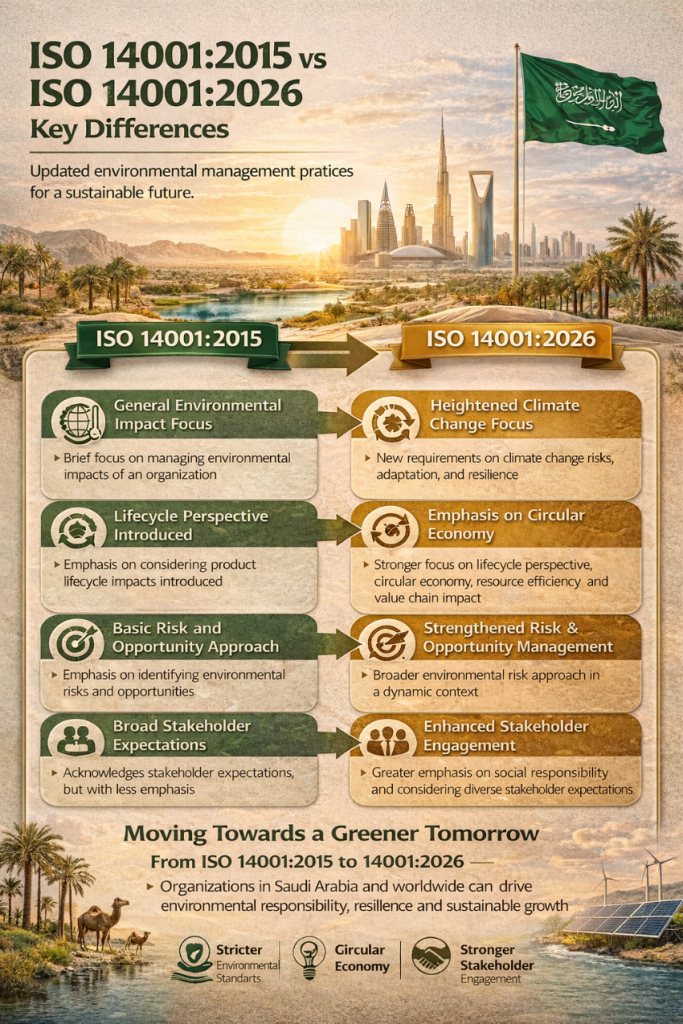
Why ISO 14001:2026 Is Creating Urgency?
The urgency surrounding ISO 14001:2026 is driven by increasing environmental risks, evolving regulations, and rising stakeholder expectations. Businesses are now required to provide real-time data, measurable outcomes, and continuous performance visibility.
In Saudi Arabia, where sustainability initiatives are gaining momentum, organizations must align quickly with global expectations. This creates a clear need for early preparation and structured implementation.
The Biggest Shift: From Compliance to Intelligence
One of the most significant changes in ISO 14001:2026 is the move from traditional compliance-based systems to intelligent environmental management.
- Continuous monitoring replaces periodic reporting – Organizations must track environmental performance in real time rather than relying on delayed audits, ensuring better accuracy and faster decision-making.
- Predictive risk management becomes essential – Businesses are expected to identify and prevent environmental risks before they occur, reducing potential disruptions and impacts.
- Data-driven decision-making becomes the norm – Accurate insights guide actions, helping organizations improve efficiency, control, and overall performance.
This shift transforms environmental management into a proactive and strategic function, where decisions are driven by real-time insights rather than historical data.
How Technology Is Reshaping Environmental Management?
Technology plays a critical role in enabling organizations to meet ISO 14001:2026 requirements. Digital systems allow businesses to monitor environmental performance continuously and respond quickly to changes.
- Real-time tracking enhances operational visibility – Continuous monitoring helps organizations detect inefficiencies early and maintain consistent environmental performance.
- Automated systems simplify reporting – Digital tools reduce manual effort, improve accuracy, and streamline compliance processes.
- Faster response capabilities reduce risks – Immediate action prevents minor issues from escalating into significant environmental or operational challenges.
Artificial intelligence further strengthens these capabilities by providing predictive insights, improving planning, and enabling smarter environmental management.
What Challenges Should Businesses Expect?
Adapting to ISO 14001:2026 requires more than system upgrades—it demands a shift in mindset and organizational culture. Many businesses will need to rethink how environmental management is integrated into daily operations.
Organizations must invest in digital infrastructure to support real-time monitoring and data analysis. At the same time, environmental management must be embedded across departments rather than treated as a separate function. Leadership involvement becomes essential, as strong direction and accountability are needed to drive effective implementation.
Without these changes, businesses may struggle to meet the expectations of the new standard.
Why This Change Creates Opportunity?
While the transition may seem complex, ISO 14001:2026 offers significant opportunities for organizations that adopt it early. Businesses can improve efficiency by optimizing resource usage and reducing waste, leading to cost savings and better operational performance.
In addition, organizations can strengthen their reputation by demonstrating transparency and accountability. This builds trust with customers, investors, and regulators, which is increasingly important in competitive markets.
For companies in Saudi Arabia, aligning with these expectations can also support long-term growth and position them as leaders in sustainability and innovation.
What Businesses Should Focus on Next?
Preparing for ISO 14001:2026 requires a structured and proactive approach. Organizations must evaluate their current systems and identify areas that need improvement.
- Conduct a gap analysis of existing environmental systems – This helps identify weaknesses and ensures that organizations understand what needs to be improved to meet new requirements.
- Invest in real-time monitoring and digital tools – Implementing advanced systems enables continuous tracking and faster decision-making.
- Train teams on data-driven and AI-supported processes – Employees must be equipped with the skills needed to use modern tools effectively.
- Align environmental objectives with business strategy – Sustainability goals should be integrated into overall planning to drive meaningful impact.
- Strengthen leadership involvement – Active participation from top management ensures accountability and successful implementation.
How Long Will It Take to Implement ISO 14001:2026?
The timeline for implementation depends on the organization’s size, complexity, and current readiness. Businesses with existing environmental management systems may transition more quickly, while others may require more time to build capabilities.
Implementation is typically carried out in phases, including system upgrades, process adjustments, and employee training. Starting early allows organizations to distribute the workload and reduce operational disruptions.
What Mistakes Should Businesses Avoid During Transition?
One common mistake is treating ISO 14001:2026 as a documentation requirement rather than a transformation. This approach limits the effectiveness of the system and reduces long-term benefits.
Another major issue is delaying the adoption of digital tools. Without real-time monitoring and data-driven systems, organizations may struggle to meet the new expectations. Lack of leadership involvement can also slow progress and weaken implementation efforts.
Avoiding these mistakes requires a clear strategy, early action, and strong commitment across the organization.
How Will ISO 14001:2026 Impact Different Industries?
ISO 14001:2026 will affect industries differently depending on their environmental impact and operational complexity. Sectors such as manufacturing, energy, construction, and logistics will experience more significant changes due to their higher environmental footprint.
These industries will need to adopt advanced monitoring systems and strengthen risk management practices. Service-based industries may face fewer technical challenges but will still need to improve transparency, reporting, and alignment with sustainability expectations.
Overall, every industry will need to enhance its environmental management approach, regardless of size or sector.
Is ISO 14001:2026 Worth the Investment?
For many organizations, the investment required to implement ISO 14001:2026 may seem substantial at first. However, the long-term benefits often outweigh the initial costs.
Improved efficiency, reduced waste, and better risk management lead to cost savings over time. Additionally, stronger reputation and increased trust can open new business opportunities and strengthen market position.
Rather than viewing it as an expense, businesses should consider ISO 14001:2026 as an investment in long-term sustainability and growth.
Final Insight
ISO 14001:2026 is not just a standard – it is a shift in how businesses operate, compete, and grow.
Organizations that act early will gain efficiency, credibility, and resilience, while those that delay may struggle to adapt in an increasingly sustainability-driven environment. The future belongs to businesses that are not only compliant, but intelligently sustainable.


