

Understanding how an audit is conducted changes how you are audited. The people who host external and customer audits most successfully have almost always run audits themselves. They know what an auditor is looking for, what an evasive answer sounds like from the other side, and why a straight answer costs less than a clever one.
cGMP internal auditor training teaches employees to examine their own plant against current Good Manufacturing Practice requirements — and, as a direct consequence, prepares the site to be audited.
- Plan, run and report an internal audit end to end
- Host external and customer audits with confidence
- Evidence, findings and corrective-action verification
- No prior audit experience required
Planning internal auditor training for your site in Iraq? Contact IAS with your location, product and group size.
cGMP internal auditor training in Iraq at a glance
- Who it is for: employees who audit, or will audit, their own GMP or cGMP quality system — QA, production, QC, warehouse, engineering and management representatives.
- Entry level: no prior audit experience expected; staff who have hosted audits without ever conducting one often gain the most.
- Focus: audit readiness — auditing and being audited treated as two views of one skill.
- Formats: classroom, live virtual, self-paced online or in-house.
- Duration and fees: depend on participant numbers and the route chosen, set out in the same written quotation.
- Certificate: a certificate of completion stating the syllabus and date, for the training records an auditor may ask to see.

What cGMP internal auditor training teaches
Employees are prepared to examine the organisation employing them against GMP and cGMP requirements, and against whatever the company has committed to in its own procedures.
cGMP asks that the system stays current — that procedures, training and records describe how the plant runs today. Internal audits are how a company finds out whether that is true before somebody else does. Where an independent assessment of the facility is what is wanted, that is set out on the cGMP certification in Iraq page.
Both sides of the same table
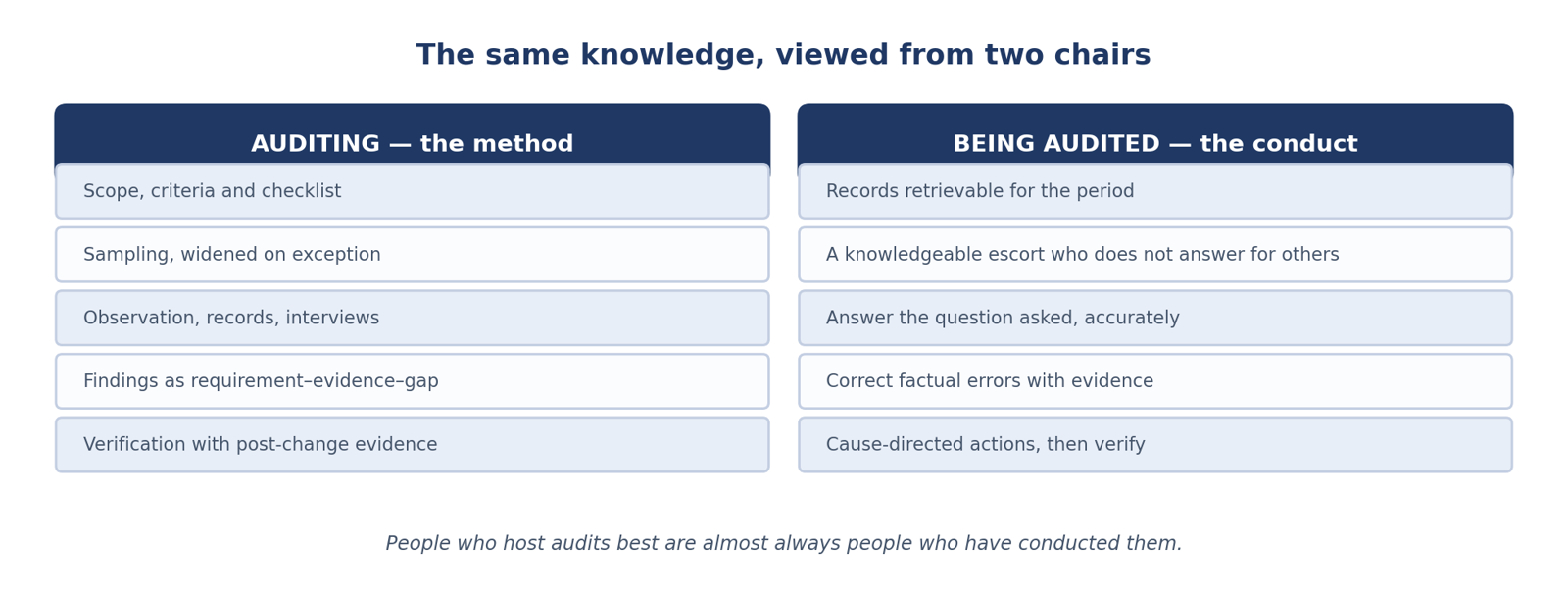
The auditor’s side is method: scope, criteria, checklist, sampling, evidence, findings, report, verification. The host’s side is preparation and conduct: knowing what will be asked, having records retrievable, answering accurately, and responding to findings usefully rather than defensively.
They are the same knowledge viewed from opposite chairs. An auditor who has traced a batch through records knows exactly how long it takes a host to produce them. A host who has audited knows that a delayed document looks like a missing one.
What hosting an audit actually requires
| Before the audit | During | After |
|---|---|---|
| Confirm scope and criteria with the auditor | Provide a knowledgeable escort who does not answer for others | Investigate root cause rather than reaching for a quick correction |
| Make sure records for the period are retrievable | Produce records promptly; say so if something takes time | Propose actions that address the cause |
| Brief staff that findings are about processes | Answer the question asked, accurately and no more | Implement, then gather evidence that it worked |
| Resolve anything already known to be outstanding | Correct factual errors immediately, with evidence | Verify before closing, not at closure |
| Have previous findings and their closure evidence ready | Take your own notes of what was examined | Feed the pattern into management review |
The middle column contains the behaviours that most affect how an audit goes. Answering the question asked — rather than a broader question, or a narrower one — shortens audits considerably. Volunteering an unrelated problem rarely helps anyone; concealing a known one always costs more later.
The habits that make audits harder
Certain responses reliably make an auditor look further, and staff who have audited recognise them instantly.
A document that cannot be found within a reasonable time reads as a document that does not exist, whatever the truth. An answer that contradicts what the records show invites a widened sample. A person who answers on behalf of an operator who is standing right there suggests the operator’s own answer would differ. And an area that produces immaculate, freshly printed records for a period spanning years invites exactly the scrutiny it was trying to avoid.
None of these is dishonest in intent. All of them lengthen audits and produce findings that a plainer approach would not have generated.
Want to see how a third-party assessment of the same system runs end to end? Read the IAS certification process.
What an internal auditor does
On the auditor’s side the work runs in a fixed sequence. Preparation — reading procedures, the previous report and open corrective actions, then building a checklist that names sources and samples. A short opening meeting to confirm scope and timing. Then the audit itself: observing activity as it genuinely happens, examining the records that should describe it, and asking the people doing the work to explain it, with referenced notes taken throughout.

Before the closing meeting the auditor writes up and grades each finding, stating the requirement, then the evidence, then the shortfall. A report follows. Later the auditor returns to the corrective action, judges whether it addressed the cause, and looks for evidence that it held rather than accepting a closure note.
The two weeks before an external audit
Audit readiness is mostly doing ordinary things earlier, and the sites that handle it best treat it as a checklist rather than a scramble.
Start with retrievability. Confirm that records for the period likely to be examined can actually be produced — batch records, calibration certificates, training files, deviation and complaint logs, previous audit reports and their corrective actions. Records held off-site or in archive should be identified now, not discovered mid-audit.
Then look at what you already know. Open corrective actions past their agreed dates are the most common finding an external auditor makes, and they are entirely visible in advance. Where an action cannot be closed in time, a documented plan with a realistic date is a far better position than an overdue item with no explanation.
Check the physical basics that produce easy findings: status labels matching system status, superseded procedure copies removed from workstations, calibration due dates on instruments in use, quarantined material genuinely segregated. These take an afternoon and remove a category of finding entirely.
Brief the people who will be interviewed, briefly. What the audit covers, that findings are raised against processes rather than individuals, that honest answers are expected, and that nobody should guess at an answer they do not know. Coaching people on what to say is counterproductive — rehearsed answers sound rehearsed and invite more questions.
Finally, decide who escorts and who answers. The escort should know the area well enough to locate records quickly and should resist answering on behalf of the person actually being asked. That single discipline shortens audits more than any other piece of preparation.
Who should attend cGMP internal auditor training
| Participant | What they gain |
|---|---|
| QA officers and managers | The method, plus the ability to prepare the site for external audits |
| Production supervisors | Confidence hosting an auditor in their own area |
| QC and laboratory personnel | Understanding of how data trails are examined |
| Warehouse and materials staff | Knowledge of what traceability testing involves |
| Engineering and maintenance | Insight into how calibration and maintenance records are read |
| Management representatives | Ability to prepare the organisation rather than react to it |
| Contract manufacturers | Frequent hosts of client audits; the benefit is immediate |
No prior audit experience is expected. Staff who have hosted audits without ever conducting one often find the course reframes the experience entirely. Colleagues new to the manufacturing-quality field normally begin with a cGMP foundation course. Teams building a wider audit programme also take the general internal auditor training and ISO lead auditor training courses, with dates on the training schedule page.
Skills the course develops
- Planning, conducting and reporting an internal audit end to end
- Building checklists that name a requirement, a sample and a source
- Gathering objective evidence with references that survive challenge
- Classifying findings consistently and wording them factually
- Escorting an external auditor without answering on others’ behalf
- Retrieving records promptly and saying honestly when something will take time
- Answering the question asked, accurately and without elaboration
- Correcting a factual error in a finding with evidence rather than argument
- Responding to findings with cause-directed actions rather than quick corrections
- Verifying that a corrective action worked before closing it
Why it pays
Sites that audit themselves competently spend less time on external audits, because there is less to discover and the discovery goes faster. Records are retrievable because someone has recently asked for them. Staff are unflustered because the questions are familiar. And the findings that do arise tend to be ones the site already knew about and had already started addressing — which reads very differently to a customer than a surprise.
The reverse case is the expensive one: a site whose first experience of a systematic audit is a customer’s, conducted by someone with commercial leverage and no interest in being generous. Regional background on how these requirements are applied is set out in the article on cGMP standards.
Training versus certification
| cGMP internal auditor training | cGMP certification | |
|---|---|---|
| Applies to | Individual employees | The organisation and its facility |
| Delivered or performed by | A training provider; staff then audit internally | An independent certification body |
| Results in | Auditing competence and a training record | A certificate covering a defined scope |
| Continues as | Audits under the internal programme | Surveillance and recertification |
A certified system is expected to audit itself, which is why the two so often go together — but neither produces the other. The wider range of schemes IAS assesses is listed under ISO certification, and the scope of the IAS accreditation is set out on the accreditation page.
cGMP internal auditor training in Iraq: course details
How long cGMP internal auditor training in Iraq runs depends on the number of participants and the route chosen, and the fees are set out in the same written quotation. Everyone who finishes is issued a certificate of completion stating the syllabus and the date, for the training records an auditor may ask to see.
- Objective. Prepare participants to plan, conduct, report and follow up internal audits of GMP and cGMP systems, and to host external audits competently as a result.
- Coverage. GMP and cGMP fundamentals; scope and criteria; planning and checklists; sampling; observation and interviewing; objective evidence; nonconformity classification; findings and reporting; corrective-action review and verification; hosting an audit; auditor and auditee conduct.
- Outcomes. Participants should be able to run an internal audit end to end and gather referenced evidence; raise and word nonconformities, produce a report and evaluate corrective actions; and prepare an area to be audited by an external party.
Delivery formats
Classroom, live virtual, self-paced online and in-house. In-house delivery allows a group to run a practice audit on their own area, which is the fastest route to confidence on both sides of the table; otherwise online cGMP internal auditor training and virtual cGMP training cover the same syllabus.
Said plainly: IAS provides training and certifies management systems. Facility licensing and product approval are decisions only regulators make.
Comparing formats across the IAS group? The full GMP internal auditor training syllabus is published on the IAS India site.
Next step: arrange training for your team
Tell IAS where the site is, what you manufacture and how many people you want to train, and you will get a format, a schedule and a written quotation. General queries about IAS assessment and training are answered on the frequently asked questions page.
Frequently asked questions
Should we volunteer problems the auditor has not found?
Known issues that are already being addressed, with a documented plan, are usually better disclosed than discovered — it demonstrates a functioning system. Unrelated problems the auditor has not asked about are a different matter and rarely help. The general rule is to answer the question asked, accurately.
What if we cannot find a document during the audit?
Say so immediately, say how long it will take, and provide it when you can. Silence and a long search read as absence. Auditors are considerably more understanding of “that is archived off-site, I can have it tomorrow” than of twenty minutes of unexplained delay followed by a document appearing.
How should we respond to a finding we disagree with?
Separate fact from judgement. If the auditor misread a revision number or was not shown a document, produce the evidence and the finding is corrected. If the facts are right but you dislike the classification, that is the auditor’s judgement to make. Arguing classification after the facts are settled rarely succeeds and costs goodwill.
Is it acceptable to correct something during the audit?
Correcting an immediate problem is sensible and shows responsiveness. It does not, however, remove the finding — the evidence at the time of the audit is what the finding records. Attempting to alter records during an audit is a different matter entirely and is the most damaging thing a site can do.
Can someone audit the area they work in?
Not their own work. Internal auditing depends on the auditor being independent of the activity being examined, which is why most programmes cross-assign auditors between departments. Someone who audits the process they run ends up verifying their own decisions, and an external assessor will notice.
Does the certificate of completion expire?
IAS does not attach an expiry date to it — the certificate records the syllabus and the date the course was completed. Most quality systems set their own requalification interval for internal auditors and treat continued participation in the audit programme as the evidence that competence has been maintained.
Does completing this course qualify someone to audit suppliers or contract manufacturers?
The syllabus is built around first-party auditing — auditing your own organisation. Much of the method transfers to supplier audits, but auditing another company on your behalf is a second-party activity with its own scope and authority arrangements, and independent certification of that company is a third-party activity IAS performs separately.
Can trained internal auditors support a later cGMP certification audit?
Yes, and that is the usual sequence. The internal audit programme is what finds and closes gaps before an external body arrives, and the corrective-action records it produces are among the first things a third-party assessor asks to see.
