


Quick answer
- FSSC 22000 stacks ISO 22000, a sector-specific ISO 22002-x prerequisite programme, and FSSC’s own additional requirements into one GFSI-recognised food safety certification.
- Version 7 replaced Version 6 in May 2026. V6 audits stay available until 30 April 2027, and every certificate has to be running on V7 by 30 April 2028.
- IAS certifies Saudi food manufacturers under UQAS accreditation, giving large-scale domestic producers a certificate that is recognised well beyond Saudi Arabia’s own market.
- EAS delivers Saudi-specific Lead Auditor and Internal Auditor courses, structured separately from the audit team that makes the certification decision.
Saudi Arabia’s food sector has been scaling up fast under Vision 2030’s food-security priorities. Large domestic dairy and date operations are expanding output, and food manufacturing more broadly is moving toward the scale international buyers expect. Buyers want that scale backed by an internationally recognised management system. FSSC 22000 sits at the centre of that expectation. It’s the GFSI-recognised certification large-scale manufacturers reach for when export ambitions or major domestic retail contracts require proof their food safety system holds up at volume, not just on paper. IAS certifies FSSC 22000 for Saudi food manufacturers across dairy, dates, and broader large-scale production. Below, you’ll find what the scheme demands, what changed with Version 7, and how the certification audit runs from application through to certificate.
What Is FSSC 22000 Certification?
Think of FSSC 22000 as three layers stacked on top of each other, not one single standard. ISO 22000 forms the base — the international food safety management system standard. Stacked above it is a prerequisite programme from the ISO 22002-x series, chosen to fit the activity being certified. Large-scale dairy processing carries different operational demands than date packing or general food manufacturing, and the standard accounts for that. On top sits FSSC’s own layer of Additional Requirements, covering food fraud, food defence, allergen management, and labelling more thoroughly than ISO 22000 does on its own. The Foundation for Food Safety Certification owns and runs the whole scheme, benchmarked in full by GFSI. That benchmark status is exactly why international retailers and brand owners take the certificate as proof enough of food safety competence at scale, without running a separate audit of their own.
FSSC 22000 V6 vs. V7: What Actually Changed
Version 7 was published in May 2026, replacing Version 6. The transition period runs to 30 April 2028, so large operations have time to work the change through multiple sites rather than one facility at a time. The scheme’s underlying shape stays the same — ISO 22000, prerequisite programmes, HACCP-based hazard analysis, Additional Requirements. What moved is summarised below.
| Area | FSSC 22000 V6 | FSSC 22000 V7 |
|---|---|---|
| Prerequisite programmes | ISO/TS 22002-x series | New ISO 22002-x:2025 series |
| GFSI benchmarking | Aligned to GFSI Benchmarking Requirements v2020 | Realigned to GFSI Benchmarking Requirements v2024 |
| Food-chain categories | Broader category groupings | More granular category & subcategory structure |
| Culture requirements | Food safety & quality culture required | Strengthened — clearer evidence of senior-management involvement expected |
| Sustainability | Limited, indirect coverage | Formal SDG-aligned requirements: food loss & waste, resource efficiency, packaging design |
| Additional Requirements | Baseline coverage | Strengthened supplier approval, allergen management, food defence, food fraud, equipment management |
Source: FSSC 22000 Version 7 update, Foundation for Food Safety Certification (fssc.com), May 2026.
Large manufacturers already certified to V6 are, in most cases, updating records and evidence to the new structure across their sites. Few are rebuilding the FSMS from scratch at each one.
Who Should Certify to FSSC 22000?
Saudi Arabia’s scale and its Vision 2030 food-security direction both push demand for FSSC 22000. The categories below show where that demand concentrates.
- Large-scale food and beverage manufacturers producing for domestic retail and export.
- Dairy processors and bottling operations, including groups expanding capacity under national food-security initiatives.
- Date processing, packing, and export operations supplying both domestic and international markets.
- Packaging manufacturers producing food-contact materials at industrial scale.
- Cold-chain storage, distribution, and logistics operators serving multi-site manufacturing groups.
- Catering and food-service operators supplying institutional or retail customers.
Transitioning from V6 to V7: Key Dates
| Milestone | Date |
|---|---|
| FSSC 22000 V7 published | May 2026 |
| Last date V6 audits are permitted | 30 April 2027 |
| V7 upgrade audit window | 1 May 2027 – 30 April 2028 |
| Deadline: every certificate must be on V7 | 30 April 2028 |
A V6 certificate remains valid until it’s upgraded. That gives multi-site Saudi groups room to sequence the transition, rather than forcing every facility through the process at once. IAS recommends large manufacturers start the V7 gap review at the group’s largest or most complex site first. Lessons from that review usually shorten the work at the smaller sites that follow.
The IAS Saudi Arabia Certification Process, Start to Finish
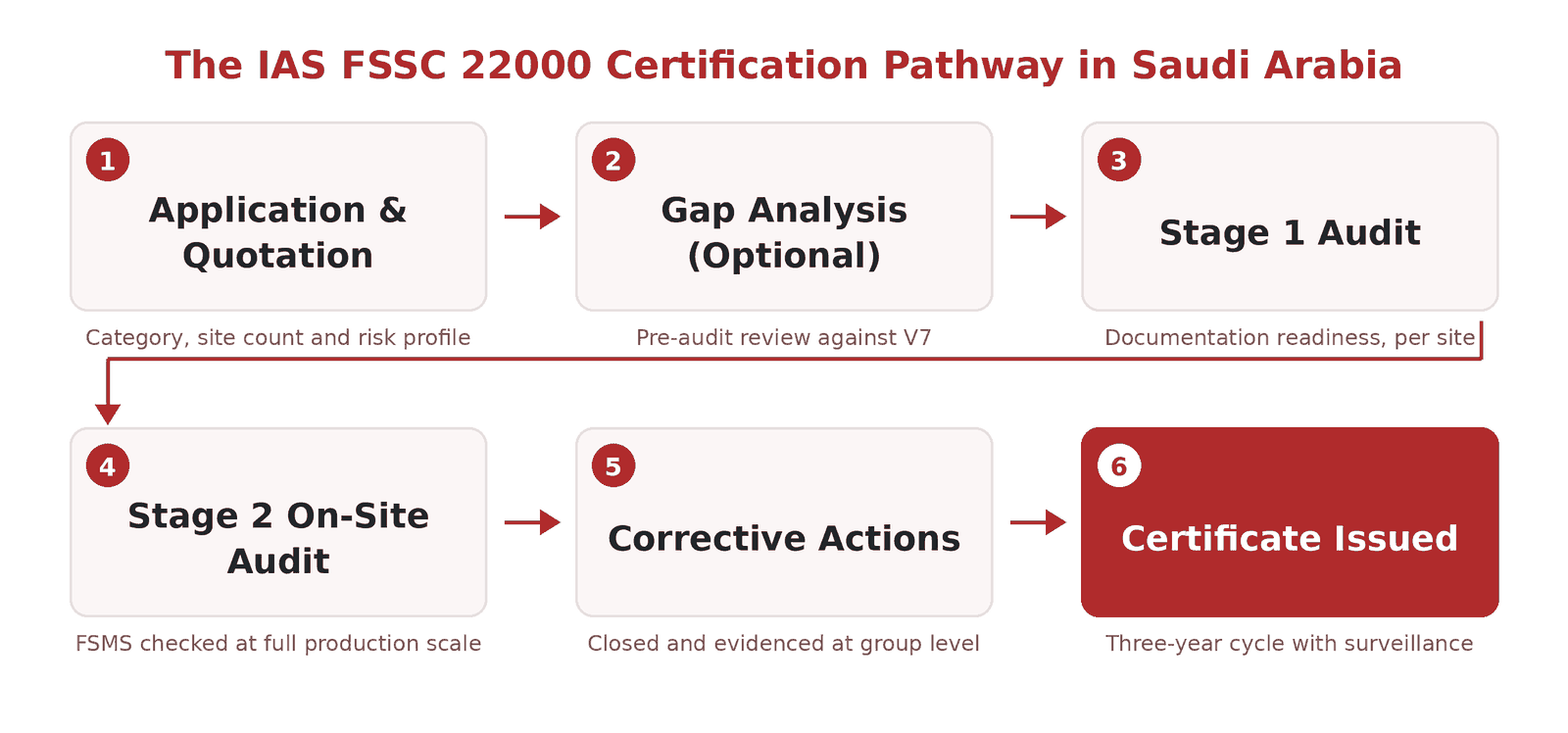
- Application and quotation — IAS reviews the group’s category, site count across the kingdom, and risk profile before issuing a tailored quotation.
- Gap analysis (optional) — a pre-audit review against FSSC 22000 V7 that surfaces gaps at scale while there’s time to close them.
- Stage 1 audit — a documentation readiness review, carried out per site for multi-site groups, ahead of scheduling Stage 2.
- Stage 2 audit — the on-site audit that checks the FSMS against real operating practice: monitoring records, HACCP verification, the prerequisite programme, traceability, and the Additional Requirements, at full production scale.
- Corrective actions (if raised) — nonconformities need resolving and evidencing before certification, tracked at group level where more than one site is involved.
- Certificate issued — valid for a three-year cycle, maintained across the group through the surveillance schedule under ‘After Certification’ below.
“At large-scale plants, the finding I see most is a mock recall that works fine for one production line but hasn’t been tested against the full volume the site actually runs,” says Adekoya Oluwatosin, FSSC 22000 v6 Lead Auditor. “Test the recall process at real throughput before Stage 2, not a scaled-down version of it.”
A large manufacturer with an established quality system can often reach certification within a few months of application per site. A multi-site group standardising its FSMS across facilities for the first time should plan for a longer, phased timeline. For a multi-site group, IAS only commits to a schedule once it has weighed the gap-analysis findings from across all the sites together.
Documentation You’ll Need for Certification
- Food safety policy signed off by top management, applied consistently across sites for multi-site groups.
- HACCP plan and prerequisite programmes mapped to the ISO 22002-x:2025 series for each activity certified.
- Food defence and food fraud vulnerability assessments and mitigation plans.
- Allergen management plan, scaled to cover the full range of product lines run at volume.
- Traceability and recall procedures, tested against real production throughput, not a reduced sample run.
- Monitoring, verification, internal audit, and management-review records, consistent across sites where applicable.
- Food safety and quality culture plan, reinforced under V7.
- Food loss and waste and sustainability records aligned with national food-security reporting where relevant.
Benefits of FSSC 22000 Certification
- Export and retail access — GFSI-recognised certification is frequently a precondition for large-scale Saudi manufacturers seeking either export contracts or major domestic retail agreements.
- Vision 2030 alignment — a structured FSMS gives large producers documented evidence supporting national food-security and quality objectives.
- Fewer high-volume recalls — hazard control tested at real production scale reduces the cost and reach of a failure at a large facility.
- Multi-site consistency — one certification framework lets a group standardise food safety management across several plants instead of managing separate local systems.
- Sustainability credentials — V7’s food loss and waste requirements give large manufacturers concrete evidence for both buyer and national sustainability reporting.
Accreditation and Training at a Glance
IAS runs its training arm at arm’s length from its certification decisions. FSSC and GFSI expect that separation from any body delivering both. Saudi teams preparing for audit can go directly to the FSSC 22000 Lead Auditor Training in Saudi Arabia and Internal Auditor Training in Saudi Arabia pages, both delivered by EAS.
| Activity | Delivered by | Accredited / Approved by |
|---|---|---|
| FSSC 22000 certification audit | IAS (Integrated Assessment Services) | UQAS (Universal Quality Accreditation Service) |
| FSSC 22000 Lead Auditor training (Saudi Arabia) | EAS (Empowering Assurance Systems) — IAS’s technical training partner | CQI-IRCA (Approved Training Partner) |
| FSSC 22000 Internal Auditor training (Saudi Arabia) | EAS — IAS’s technical training partner | EAS’s own in-house training curriculum (CQI-IRCA approval applies to the Lead Auditor course only) |
Verified against IAS’s published accreditation page and EAS’s published accreditation page, August 2026.
After Certification: Surveillance for Large-Scale Manufacturers
For a multi-site Saudi group, the three-year cycle a certificate opens needs coordinating across facilities — not tracked site by site in isolation. IAS runs surveillance every year and keeps at least one visit in the cycle unannounced. It also times recertification, matched to the original Stage 2 in scope, to close out before the certificate expires.
- Groups adding a new production line, a new facility, or a big capacity expansion should notify IAS promptly. That’s a common pattern under Vision 2030-linked investment, and an extension audit is often needed before the new scope is covered by the existing certificate.
- Where certification spans multiple sites, IAS samples a subset of locations at each surveillance visit rather than auditing every site every year. Keeping the group’s site list current with IAS matters for accurate sampling.
- Missed surveillance dates or unresolved major nonconformities at any one site in a group can affect the group’s overall certification standing. It’s worth building that into internal group-wide audit planning.
- An unannounced audit can land at any site in the group without notice. Throughput-scale traceability and recall readiness needs to hold up on an ordinary production day at every facility, not just the flagship site.
Why Certify with IAS?
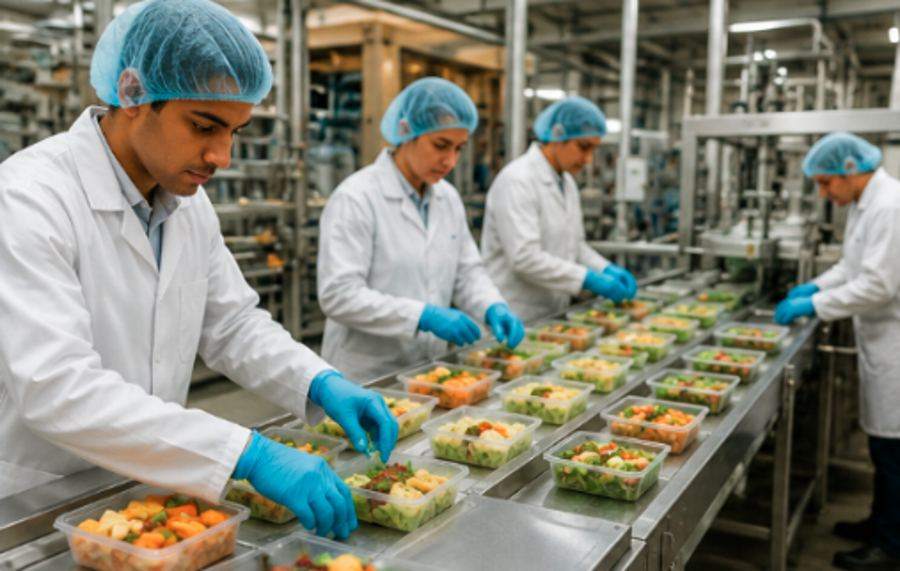
IAS auditors bring direct experience with large-scale food manufacturing, dairy processing, and multi-site certification. The audit reflects the realities of production at volume, not a checklist built for a single small facility. IAS also certifies related standards, including ISO 22000, ISO 9001, and HACCP. Folding more than one scheme into a single visit trims real time off a group’s overall certification programme, which matters when several certifications are managed at once. For auditor training, IAS’s partner EAS runs the CQI-IRCA approved Lead Auditor course through the Saudi-specific pages linked above.
About the reviewer
Adekoya Oluwatosin is more than eight years into a food safety career that mixes consulting, training, and auditing. Bureau Veritas Group awarded her FSSC 22000 v6 Lead Auditor status, built on work spanning manufacturing floors, packaging lines, catering settings, and storage-and-distribution operations. She has personally run upwards of 22 internal audits, touching both FSSC 22000 and ISO 9001:2015 assessments. She has also steered more than ten companies through the FSMS and QMS groundwork that leads to certification, and delivered training to more than 200 delegates through Highfield-accredited Food Safety and HACCP coursework.
Explore More
- FSSC 22000 Lead Auditor Training in Saudi Arabia — CQI-IRCA approved, delivered by EAS
- FSSC 22000 Internal Auditor Training in Saudi Arabia — EAS’s in-house curriculum
- ISO 22000 Certification — the base standard FSSC 22000 is built on
- ISO 9001 Certification — for a combined audit with FSSC 22000
- HACCP Certification — hazard analysis and critical control points
- IAS Accreditation — IAS’s global UQAS accreditation scope
- EAS (Empowering Assurance Systems) — IAS’s training partner for Lead Auditor and Internal Auditor courses
Get Started with FSSC 22000 Certification in Saudi Arabia
Contact IAS for a tailored FSSC 22000 V7 quotation for your Saudi operation, or to plan a phased V6-to-V7 upgrade across a multi-site group ahead of the 30 April 2028 deadline. Groups that also need Lead Auditor or Internal Auditor training can fold it into the same conversation with EAS.
Phone: +971 52 873 2160
Contact page: iasiso-gulf.com/SA/contact-us/
Frequently Asked Questions
Does a large Saudi manufacturer need a separate FSSC 22000 certificate for each production site?
Multi-site certification under one certificate is possible, depending on how the sites are managed and controlled. IAS reviews the group structure at application stage to determine the right scope.
How does FSSC 22000 connect to Saudi Arabia’s Vision 2030 food-security goals?
It’s not a Vision 2030 requirement itself. But a GFSI-recognised FSMS gives large domestic producers documented evidence that supports national food-security and quality goals, which many buyers and programmes look favourably on.
Is a Saudi manufacturer’s existing V6 certificate still valid?
Yes, until upgraded. V6 audits remain available through 30 April 2027, with full V7 adoption required by 30 April 2028.
Should a large facility applying for the first time go for V6 or V7?
V7. Certifying directly to the current version avoids scheduling an upgrade shortly after first certification.
How are surveillance audits scheduled across a multi-site Saudi group?
IAS samples a subset of sites at each surveillance visit under a documented multi-site sampling approach. It doesn’t audit every facility every year.
What does FSSC 22000 certification cost for a large-scale Saudi manufacturer?
There’s no fixed published rate. For a large manufacturer it depends heavily on site count, product category, and risk profile — IAS reviews the application first and prices the quotation around what it finds.
Can an FSSC 22000 audit be combined with an ISO 9001 audit at a Saudi facility?
Yes. IAS can align the audit dates so a single site visit covers both schemes.
Who accredits IAS to certify FSSC 22000 in Saudi Arabia?
UQAS (Universal Quality Accreditation Service). Its public register lets buyers verify the accreditation independently.
Where do Saudi teams get FSSC 22000 auditor training?
Through EAS’s Saudi-specific Lead Auditor and Internal Auditor pages. The Lead Auditor course is CQI-IRCA approved; the Internal Auditor course is EAS’s own in-house curriculum.
How long does FSSC 22000 certification take for a large Saudi manufacturing group?
It depends on FSMS maturity and how many sites are involved. Once the gap-analysis results from across the group are in, IAS can lay out a phased timeline that reflects that reality.