


Qatar’s Environmental Transition Starts with Your Internal Auditors
Qatar’s environmental management landscape is undergoing its most significant shift in over a decade.
With ISO 14001:2026 officially published on April 15, 2026, every Qatar organization certified under ISO 14001:2015 now operates within a defined transition window. Internal auditors are not simply participants in this transition – they are the driving force behind it.
Before any external certification body arrives to assess your EMS against the new standard, your internal auditors must already be equipped to identify compliance gaps, document non-conformances, and initiate corrective action across every expanded clause area introduced by ISO 14001:2026.
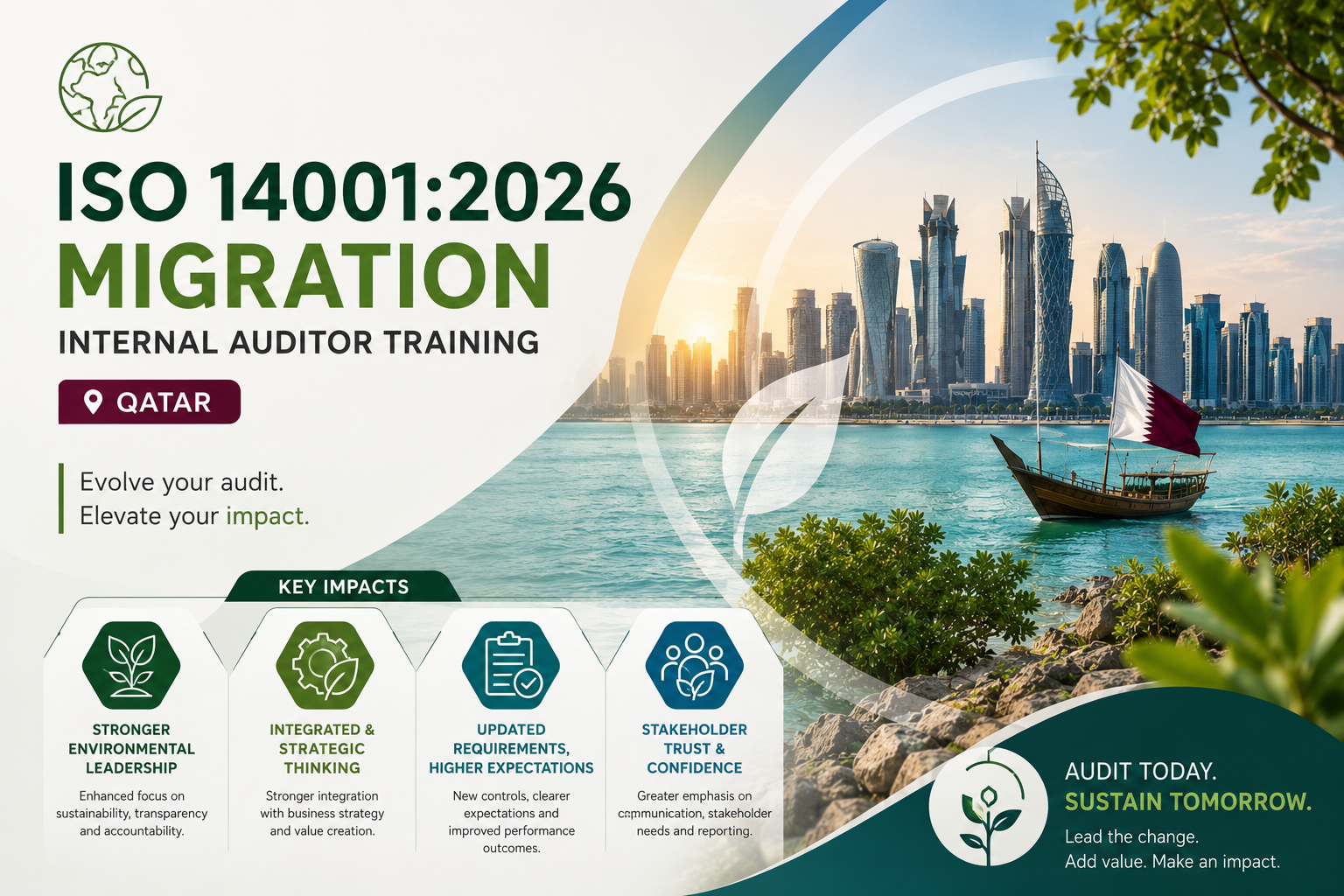
Our ISO 14001:2026 Migration Internal Auditor Training is purpose-built for environmental coordinators, HSE officers, compliance professionals, and appointed internal auditors working inside Qatar organizations — the people responsible for keeping the EMS audit-ready, continuously improving, and fully aligned with the newly published standard requirements.
Why ISO 14001:2026 Has Fundamentally Changed Internal Auditing in Qatar?
Internal auditors in Qatar who completed their training under ISO 14001:2015 are now working with an incomplete and outdated audit scope.
ISO 14001:2026 formally expands the boundaries of what internal auditors must assess during every EMS audit cycle. For Qatar’s dominant industries — oil and gas, construction, infrastructure, logistics, and hospitality — these changes are not procedural adjustments. They are mandatory new requirements that demand new competencies, new audit questions, and evidence gathered across areas that were previously optional or entirely absent from internal audit programs.
Organizations that delay internal auditor migration training risk missing critical non-conformances before their next external certification audit — creating avoidable compliance exposure at exactly the wrong moment in Qatar’s sustainability transition.
New ISO 14001:2026 Requirements Qatar Internal Auditors Must Be Trained On
Climate Change – Formally Mandatory for Internal Audit Verification
ISO 14001:2015 treated climate change as a voluntary consideration. ISO 14001:2026 makes it a non-negotiable mandatory environmental aspect. Qatar internal auditors must now verify that climate-related risks and opportunities are formally identified, documented within the environmental aspects register, and actively managed through EMS planning processes — directly supporting Qatar’s National Climate Change Action Plan and Qatar National Vision 2030 environmental pillars.
Biodiversity – A New Standalone Internal Audit Obligation
Biodiversity protection was entirely absent as a specific requirement under ISO 14001:2015. ISO 14001:2026 formally includes it as a standalone obligation. Qatar internal auditors working in construction, energy, and coastal infrastructure must now assess and document the organization’s impact on marine ecosystems, desert habitats, and protected natural environments as part of every internal audit cycle.
Life Cycle Thinking – Supply Chain Audit Scope Now Extended
ISO 14001:2015 generally confined internal audit scope to the organization’s own Qatar operational boundaries. ISO 14001:2026 strengthens life cycle thinking requirements, pushing internal audit accountability beyond the facility perimeter to cover GCC supply chain partners, procurement decisions, and end-of-life product environmental impacts.
ESG Performance – Now Requires Internal Audit Evidence
ISO 14001:2026 directly integrates ESG alignment into the standard’s requirements. Qatar internal auditors must now confirm that environmental performance data is captured and communicated in a way that supports external ESG disclosure obligations — a growing requirement for Qatar Stock Exchange listed entities and organizations operating under government procurement frameworks.
Stakeholder Reporting – Structured Verification Now Required
Enhanced stakeholder reporting obligations under ISO 14001:2026 require internal auditors to verify that environmental communication processes are structured, consistent, and externally verifiable — not simply documented in a procedure that goes unimplemented in practice across Qatar operations.
Two-Day Program Structure
This focused 2-day program is built specifically around the expanded internal audit scope and new competencies introduced by ISO 14001:2026 — designed for professionals working inside Qatar organizations.
Day 1 – ISO 14001:2026 Through the Internal Auditor’s Lens
Day 1 develops clause-level understanding of ISO 14001:2026 as it applies directly to internal auditing practice within Qatar organizations. Content covers specific clause differences between ISO 14001:2015 and ISO 14001:2026, Annex SL implications for integrated internal audit programs, how to formally audit climate change as a mandatory environmental aspect, verifying biodiversity impact documentation across Qatar industry contexts, auditing GCC supply chain life cycle accountability, assessing top management EMS involvement and leadership accountability evidence, and reviewing documentation, operational control, and emergency preparedness requirements under the new standard.
Practical activities during Day 1 include building ISO 14001:2026 internal audit checklists from the ground up, mapping updated environmental aspects against new clause requirements, and working through real-life internal audit scenarios drawn from Qatar oil and gas, construction, logistics, hospitality, and infrastructure environments.
Day 2 – Simulation and Certification Assessment
Day 2 is entirely hands-on. Delegates conduct fully simulated internal audit exercises covering opening meeting facilitation, structured audit interview techniques, objective evidence collection against ISO 14001:2026 clauses, non-conformance identification and classification, corrective action request writing, and closing meeting delivery of findings.
The session concludes with a written certification assessment. Every delegate completing Day 2 will be independently ready to plan, conduct, and formally close a complete internal audit cycle aligned to ISO 14001:2026 within their own Qatar organization.
Who Should Enroll?
This ISO 14001:2026 Migration Internal Auditor Training is the right program for:
- Environmental coordinators and HSE officers managing day-to-day EMS compliance across Qatar operations
- Practicing internal auditors currently conducting EMS audits under ISO 14001:2015 who need to upgrade their competence to the new standard
- Sustainability managers and environmental officers leading the organization’s ISO 14001:2026 internal transition across Doha and wider Qatar operations
- Operations and compliance staff involved in internal audit scheduling, EMS documentation management, and non-conformance tracking
Any professional formally appointed as an internal auditor within a Qatar organization currently transitioning from ISO 14001:2015 to ISO 140
