


Independent third-party cGMP certification for Qatar’s manufacturers — scoped to your product category and sites, assessed against the applicable GMP framework, and backed by a fixed written quotation.
- UQAS-accredited certification body
- Fixed written quotation, no open-ended fees
- Nearly two decades of assessment experience
- Open to every manufacturing industry, not just food and pharma
Ready to scope your certification? Talk to IAS and get a fixed written quotation — contact us today.
cGMP certification in Qatar at a glance
- Scope: assessed against the applicable GMP/cGMP scheme for your product category and sites — stated on the certificate itself.
- Eligible industries: food, pharmaceuticals, nutraceuticals, cosmetics, specialty chemicals, and any other manufacturing or handling operation.
- Certification cycle: the first audit leads to the certificate; surveillance follows each year until recertification.
- Pricing: one fixed, written quotation once scope is confirmed — no open-ended fees.
- Accreditation: IAS issues cGMP certification under its UQAS accreditation.

Qatar’s growing local manufacturing base is reshaping what “quality proof” means
Qatar’s manufacturing base has been growing across food, pharmaceuticals, nutraceuticals and specialty chemicals, with more production moving from imported goods to local facilities. New processing plants, cold-chain facilities, pharmaceutical formulation units and specialty chemical operations have opened across Doha’s industrial zones as manufacturers build out local production capacity.
- What has changed for buyers and regulators concerns facilities that recently switched from importing finished goods to manufacturing them locally. Such a facility now has to prove, in a form outsiders can trust, that its processes are consistently controlled.
- Who is asking: domestic retailers, government tender boards and export customers across the GCC and beyond. They increasingly ask for documented evidence of good manufacturing practice — the common language of quality assurance across food, pharma, cosmetics and chemical supply chains.
- Where cGMP certification fits: an independent, third-party assessment confirming that a facility’s processes are managed against a recognised good-manufacturing-practice framework, appropriate to its product category and scope.
The shift is visible on the ground. Facilities that once imported finished dairy, snack or personal-care products now run their own filling and packaging lines, operating out of industrial areas such as Doha Industrial Area or Umm Salal. A pharmaceutical formulator setting up its first local production line faces a different question from an established exporter renewing a certificate: how to build, from day one, the documented process control that buyers and licensing authorities both expect. Independent cGMP certification in Qatar gives that answer a structure to follow, rather than leaving quality assurance to be improvised site by site.
cGMP requirements by category: there is no one rulebook
cGMP is not a single global certification standard; it is a family of related good-manufacturing-practice frameworks that differ by product category and jurisdiction.
| Product category | Commonly referenced framework(s) | Typical driver |
|---|---|---|
| Food & beverage processing | WHO GMP guidance and internationally recognised food manufacturing practice | Domestic retail, GCC export |
| Pharmaceuticals & nutraceuticals | WHO GMP or PIC/S-aligned GMP guidance, as applicable to the product line | Regional distribution, tender qualification |
| Cosmetics & personal care | ISO 22716 good manufacturing practice for cosmetics | Retail, e-commerce, export |
| Products destined for the US market | US FDA 21 CFR requirements, which govern only the US market | US import compliance |
| Other manufacturing (packaging, chemicals, feed, contract packing, warehousing) | GMP principles applied to your own product and process | B2B supply chains, industrial buyers |
A Qatari facility choosing cGMP certification selects the scheme and scope relevant to what it makes and where it plans to sell, and that scheme and scope are stated on the certificate itself. cGMP certification in Qatar is open to any manufacturing or handling operation, scoped to what it produces or handles — it is not reserved for food, pharma, cosmetics or medical devices alone.
cGMP meaning: GMP vs cGMP, same foundation, different emphasis
GMP sets out baseline good manufacturing practice. cGMP — “current” GMP — emphasises that a facility keeps its systems, equipment and controls up to date with present-day practice, rather than frozen at whatever standard applied when the facility opened.
| Dimension | GMP | cGMP |
|---|---|---|
| Focus | Documented, consistent manufacturing controls | The same controls, kept demonstrably current |
| Typical trigger for review | Baseline facility and process assessment | Equipment upgrades, formulation changes, evolving practice |
| Certificate wording | States the applicable scheme and scope | States the applicable scheme, scope and “current” emphasis where relevant |
In everyday use across Qatar’s industry the two terms are often treated as interchangeable, and both point to the same underlying discipline: documented process control, traceability, and a facility able to demonstrate consistent output quality on demand. The distinction matters mainly in how an assessment is scoped — a cGMP-focused review looks specifically at how a facility keeps its practices current as equipment, formulations or regulatory expectations evolve.
Who actually oversees what in Qatar
Understanding Qatar’s oversight landscape prevents a common mix-up: no single authority “certifies cGMP”, and none of the bodies below issue the kind of voluntary, scope-defined certificate that IAS provides.
| Body | Role | Nature of authority |
|---|---|---|
| Ministry of Public Health — Pharmacy and Drug Control Department | Licenses pharmaceutical manufacturers, registers medicinal products, and conducts its own GMP inspections for the pharma sector in Qatar | Statutory licensing & inspection |
| Ministry of Commerce and Industry / QGOSM | Sets and enforces broader product standards, technical regulations and metrology requirements across sectors | Statutory standards oversight |
| World Health Organization (WHO) | Publishes GMP guidelines that manufacturers and certifiers reference; sets no Qatari requirements and issues no certificates | Standard-setter only |
| US FDA | Regulates only products entering the US market; has no jurisdiction in Qatar and issues no certificates through third parties | US-market regulator only |
| IAS | Independent third-party body that assesses a facility against the applicable GMP/cGMP scheme and issues certification under its UQAS accreditation | Independent certification body |
- Not a government approval. An IAS cGMP certificate is a voluntary, independent statement of conformity to a defined scheme and scope. IAS never presents it as Ministry of Public Health approval, product registration, or any form of regulatory clearance, and it does not replace a manufacturer’s licensing or registration obligations. Certification sits alongside those obligations, giving buyers, tender boards and export partners an independent quality reference in addition to them.
- Common mix-ups. A WHO reference in process documentation does not carry WHO’s own endorsement, since WHO publishes guidance rather than certifying facilities. And while 21 CFR generally does not apply to products sold only in Qatar, a facility later exporting to the United States would need to address FDA certification requirements separately from, and in addition to, any IAS certification it holds.
Not sure which scheme applies to your products? See the full range of IAS certification in Qatar, or ask us for a scoping conversation.
What an IAS assessment actually looks at
The depth and focus of an assessment depend on the applicable scheme and product category. What assessors generally examine is how well a facility can demonstrate control over its own processes. For a new production line that is often the first time controls have been documented in a structured way; for an established exporter it is mostly a matter of confirming current practice. Areas typically reviewed, as applicable, include:
- Facility layout, hygiene zoning and environmental controls
- Raw-material handling, incoming inspection and supplier controls
- Process controls, in-process checks and equipment qualification
- Batch and lot record-keeping and traceability
- Change control, deviation handling and corrective action (CAPA)
- Staff training, hygiene practice and competency records
- Storage, warehousing and distribution controls
Documentation reviewed typically includes a quality manual, standard operating procedures, batch or production records, calibration and maintenance logs, and validation records — as applicable to the certification scheme and product category. No single fixed checklist applies to every applicant.
The IAS certification journey, step by step
- Application and scope review — the applicant defines its product category, sites and intended scheme. The IAS application form linked alongside this page starts this stage.
- Documentation assessment — IAS reviews the facility’s quality manual, SOPs and records relevant to the chosen scheme.
- On-site assessment — assessors verify that documented practice matches what actually happens on the production floor.
- Nonconformity resolution — any gaps identified are addressed through corrective action before a decision is made.
- Certification decision — an independent technical review confirms the facility meets the applicable scheme and scope.
- Certificate issuance — the certificate states the scheme, scope and sites covered.

The full IAS certification process applies consistently across IAS’s certification services, adapted here to cGMP scope and category.
Staying certified: the lifecycle after the audit
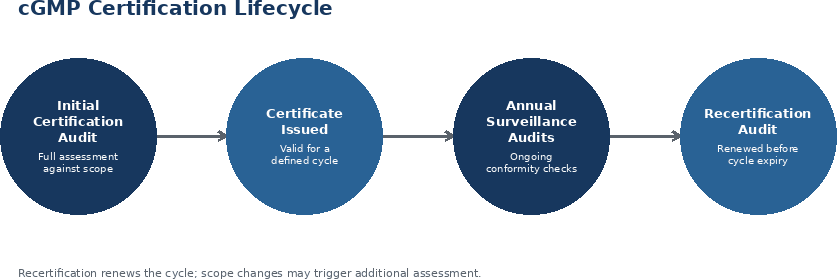
Certification is not a one-time event. After the initial certification audit and certificate issuance, IAS conducts periodic surveillance audits to confirm the facility continues to operate within its certified scope, followed by a recertification audit before the cycle renews. Facilities that change their product lines, add sites, or substantially alter their processes should expect their scope to be reassessed rather than assumed to carry over automatically.
cGMP certification cost in Qatar: what shapes cost and duration
Neither cost nor duration is fixed in advance — both depend on facility-specific factors that IAS reviews during the application stage. IAS provides a fixed, written quotation once scope is confirmed, so there are no open-ended fees once an agreement is in place.
| Cost / timeline driver | What it reflects |
|---|---|
| Facility readiness | How mature existing documentation, hygiene controls and record-keeping already are |
| Scope and site count | Single site versus multiple production or warehousing locations under one certificate |
| Product category complexity | A multi-line food and beverage plant differs from a single-formulation cosmetics workshop |
| Applicable scheme | WHO-referenced GMP, PIC/S-aligned GMP or ISO 22716 assessments carry different depth of review |
| Corrective action needs | Time required to close nonconformities identified during assessment |
Timelines follow the certification lifecycle above — initial audit, certificate issuance, annual surveillance, recertification — rather than a fixed number of weeks or months quoted in isolation.
Want a real number, not a range? Download the cGMP brochure from the panel at the top of this page for an overview, then ask IAS for a fixed, written quotation.
Who in Qatar is actually applying
Beyond food and pharmaceutical processors, IAS sees cGMP certification interest from a wider range of manufacturers:
| Sector | Why they apply |
|---|---|
| Dairy, poultry and fresh-produce processors | Supplying Qatari retail chains and institutional buyers |
| Pharmaceutical and nutraceutical formulators | Supporting local production alongside Ministry of Public Health licensing |
| Cosmetics and personal-care manufacturers | Selling through Qatari retail and regional e-commerce channels |
| Specialty chemical and cleaning-product manufacturers | Supplying industrial and institutional buyers with documented quality evidence |
| Contract packers and co-packing operations | Producing on behalf of brand owners who require documented process control |
| Cold-chain and food warehousing operators | Handling storage and distribution stages of the food supply chain |
Many of these same facilities pursue related IAS services. For food safety management there is ISO 22000 certification in Qatar and HACCP certification in Qatar; for medical device manufacturers, ISO 13485 certification in Qatar. ISO 9001 certification in Qatar provides a broader quality management foundation, and product certification in Qatar suits facilities needing product-specific conformity evidence alongside process certification.
What certification actually changes on the ground
For a facility that recently moved into local manufacturing, certification is less about a wall certificate and more about what it enables in day-to-day commercial conversations:
- Retail and hospitality buyers can accept documented quality evidence instead of relying solely on site visits.
- Government tender processes that request independent quality assurance evidence have a recognisable answer on file.
- Export conversations with GCC and international distributors start from a shared reference point instead of a one-off questionnaire.
- Internal teams gain a documented baseline for training, change control and corrective action that survives staff turnover — the reason many certified sites also run cGMP internal auditor training for their own staff.
- New production lines added later can be brought into an existing certification structure rather than starting from zero.
Why manufacturers work with IAS in Qatar
Choosing a certification body matters as much as choosing to certify at all. IAS assesses facilities strictly as an independent third party, separate from any consulting relationship, and issues certification under a single, consistently applied accreditation:
- Independent, third-party assessment — no conflict between advising and certifying the same facility.
- UQAS accreditation — giving buyers a recognisable, verifiable mark.
- Nearly two decades of assessment experience — across food, pharma, cosmetics and general manufacturing.
- Fixed, written quotations — no open-ended cost surprises once scope is agreed.
- One point of contact — through application, assessment, surveillance and recertification. More about the organisation is on our about us page.
Quick definitions
- GMP: Good Manufacturing Practice — baseline documented manufacturing controls.
- cGMP: Current GMP — the same discipline, with an explicit emphasis that systems, equipment and controls stay up to date with present-day practice.
- Scheme & scope: the specific framework and product range an assessment is measured against, defined at application and stated on the certificate.
- Surveillance audit: a periodic check confirming the facility still operates within its certified scope.
- Recertification: the audit performed before the certification cycle renews.
Next step: talk to IAS about certifying your facility
Whether your facility is newly established, expanding local production, or an established manufacturing line looking to formalise its quality evidence, IAS can scope a cGMP assessment to your specific product category and sites. Broader questions about how IAS certification works are answered on our frequently asked questions page.
- No obligation to proceed after scoping.
- Fixed, written quotation once scope is confirmed.
- Combine with ISO 22000, HACCP, ISO 13485 or ISO 9001 certification where useful.
Call +971528732160 or email enquiry@iascertification.com to request a fixed, written quotation for cGMP certification in Qatar.
Frequently asked questions
Does Qatari regulation make cGMP certification compulsory?
No. Manufacturing in regulated sectors such as pharmaceuticals requires licensing and inspection by the Ministry of Public Health. cGMP certification in Qatar from IAS is a separate, voluntary step that gives buyers, tender boards and export partners independent evidence of process control.
Does an IAS cGMP certificate mean the Ministry of Public Health has approved our facility?
No. IAS certification is independent of Ministry of Public Health licensing and inspection. It confirms conformity to the applicable cGMP scheme and scope, and it never substitutes for, or implies, any government approval, registration or clearance.
Our facility already passed a Ministry of Public Health GMP inspection — why pursue IAS certification too?
A regulatory inspection confirms that you meet Qatar’s licensing conditions. Independent certification gives buyers, distributors and export customers outside Qatar a recognisable, verifiable form of quality evidence, which a domestic inspection report alone does not provide in the same way.
Is cGMP certification only available to food and pharmaceutical manufacturers?
No. Cosmetics manufacturers, specialty chemical producers, animal-feed mills, contract packers and warehousing operators can all apply, with the assessment scoped to whatever products or processes they actually handle.
Can a facility that recently switched from importing to local manufacturing apply?
Yes. Many applicants are exactly this profile — operations that recently began local production and now need documented quality evidence for domestic and regional buyers.
How are nonconformities handled once the assessment is over?
IAS documents the findings, and the facility addresses them through corrective action before a certification decision is made. This is a normal part of the process rather than an automatic failure.
Can one certificate cover multiple production lines or product categories at the same site?
Scope is defined during the application stage and stated on the certificate. A single site producing multiple product categories can be certified across those lines, where each line is properly assessed against its applicable framework.
How is the certificate kept current after it is issued?
The certificate stays active through periodic surveillance audits confirming continued conformity, followed by a recertification audit before the certification cycle renews — the ongoing lifecycle described earlier on this page.
