


Why ISO 14001:2026 Is Forcing Businesses to Rethink Everything
Sustainability is no longer an optional initiative—it is becoming a core requirement for business continuity and credibility. With the introduction of ISO 14001:2026, organizations are expected to move beyond basic environmental compliance and adopt systems that are real-time, predictive, and performance-driven.
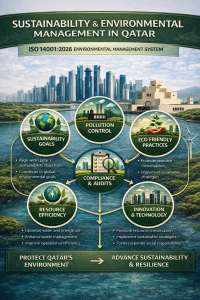
In Qatar, where rapid development and sustainability goals are advancing side by side, this transformation carries strong relevance. Businesses are now expected to demonstrate clear environmental accountability supported by accurate data, transparency, and continuous improvement.
ISO 14001:2026 is not just a revision—it is a complete reset of how environmental management is approached, integrating strategy, technology, and measurable outcomes.
Why the Pressure to Adapt Is Increasing?
The urgency surrounding ISO 14001:2026 is driven by global environmental challenges, evolving regulatory expectations, and growing stakeholder demand for transparency. Organizations must now provide consistent, data-backed proof of their environmental performance.
For businesses in Qatar, this pressure is further influenced by international exposure and sustainability-focused development. Companies that delay adaptation may face increasing challenges, while those that act early can strengthen their market position.
Moving Beyond Compliance: A Smarter Environmental Model
ISO 14001:2026 introduces a shift from traditional compliance-based systems to a smarter and more responsive environmental management model.
- Continuous monitoring becomes the new standard – Organizations must track environmental metrics such as emissions, waste, and energy usage in real time to maintain accuracy and control.
- Predictive risk management gains importance – Businesses are expected to identify potential environmental risks early and take preventive action.
- Data-driven decisions replace assumptions – Reliable insights guide operational improvements and strategic planning.
This shift ensures that environmental management is proactive, integrated, and continuously evolving.
The Role of Digital Transformation in Compliance
Technology plays a central role in enabling organizations to meet ISO 14001:2026 requirements. Digital tools allow businesses to manage environmental performance with greater efficiency and precision.
- Real-time data collection improves visibility – Continuous tracking helps organizations maintain better control over environmental performance.
- Automation enhances efficiency – Reduces manual effort and ensures faster, more accurate reporting.
- Immediate response systems reduce risks – Quick action helps prevent environmental issues from escalating.
With AI-driven capabilities, businesses can move toward predictive and intelligent environmental management.
What Makes Implementation More Challenging?
Adapting to ISO 14001:2026 requires more than technical upgrades—it demands a change in organizational mindset. Businesses must integrate environmental management into core operations rather than treating it as a separate function.
The need for real-time monitoring, combined with cross-functional coordination, increases complexity. Leadership involvement becomes essential to ensure alignment, accountability, and successful execution.
Organizations that fail to address these challenges may struggle to meet the expectations of the new standard.
Why This Shift Creates Business Opportunities
While ISO 14001:2026 introduces new requirements, it also offers significant opportunities. Businesses can improve efficiency by optimizing resource use and reducing waste, leading to cost savings.
Enhanced transparency builds trust with stakeholders, including investors and customers. This trust strengthens brand reputation and supports long-term growth.
For organizations in Qatar, adopting these practices can position them as leaders in sustainability and innovation.
What Should Businesses Do First?
Preparing for ISO 14001:2026 requires a structured approach and early action. Organizations must assess their current systems and take steps to align with new expectations.
- Conduct a gap analysis of environmental systems – Identify areas that need improvement and align processes with updated requirements.
- Invest in real-time monitoring tools – Enable continuous tracking and faster response to environmental changes.
- Train employees on modern practices – Build internal capability to manage data-driven environmental systems effectively.
- Align sustainability with business strategy – Ensure environmental goals support overall organizational objectives.
- Strengthen leadership involvement – Drive accountability and ensure consistent implementation.
How Will ISO 14001:2026 Impact Key Industries?
The impact of ISO 14001:2026 will vary across industries in Qatar. Sectors such as construction, energy, and manufacturing will face more significant changes due to their environmental footprint.
These industries will need to adopt advanced monitoring systems and strengthen risk management practices. Service sectors will also need to improve transparency and reporting to meet stakeholder expectations.
Overall, every industry will need to enhance its environmental management approach to remain competitive.
How Can Businesses Stay Competitive in This New Era?
To stay competitive, organizations must move beyond compliance and focus on continuous improvement, innovation, and adaptability.
- Strengthen real-time environmental visibility – Implement systems that provide continuous insights, enabling faster and more informed decision-making.
- Integrate sustainability into core operations – Ensure environmental practices are embedded across all departments for consistent performance.
- Leverage predictive analytics for planning – Use data-driven insights to anticipate risks and improve long-term strategies.
- Improve transparency and communication – Provide clear, data-backed reporting to build stakeholder trust and credibility.
- Invest in workforce development – Train employees to adapt to new technologies and evolving environmental requirements.
What Benefits Can Organizations Expect?
- Improved efficiency through optimized resource usage – Businesses can reduce waste and lower operational costs while improving productivity.
- Stronger compliance and reduced risks – Continuous monitoring helps maintain alignment with regulations and prevents potential issues.
- Enhanced brand reputation – Transparent environmental performance builds trust with stakeholders and improves market positioning.
- Better resilience and risk management – Proactive strategies help organizations handle environmental challenges effectively.
- Increased competitiveness in global markets – Strong sustainability practices attract partners and open new opportunities.
Is ISO 14001:2026 a Long-Term Investment?
Implementing ISO 14001:2026 requires investment in systems, training, and process improvements. However, the long-term benefits make it a strategic decision. Organizations can achieve cost savings through improved efficiency and reduced waste, while stronger environmental performance enhances credibility and supports business growth. Businesses that view ISO 14001:2026 as an investment are more likely to achieve sustainable success and long-term resilience.
- Improved access to global markets and partnerships – Organizations with strong environmental systems are more attractive to international clients and stakeholders.
This increases business opportunities and strengthens competitiveness in sustainability-driven markets. - Better regulatory readiness and reduced compliance risks – Proactive environmental management helps businesses stay ahead of changing regulations.
This minimizes the risk of penalties, disruptions, and last-minute compliance challenges. - Enhanced innovation and operational agility – Continuous improvement encourages businesses to adopt smarter and more efficient practices.
This drives innovation, improves adaptability, and supports long-term growth in evolving market conditions.
Final Thought
ISO 14001:2026 is not just a compliance requirement—it is a strategic shift toward smarter, more accountable, and more resilient business practices.
Organizations that act early will gain a competitive advantage, while those that delay risk falling behind in an increasingly sustainability-driven world.


