


Quick answer
- FSSC 22000 sets a food safety bar built from ISO 22000, a sector-specific ISO 22002-x prerequisite programme, and FSSC’s own additional requirements — recognised under the GFSI benchmark most major buyers look for.
- FSSC 22000 moved to Version 7 in May 2026. V6 audits remain available until 30 April 2027, and every certificate must sit on V7 by 30 April 2028.
- IAS certifies Qatari food producers under UQAS accreditation, giving domestic dairy and food-security producers a certificate that carries recognition beyond Qatar’s own borders.
- EAS delivers Qatar-specific Lead Auditor and Internal Auditor training, run separately from the audit team to protect certification impartiality.
Since 2017, Qatar has pushed hard toward food self-sufficiency. Dairy is the sector most people point to first — domestic milk production scaled up rapidly to reduce reliance on imports, and government-backed food security programmes have followed with investment across other categories too. Alongside that push sits a large hospitality sector that answers to international hotel and event-catering standards. FSSC 22000 fits both threads. It’s the certification domestic food-security producers reach for to prove their systems match international benchmarks, and it’s what hospitality supply chains increasingly expect from their food suppliers. IAS certifies FSSC 22000 for Qatari dairy, food manufacturing, and hospitality-supply businesses. Read on for what the scheme demands, what’s new in Version 7, and how an IAS audit actually runs.
What Is FSSC 22000 Certification?
Rather than a single standard, FSSC 22000 is a scheme assembled from three layers. ISO 22000 — the international food safety management system standard — forms the foundation. A prerequisite programme from the ISO 22002-x series sits above that, tailored to the activity being certified: dairy processing, food manufacturing, or storage and catering supply. FSSC’s own Additional Requirements make up the third layer. They cover food fraud, food defence, allergen management, and labelling in more depth than ISO 22000 addresses alone. The Foundation for Food Safety Certification owns the whole scheme. Full GFSI benchmark status is what gets it accepted by international hotel groups, retailers, and government procurement programmes as evidence enough of food safety competence.
FSSC 22000 V6 vs. V7: What Actually Changed
Version 7 was published in May 2026 as the successor to Version 6. Certified sites have until 30 April 2028 to complete the transition. The scheme’s core structure hasn’t been rebuilt — ISO 22000, prerequisite programmes, HACCP-based hazard analysis, Additional Requirements all stay in place. The changes are summarised in the table below.
| Area | FSSC 22000 V6 | FSSC 22000 V7 |
|---|---|---|
| Prerequisite programmes | ISO/TS 22002-x series | New ISO 22002-x:2025 series |
| GFSI benchmarking | Aligned to GFSI Benchmarking Requirements v2020 | Realigned to GFSI Benchmarking Requirements v2024 |
| Food-chain categories | Broader category groupings | More granular category & subcategory structure |
| Culture requirements | Food safety & quality culture required | Strengthened — clearer evidence of senior-management involvement expected |
| Sustainability | Limited, indirect coverage | Formal SDG-aligned requirements: food loss & waste, resource efficiency, packaging design |
| Additional Requirements | Baseline coverage | Strengthened supplier approval, allergen management, food defence, food fraud, equipment management |
Source: FSSC 22000 Version 7 update, Foundation for Food Safety Certification (fssc.com), May 2026.
For dairy operations already certified to V6, most of the V7 workload is realigning records and evidence with the updated structure. It’s not a ground-up rebuild of the FSMS.
Who Should Certify to FSSC 22000?
Qatar’s food-security push and its hospitality sector both drive demand for FSSC 22000. Here’s where that demand shows up most.
- Dairy processors and bottling operations central to Qatar’s self-sufficiency programmes.
- Food manufacturers producing under domestic food security and local-production initiatives.
- Hospitality and catering supply chains — hotels, event caterers, and food-service operators serving the tourism and events sector.
- Bakery and beverage manufacturers supplying retail and hospitality customers.
- Cold-chain storage and distribution operators supporting both domestic production and imports.
- Packaging manufacturers producing food-contact materials for the sector.
Transitioning from V6 to V7: Key Dates
| Milestone | Date |
|---|---|
| FSSC 22000 V7 published | May 2026 |
| Last date V6 audits are permitted | 30 April 2027 |
| V7 upgrade audit window | 1 May 2027 – 30 April 2028 |
| Deadline: every certificate must be on V7 | 30 April 2028 |
A V6 certificate doesn’t expire the moment V7 becomes current — it simply has a defined window left to run. IAS recommends Qatari dairy and food-security producers build the V7 gap review into their existing government-programme reporting cycle where one applies. That way the certification upgrade and any related compliance reporting move together, rather than as two separate exercises.
The IAS Qatar Certification Process, Start to Finish
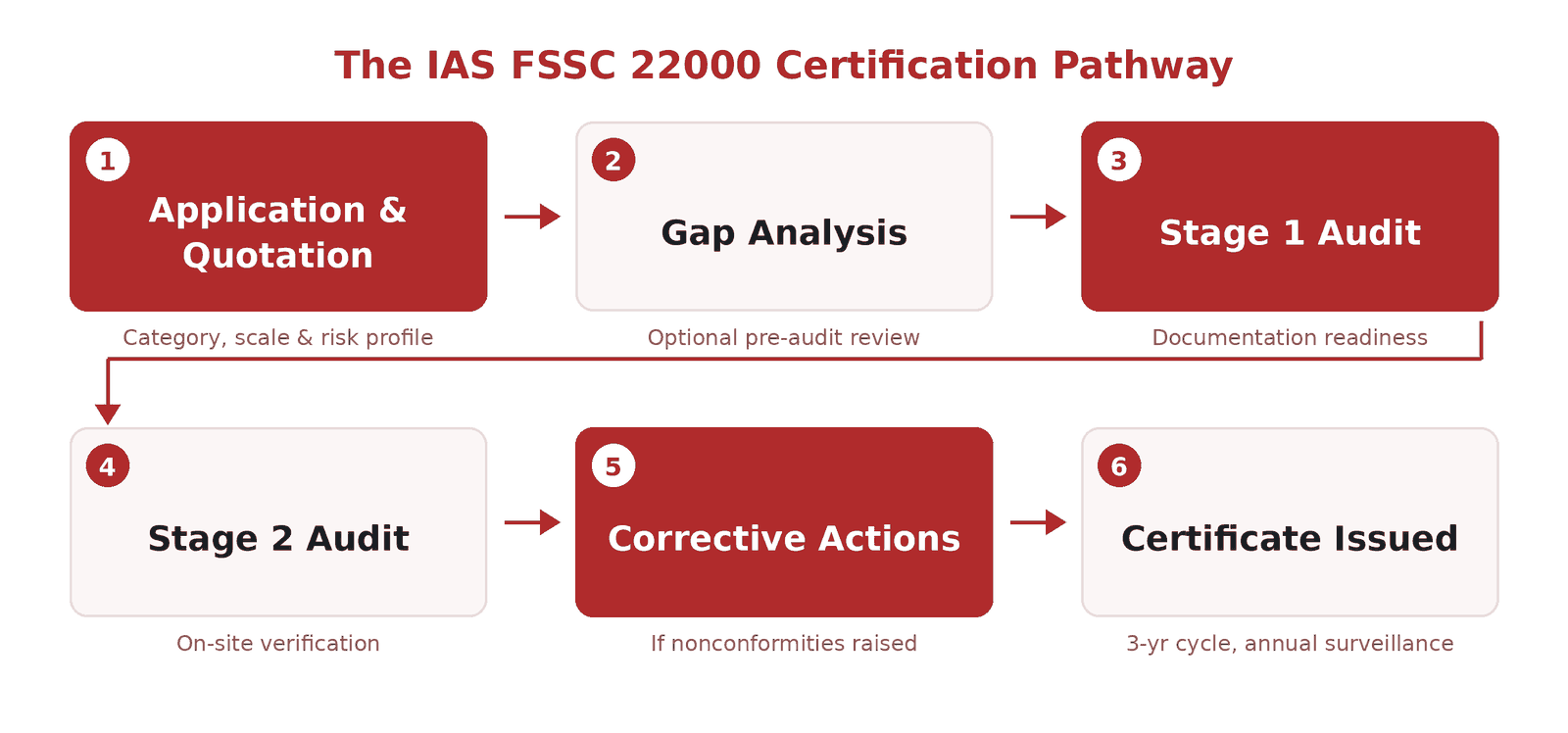
- Application and quotation — IAS assesses the operation’s category and scale — dairy, manufacturing, or hospitality supply — against its risk profile and issues a quotation specific to it.
- Gap analysis (optional) — a pre-audit review against FSSC 22000 V7 that surfaces gaps while there’s time to act on them.
- Stage 1 audit — IAS reviews whether the FSMS documentation is genuinely ready for an on-site visit.
- Stage 2 audit — auditors visit the site to confirm the FSMS is operating as written, across monitoring records, HACCP verification, the prerequisite programme, traceability, and the Additional Requirements.
- Corrective actions (if raised) — nonconformities are corrected and evidenced before a certificate is issued.
- Certificate issued — valid for a three-year cycle, sustained by the surveillance schedule set out under ‘After Certification’ below.
“Dairy operations that scaled up quickly for food security programmes sometimes outgrew their own documentation before anyone noticed,” says Dr. C.D. Mohana Priya, ISO 22000:2018 Lead Auditor. “The production capacity is there; the records need to catch up to match it before Stage 2, not during it.”
A dairy or hospitality-supply operation that already has its quality system in order can often finish within a few months of applying. A rapidly scaled facility still catching its records up to its production capacity should plan for longer. A realistic timeline isn’t quoted until the gap-analysis review is done — there’s no generic figure handed out ahead of that.
Documentation You’ll Need for Certification
- Top-management-approved food safety policy.
- HACCP plan and prerequisite programmes mapped to the ISO 22002-x:2025 series relevant to dairy, manufacturing, or hospitality supply.
- Food defence and food fraud vulnerability assessments and mitigation plans.
- Allergen management plan, particularly where hospitality supply covers multiple menu categories.
- Traceability and recall procedures, backed by actual test records covering a real production batch.
- Internal audit, management-review, and day-to-day monitoring and verification records.
- Records demonstrating alignment with any relevant domestic food security or local-production programme requirements.
- Food safety and quality culture plan, strengthened in line with V7’s requirements.
Benefits of FSSC 22000 Certification
- Food security credibility — GFSI-recognised certification gives domestic dairy and food producers concrete evidence that their systems meet international benchmarks, not just local requirements.
- Hospitality supplier qualification — international hotel groups and event caterers increasingly require FSSC 22000 from their food suppliers as a baseline condition.
- Fewer supply disruptions — structured hazard control and monitoring reduce the risk of a quality issue interrupting supply during high-demand tourism and events periods.
- Regulatory standing — a documented FSMS makes it easier to demonstrate compliance to Qatari regulators alongside food-security programme requirements.
- Sustainability evidence — V7’s food loss and waste and SDG-aligned requirements give producers concrete evidence for national sustainability reporting as well as buyer requests.
Accreditation and Training at a Glance
IAS never lets the certification side and the training side blur together. FSSC and GFSI both require that separation of a certification body that also teaches. Qatari teams preparing for audit can go directly to the FSSC 22000 Lead Auditor Training in Qatar and Internal Auditor Training in Qatar pages, both delivered by EAS.
| Activity | Delivered by | Accredited / Approved by |
|---|---|---|
| FSSC 22000 certification audit | IAS (Integrated Assessment Services) | UQAS (Universal Quality Accreditation Service) |
| FSSC 22000 Lead Auditor training (Qatar) | EAS (Empowering Assurance Systems) — IAS’s technical training partner | CQI-IRCA (Approved Training Partner) |
| FSSC 22000 Internal Auditor training (Qatar) | EAS — IAS’s technical training partner | EAS’s own in-house training curriculum (CQI-IRCA approval applies to the Lead Auditor course only) |
Verified against IAS’s published accreditation page and EAS’s published accreditation page, August 2026.
After Certification: Surveillance for Food Security and Hospitality Supply
The three-year cycle a certificate starts is meant to stay active, not go quiet until renewal. IAS books annual surveillance visits and keeps at least one of them unannounced within the cycle. It also schedules recertification, to the same depth as the original Stage 2, early enough that it wraps up before the cycle’s three years are out.
- Dairy and food-security producers expanding capacity mid-cycle should notify IAS promptly. That’s a common pattern as domestic production targets rise, and a major capacity increase can shift the risk profile the certificate was originally scoped against.
- Hospitality supply chains that add new hotel or event-catering contracts covering unfamiliar menu categories should flag the change at the next surveillance visit — especially where new allergens or new product types enter the supply relationship.
- Seasonal demand peaks tied to Qatar’s tourism and events calendar are worth discussing with IAS in advance. That way surveillance timing doesn’t collide with the periods when supply chains are under the most pressure.
- An unannounced audit can arrive at any point in the cycle. Monitoring and traceability records need to hold up on an ordinary production day, including during a rapid-scale-up phase when records can otherwise lag behind capacity.
Why Certify with IAS?
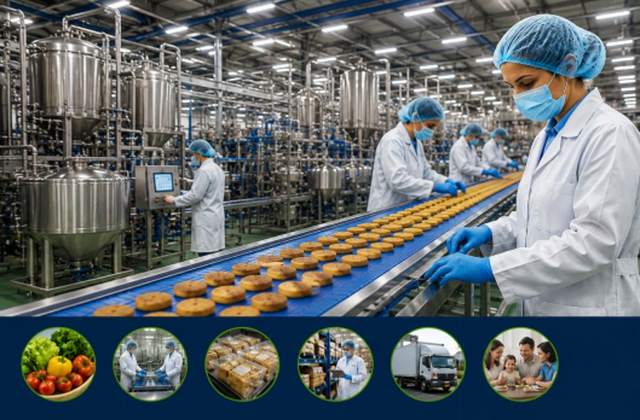
IAS auditors bring direct exposure to dairy production, food manufacturing, and hospitality supply operations. The audit reflects Qatar’s specific mix of food-security production and international hospitality demand, rather than a generic checklist. IAS also certifies related standards, including ISO 22000, ISO 9001, and HACCP. Running two schemes off one site visit saves scheduling a second audit altogether. For auditor training, IAS’s partner EAS runs the CQI-IRCA approved Lead Auditor course through the Qatar-specific pages linked above.
About the reviewer
Dr. C.D. Mohana Priya reviews a Qatar food safety audit through a distinctly laboratory-trained eye. That fits, given her over 15 years spent across clinical-lab duties, molecular-diagnostic testing, hands-on microbiology work, and, more recently, management-system implementation — all as a molecular geneticist turned Associate Professor (Research). Empowering Assurance Systems Pvt. Ltd., operating out of Chennai, issued her two separate Lead Auditor credentials — one for ISO 22000:2018, one for ISO 9001:2015 — plus an Internal Auditor credential for ISO 15189:2022. Her ISO/IEC 17025 laboratory implementation work has likewise been hands-on rather than theoretical. Classroom and live virtual formats both still feature on her ISO management-system training schedule.
Explore More
- FSSC 22000 Lead Auditor Training in Qatar — CQI-IRCA approved, delivered by EAS
- FSSC 22000 Internal Auditor Training in Qatar — EAS’s in-house curriculum
- ISO 22000 Certification — the base standard FSSC 22000 is built on
- ISO 9001 Certification — for a combined audit with FSSC 22000
- HACCP Certification — hazard analysis and critical control points
- IAS Accreditation — IAS’s global UQAS accreditation scope
- EAS — IAS’s training partner for Lead Auditor and Internal Auditor courses
Get Started with FSSC 22000 Certification in Qatar
Contact IAS for a tailored FSSC 22000 V7 quotation for your Qatari operation, or to plan a V6-to-V7 upgrade ahead of the 30 April 2028 deadline. Where training for either auditor role is also on the agenda, fold that into the same enquiry through EAS.
Phone: +971 52 873 2160
Contact page: iasiso-gulf.com/QA/contact-us/
Frequently Asked Questions
Why does dairy come up so often in discussions of FSSC 22000 in Qatar?
Domestic dairy production scaled up rapidly after 2017 as part of Qatar’s food self-sufficiency push. FSSC 22000 has become the certification that lets that domestic production show it meets international benchmarks, not just local standards.
Do hospitality suppliers in Qatar actually need FSSC 22000, or does a local food licence cover it?
A food licence covers legal operation inside Qatar. International hotel groups and event caterers frequently require GFSI-recognised certification such as FSSC 22000 on top of that, as a supplier qualification condition.
Is a Qatari producer’s existing V6 certificate still valid?
Yes, until it’s upgraded. V6 audits remain available through 30 April 2027, with full V7 adoption required by 30 April 2028.
Should a first-time Qatari applicant certify to V6 or V7?
V7. Certifying directly to the current version avoids an unnecessary near-term upgrade.
How does IAS handle audits for rapidly scaled-up dairy operations?
IAS reviews whether records and monitoring have kept pace with production capacity. That’s a common gap when a facility scales up quickly under a food-security programme.
What does FSSC 22000 certification cost in Qatar?
There’s no fixed published rate. Cost depends on category, scale, and risk profile, and a quotation follows only once IAS has been through the application.
Can an FSSC 22000 audit be combined with an ISO 9001 audit for a Qatari producer?
Yes. IAS can align audit dates so a single site visit covers both schemes.
Who accredits IAS to certify FSSC 22000 in Qatar?
UQAS (Universal Quality Accreditation Service). Its public register lets buyers and hotel groups check independently.
Where do Qatari teams get FSSC 22000 auditor training?
Through EAS’s Qatar-specific Lead Auditor and Internal Auditor pages. The Lead Auditor course is CQI-IRCA approved; the Internal Auditor course is EAS’s own curriculum.
How long does FSSC 22000 certification take for a Qatari dairy or hospitality supplier?
It depends on how developed the FSMS already is. A firm estimate waits until after IAS has been through the gap-analysis findings.
