



Qatar’s FSSC 22000 Auditors Face New Qualification Rules Under Version 7
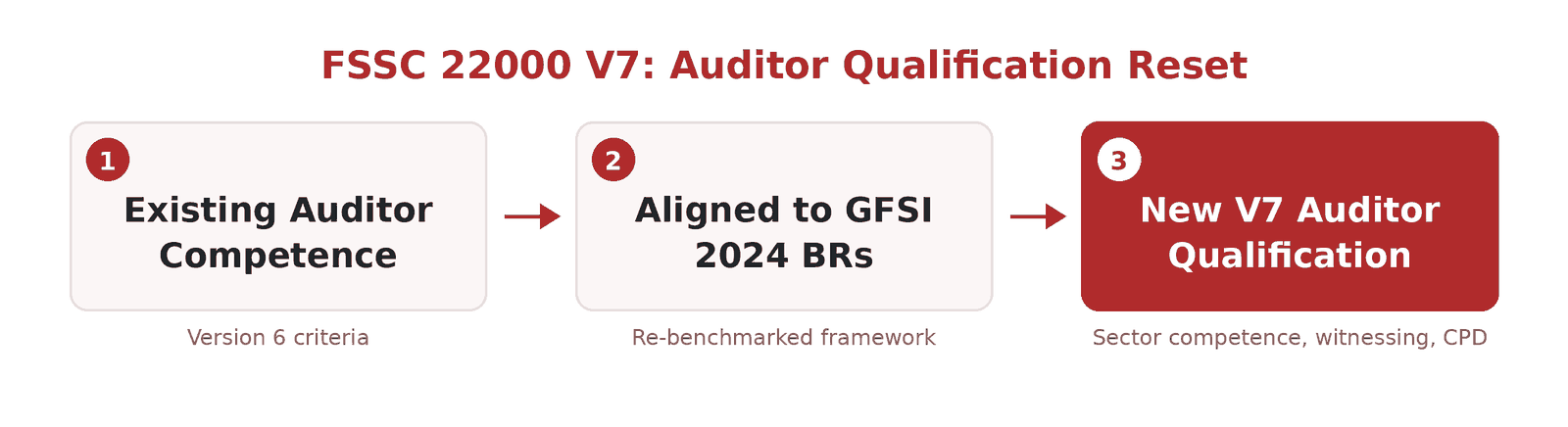
FSSC 22000 Version 7 updates auditor qualification and competence requirements to align with the GFSI Benchmarking Requirements version 2024, replacing the auditor competence criteria that applied under FSSC 22000 Version 6. For certification bodies, lead auditors and organisations planning audit dates in Qatar, this means auditors assigned to FSSC 22000 audits must meet the newer GFSI-2024-aligned qualification criteria going forward, rather than the older Version 6 competence framework. Here is what this change means in practice for Qatar-based certified organisations, and what, if anything, your own team needs to do about it.
Key Changes at a Glance
- Auditor qualification criteria under Version 7 now align with GFSI Benchmarking Requirements version 2024.
- This mainly affects certification bodies, not the internal management systems of certified organisations.
- Qatar-based sites should confirm their next assigned auditor is qualified under the updated criteria.
- Covered areas include technical sector competence, witnessed audits, and ongoing professional development.
- The change reinforces auditor credibility, which underpins GFSI recognition for the whole scheme globally.
- Internal Auditor training in Qatar is being updated to reflect similar GFSI-2024-aligned expectations.
- No direct action is required on your food safety management system because of this specific change.
What Changed in Auditor Qualification Requirements
GFSI periodically updates its Benchmarking Requirements, the overarching framework that GFSI-recognised food safety schemes like FSSC 22000 must comply with. The 2024 version of these requirements includes revised expectations for auditor competence, training and ongoing qualification maintenance. FSSC 22000 Version 7 incorporates these updated GFSI criteria directly into the scheme’s own auditor qualification requirements, replacing the Version 6 framework entirely rather than layering new criteria on top of the old one. Every GFSI-recognised scheme goes through this same re-benchmarking exercise periodically, so FSSC 22000 is not unusual in updating its auditor requirements this way.
In practice, this affects how certification bodies select, train and monitor the auditors they assign to FSSC 22000 audits — including audits in Qatar — covering areas such as technical sector competence, witnessed audit requirements, and continuing professional development. It is primarily a scheme-level and certification-body-level change rather than something a certified organisation itself needs to implement directly inside its own management system. Certification body accreditation bodies also review compliance with these criteria as part of their own oversight of certification bodies operating in the region.
The update also connects to FSSC 22000’s more clearly defined food chain category structure under Version 7, since matching auditor competence to the correct category and sub-category is one of the practical outcomes the updated GFSI-2024-aligned criteria are designed to reinforce and make more consistent across every certification body operating in Qatar and beyond.
What This Means for Certified Organisations in Qatar
If your organisation in Qatar holds an FSSC 22000 certificate, the practical effect of this change is that the auditor assigned to your next surveillance or recertification audit will need to meet the updated Version 7 and GFSI-2024 qualification criteria. You are not required to take any direct action on your own management system as a result of this specific change alone, and there is no separate paperwork or self-declaration for your organisation to complete.
It is still worth confirming with your certification body that the auditor scheduled for your Qatar site’s next visit has been qualified under the updated criteria, particularly if your audit is scheduled close to your certification body’s own transition date for applying Version 7, when both old and new qualification cohorts may still be active. This is a simple, low-effort question to raise and gives your team confidence that the audit will run smoothly.
Larger organisations in Qatar managing multiple certified sites may also want to ask their certification body how auditor reassignment is being handled across their portfolio, since not every currently assigned auditor may already hold the updated qualification at the same time. Getting this confirmed in writing ahead of a multi-site audit programme can help avoid scheduling surprises.
Why Auditor Competence Matters Under FSSC 22000
FSSC 22000 is a GFSI-recognised certification scheme built on the ISO 22000 food safety management system standard. Because GFSI recognition depends on demonstrating consistent, competent auditing across every certification body and market where the scheme operates, auditor qualification requirements are one of the most closely scrutinised parts of any GFSI benchmark revision, and one of the first things reviewed when a scheme is re-benchmarked. A scheme that cannot demonstrate consistent auditor competence risks losing the very recognition that makes its certificates valuable in the first place.
For food businesses in Qatar — including manufacturers, packaging producers and food logistics operators — a strong auditor qualification framework is part of what makes an FSSC 22000 certificate credible to international retailers and trading partners, alongside the scheme’s PRP requirements and its more clearly defined food chain category structure under Version 7. Buyers evaluating suppliers often look past the certificate itself to the credibility of the scheme behind it, which is exactly what these auditor competence requirements are designed to protect over the long term.
For a broader look at how the auditor qualification update fits alongside the rest of the Version 7 changes, our FSSC 22000 certification page for Qatar covers the complete set of updates certified and certifying organisations across the region are working through, giving Qatar-based teams the fuller context in one place.
Common Misconceptions About the Auditor Qualification Update
One misconception is that the auditor qualification change requires certified organisations in Qatar to retrain their own staff immediately. It does not — the criteria govern how certification bodies qualify the external auditors they assign, not your internal team’s qualifications, though your internal auditors do benefit from understanding the same GFSI-2024 concepts as part of their own professional development.
Another misconception is that this change signals FSSC 22000 losing or regaining GFSI recognition. It does not — FSSC 22000 remains GFSI-recognised throughout; this update simply keeps the scheme’s auditor competence criteria current with GFSI’s latest benchmarking cycle, which is a routine part of maintaining recognition rather than a response to any specific concern about the scheme.
A third misconception is treating the update as a one-time event with no ongoing relevance. In reality, GFSI-aligned competence maintenance, including continuing professional development, is an ongoing expectation for auditors under Version 7, not a single qualification checkpoint that, once passed, never needs revisiting. Certification bodies are expected to keep monitoring auditor competence throughout each auditor’s career, not just at initial qualification.
Getting Your Qatar Team Ready With IAS Gulf
Understanding the updated auditor qualification criteria is also valuable for internal auditors and quality managers in Qatar, since Internal Auditor training programmes are being updated to reflect the same GFSI-2024-aligned competence expectations that external lead auditors now need to meet.
IAS Gulf offers Lead Auditor and Internal Auditor training in Qatar that has been updated for FSSC 22000 Version 7, including these auditor qualification changes. Explore our FSSC 22000 Lead Auditor and Internal Auditor Training programmes to prepare your audit team before the transition window closes.
Qatar’s food manufacturing, packaging and logistics sectors continue to expand, and keeping pace with GFSI-aligned auditor competence requirements is part of what keeps an FSSC 22000 certificate meaningful to international buyers evaluating suppliers based in Qatar and across the wider Gulf region. Building internal familiarity with the updated criteria now, rather than reacting to it at audit time, is a straightforward way to stay ahead of the transition.
FSSC 22000 Version 6 vs Version 7: Auditor Qualification at a Glance
| Aspect | Version 6 | Version 7 |
|---|---|---|
| Governing framework | Pre-2024 GFSI Benchmarking Requirements | GFSI Benchmarking Requirements version 2024 |
| Technical sector competence | Matched to broader category definitions | Matched to the more clearly defined Version 7 category and sub-category structure |
| Witnessed audit requirements | Version 6 witnessing criteria | Updated witnessing criteria aligned with GFSI 2024 |
| Continuing professional development | Version 6 CPD expectations | Updated CPD expectations aligned with GFSI 2024 |
| Who is directly affected | Certification bodies and their auditors primarily | Certification bodies and their auditors; certified organisations confirm indirectly |
| Certified organisation action | Not applicable | Confirm assigned auditor meets updated criteria; no management system change required |
Note: exact FSSC 22000 Version 6 to Version 7 transition and cascade dates should be confirmed directly with your certification body.
About the author
Adekoya Oluwatosin is a food safety consultant, trainer and FSSC 22000 v6 Lead Auditor with over eight years of hands-on experience across food manufacturing, packaging, storage and distribution, and catering. She has personally conducted more than 22 internal audits — including FSSC 22000 and ISO 9001:2015 audits — and led FSMS/QMS implementation projects that guided over ten organisations to certification.
Frequently Asked Questions
What changed in FSSC 22000 Version 7 auditor qualification requirements?
Auditor qualification and competence criteria were updated to align with the GFSI Benchmarking Requirements version 2024, replacing the criteria used under Version 6. This affects how certification bodies qualify their auditors.
Do certified organisations in Qatar need to do anything about the auditor qualification change?
No direct action is required on your management system; the change affects how certification bodies qualify and assign auditors to your future audits, not your own procedures.
Is this the same as GFSI recognition changing for FSSC 22000?
No. FSSC 22000 remains GFSI-recognised; this change specifically updates auditor competence criteria to keep pace with GFSI’s 2024 Benchmarking Requirements, a routine part of maintaining that recognition.
How do I know if my next auditor in Qatar meets the updated criteria?
Ask your certification body directly to confirm the auditor assigned to your next audit has been qualified under the Version 7 / GFSI-2024 criteria before the visit.
Where can Qatar-based auditors get updated on the Version 7 qualification criteria?
IAS Gulf’s Lead Auditor and Internal Auditor training programmes in Qatar cover the updated FSSC 22000 Version 7 auditor qualification requirements in full.
Do auditors already qualified under Version 6 need to be re-qualified from scratch in Qatar?
No — auditors typically need to demonstrate they meet the updated GFSI 2024-aligned competence criteria rather than restart their qualification, though certification bodies serving Qatar verify this before assigning them to Version 7 audits.


