


Course Aim – ISO 14001 Lead Auditor Training
This course aims to provide participants with the necessary knowledge and skills to perform first, second, and third-party audits of an Environmental Management System against the requirements of ISO 14001.
This course will provide participants with a thorough understanding of all aspects of EMS auditing — including how to plan and execute audits, evaluate compliance and non-compliance, and prepare audit reports. With ISO 14001:2026 officially published on April 15, 2026, this training has been fully updated to ensure every Bahrain delegate audits against the current standard from day one.
EAS is a sister organization of IAS that offers IRCA certified ISO 14001 lead auditor training in Bahrain. The training is given by expert auditors who have vast experience in conducting audits as well as teaching the course.
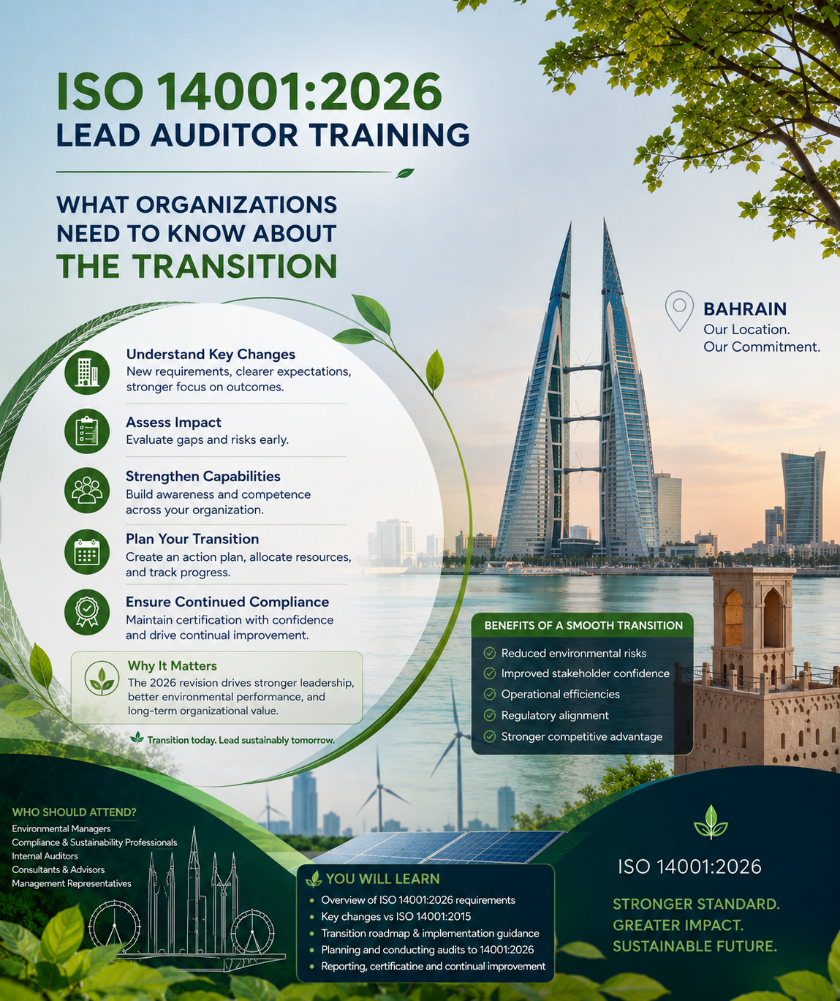
Why ISO 14001 Lead Auditor Training in Bahrain?
ISO 14001 is a widely used standard that defines the requirements for establishing and managing an Environmental Management System (EMS). As such, it is essential for organizations in all industries to have trained environmental auditors who are capable of effectively assessing compliance with ISO 14001 and identifying any areas where improvements can be made.
Lead auditor training provides participants with the knowledge they need to properly evaluate an organization’s compliance with ISO 14001. The course covers a range of topics including environmental management systems, environmental impact assessments, and auditing approaches. With ISO 14001:2026 now published, Bahrain lead auditors must also be equipped to assess mandatory new requirements — including climate change, biodiversity, and ESG alignment — that were absent or optional under ISO 14001:2015.
What ISO 14001:2026 Introduces That Every Bahrain Lead Auditor Must Know?
The publication of ISO 14001:2026 on April 15, 2026 fundamentally changes what lead auditors in Bahrain are expected to assess during every EMS audit. Auditors continuing to operate solely under ISO 14001:2015 knowledge will be unable to conduct fully compliant audits — creating professional and organizational risk for both the auditor and the client.
For Bahrain’s dominant industries — oil and gas, construction, financial services, logistics, and manufacturing — the new mandatory requirements introduced by ISO 14001:2026 directly expand the lead auditor’s scope and evidence-gathering obligations.
Key ISO 14001:2026 changes every Bahrain lead auditor must understand and be trained on:
- Climate change is now a mandatory environmental aspect — Bahrain lead auditors must verify that organizations formally assess, document, and manage climate-related risks and opportunities within their EMS planning processes — directly relevant to Bahrain’s Net Zero 2060 national commitments
- Biodiversity and ecosystem protection are formally included as standalone requirements under ISO 14001:2026 — lead auditors working with Bahrain industries operating near Arabian Gulf marine environments, coral reef ecosystems, and coastal zones must now assess and verify biodiversity impact documentation
- Life cycle thinking requirements are strengthened, extending lead auditor scope beyond the organization’s own facility to GCC supply chains, procurement decisions, and end-of-life product environmental impacts that organizations are now formally accountable for managing
- ESG alignment is directly integrated into ISO 14001:2026 — Bahrain lead auditors must evaluate whether organizations connect EMS performance data to Bahrain Bourse ESG reporting obligations and international investor disclosure expectations
- Enhanced stakeholder reporting obligations require lead auditors to assess whether environmental performance communication is structured, consistent, and externally verifiable — not simply present in a documented procedure
- Leadership accountability requirements are elevated, requiring lead auditors to gather and evaluate direct evidence of active top management involvement in EMS outcomes across every audited Bahrain organization
Benefits of ISO 14001 Lead Auditor Training in Bahrain
- Understand the requirements for an effective environmental management system aligned to the newly published ISO 14001:2026 standard
- Learn how to lead an audit team and conduct an audit in accordance with international standards including ISO 19011 and ISO 14001:2026
- Gain the skills necessary to assess an organization’s compliance with environmental regulations across Bahrain and the GCC region
- Build your knowledge and expertise of best practices for managing environmental issues in a wide range of Bahrain industries including oil and gas, construction, logistics, and manufacturing
- Develop the ability to identify opportunities for environmental improvement within an organization under both current and transition audit scenarios
- Enhance your career prospects and earning potential by becoming a recognized expert in ISO 14001:2026 environmental management systems auditing
Who Can Attend?
This course is ideal for environmental professionals who wish to develop their skills in auditing environmental management systems. Such as:
- Environmental managers and consultants
- Environmental engineers and technicians
- Quality managers and professionals
Pre-Requisites
Attendees who wish to pursue our ISO 14001 lead auditor training in Bahrain are strongly recommended to have a firm understanding of environmental management systems and auditing principles. It will be beneficial if attendees have prior work experience in an organization that has implemented an EMS.
Course Duration and Delivery Method
The ISO 14001 lead auditor training is conducted in Bahrain as a full-time course for 5 days (40 hours) and offers both continuous and weekend-based courses.
The ISO 14001 lead auditor training in Bahrain is delivered using Google Meet or Zoom meetings with tutor-led sessions. Our expert lead auditors will give interactive course lectures throughout the training program to help you prepare for the IRCA ISO 14001:2026 lead auditor examination, which will take place on the last day of the course.
To obtain this well-known professional credential, students must pass the lead auditor exam with at least 70 percent marks.