


Internal auditing in a cGMP environment is mostly reading. cGMP internal auditor training equips quality and production staff to do that reading properly. They learn how a record was created and how to test it against what actually happened on the floor. They also learn to recognise when a complete-looking document describes something that never took place as written.
Documentation is where most internal audits spend most of their time, and where most findings originate. It is also the area where auditors are most easily satisfied by appearances. A file with every box filled and every line signed looks like control. Whether it is control depends on when those entries were made, by whom, and against what.

Training a team in Bahrain? Contact us with your site, product categories and group size for a delivery proposal.
What cGMP internal auditor training covers
The course builds the ability to audit your own employer against GMP and cGMP requirements, and against the documented system the company operates to.
The “c” in cGMP stands for current, and documentation is where that word does most of its work. A procedure may no longer describe the process. A form may capture data nobody uses, or a record may be retained without anyone reading it. Each case is a quality system drifting away from the operation it is supposed to control. Internal audit is how that drift is found.
Participants learn the full audit method — planning, checklists, evidence, findings, reporting and follow-up — with particular depth on documentation and record review. Bringing in an outside body to assess the site is a different undertaking, described on the cGMP certification in Bahrain page.
Where records go wrong
A record has a life, and problems enter at identifiable points along it.
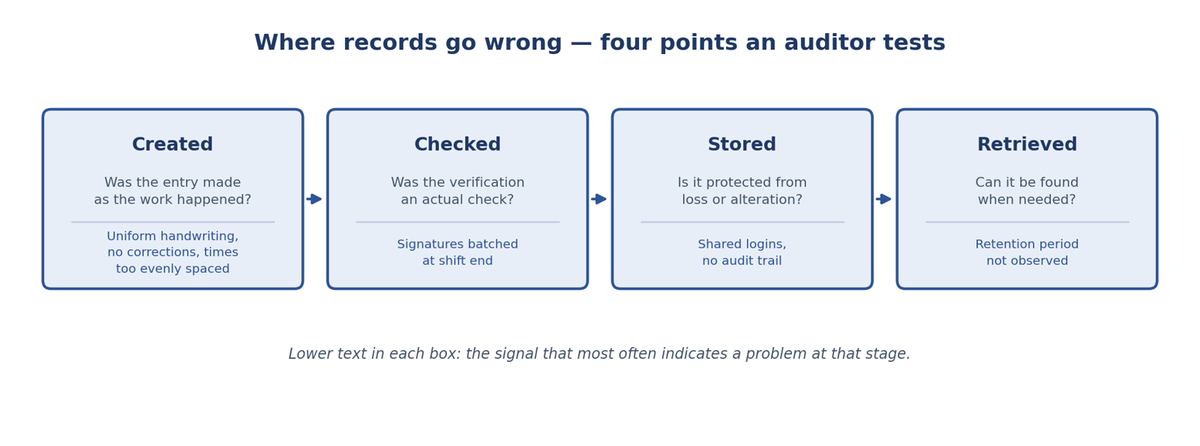
At creation: was the entry made as the work happened?
Entries completed afterwards — at shift end, from memory, from a scrap of paper — are the single most common documentation weakness, and they are detectable. Uniform handwriting across a whole batch, entry times too evenly spaced, or a complete absence of corrections in a document spanning months all point the same way.
At the check: was the verification real?
A second signature means someone confirmed something. If that person signed twenty records together at the end of the day, the signature exists and the check does not.
In storage and retrieval
The questions here are simpler but still worth asking: can the record be found when needed, is it protected from loss or alteration, and is the retention period being observed.
Attributes an auditor tests
The ALCOA attributes give auditors a practical vocabulary for record quality, and the training uses them as a working checklist rather than as theory.
| Attribute | The question it asks | What a weakness looks like |
|---|---|---|
| Attributable | Who made this entry? | Shared logins, unsigned entries, initials nobody can identify |
| Legible | Can it still be read? | Overwritten figures, correction fluid, faded thermal prints |
| Contemporaneous | Was it recorded when the work happened? | Entry times clustered at shift end; batch records completed the next day |
| Original | Is this the first record, or a transcription? | Data written on a loose sheet then copied into the log |
| Accurate | Does it reflect what actually occurred? | Values that disagree with the equipment printout or the production schedule |
Electronic records and data integrity
Electronic records raise the same data integrity questions in a different form. Instead of handwriting, the auditor looks at access control and at the audit trail. The questions are whether the trail is enabled and reviewed, and whether values can be altered without a trace. The auditor also checks whether spreadsheets used for calculations are controlled or sitting on a shared drive with no version history.
Documents versus records
The distinction sounds academic and is not. Auditors examine both, but for different reasons.
| Documents | Records | |
|---|---|---|
| What they are | Instructions — SOPs, specifications, methods, forms | Evidence — completed batch records, logs, certificates, test results |
| The audit question | Is the current version controlled, approved and in use at the point of work? | Was this completed properly, at the time, by someone authorised? |
| Typical finding | The version at the workstation is not the version in the register | Entries made retrospectively, or a required verification missing |
| Where to look | Document register, workstation copies, revision history | The completed files themselves, sampled across a period |
A frequent audit failure is checking one and assuming the other. A perfectly controlled SOP system tells you nothing about whether the SOPs are followed; immaculate batch records tell you nothing about whether they were completed against the current method.
What an internal auditor does
Documentation review does not happen in isolation. The auditor reads the procedure, watches the corresponding activity, examines the records that should describe it, and asks the person performing the work to explain it. Records are strongest as evidence when they can be compared against something observed.
Findings are recorded with references — document number and revision, batch or lot numbers sampled, dates, equipment identifiers — and worded as requirement, then evidence, then gap. Individuals are not named. A record completed late is a system finding about how and when documentation is captured, not a complaint about the person who signed it.
Who should attend cGMP internal auditor training
| Participant | Relevance of the documentation focus |
|---|---|
| QA officers and managers | Own the document control and record retention systems |
| QC and laboratory personnel | Test records, worksheets and instrument data face the closest examination |
| Production supervisors | Batch records and logbooks are completed under their supervision |
| Engineering and maintenance | Calibration certificates and maintenance logs are audited routinely |
| Warehouse and materials staff | Receipt records, status labels and storage logs carry traceability |
| IT and systems staff | Access control and audit trails on electronic records |
| Compliance and regulatory staff | Add record-review technique to requirements knowledge |
| Contract manufacturers | Client audits concentrate heavily on documentation |
Prior audit experience is not required. Employees working within a GMP system apply the material immediately; anyone new to manufacturing quality is better placed after a cGMP foundation course. Teams auditing to other standards alongside cGMP can look at the wider ISO internal auditor training range on this site.

Skills participants develop
- Reading a procedure critically and identifying what in it is auditable
- Distinguishing a document from a record and auditing each appropriately
- Checking that the version at the workstation matches the controlled version
- Recognising entries made retrospectively rather than as work happened
- Testing whether a verification signature represents an actual check
- Applying the ALCOA attributes as a practical review method
- Examining electronic records for access control and audit-trail weaknesses
- Identifying uncontrolled spreadsheets used for calculations or decisions
- Sampling records across a period rather than from the top of the file
- Wording documentation findings against the system rather than the signer
What sites gain
Documentation problems are cheap to fix and expensive to leave. A form may not match the process. A verification step may be one nobody can realistically perform, or a logbook may duplicate another log. Each of these quietly degrades until an external auditor or a customer finds it.
There is also a behavioural effect worth naming. When people know records are read carefully rather than filed, records improve. That change is not something an audit programme can claim as a finding, but it is often the largest benefit a site gets from training its own auditors properly.
Wider background on manufacturing-quality requirements appears in the IAS overview of GMP certification and the guide on how to get GMP certification.
Training and certification
| cGMP internal auditor training | cGMP certification | |
|---|---|---|
| Applies to | Individual employees | The company and its manufacturing site |
| Audit type | First-party, internal | Third-party, independent |
| Result | Trained auditors and a training record | A certificate covering a defined scope |
| Continues as | An internal audit programme | Surveillance and recertification |
Trained internal auditors help sustain a certified system. Completing a course does not certify a company, and holding a certificate does not remove the requirement to audit internally.
cGMP internal auditor training in Bahrain: course details
Course duration and fees for cGMP internal auditor training in Bahrain are confirmed once the delivery route is agreed, since in-house, live online and self-paced routes differ. Each participant completing the course receives a certificate of completion, itself a record an assessor expects to find in the training file. Upcoming open sessions are listed on the IAS training schedule.
Drafting the audit report is included, with practice in wording a documentation finding that holds up under challenge. Reaching the root cause of a repeat issue, without naming the signer, is covered as well.
- Objective. Enable participants to plan, conduct, report and follow up internal audits of GMP and cGMP quality systems, with practical competence in documentation and record review.
- Coverage. GMP and cGMP fundamentals; criteria and scope; audit planning and checklists; document control versus record review. Contemporaneous completion; verification signatures; the ALCOA attributes; electronic records, audit trails and access control. Observation and interviewing; nonconformity classification; findings and reporting; corrective-action review and verification; auditor conduct.
- Outcomes. Participants should be able to audit a document control system and a body of records. They should recognise retrospective completion and weak verification, and examine electronic records for integrity weaknesses. They should also word documentation findings factually and verify corrective actions.
Delivery formats
Classroom, live online, self-paced study, and delivery at your own site. Record review is best learned on real files, so in-house delivery lets a group examine their own documentation under guidance. Where that is impractical, online cGMP internal auditor training and virtual cGMP training cover the same material; the syllabus is set out on the IAS GMP internal auditor training page. Other standards run through the same ISO training programme.
Let us know the site, the product categories and how many people need training, and we will propose a format. One thing should not be left implied: IAS trains auditors and certifies management systems. Whether a facility may operate, and whether a product may be sold, are questions only regulators answer.
Ready to book? Contact the IAS Bahrain team with your group size and preferred delivery route.
Frequently asked questions
How many records should be sampled in a documentation review?
Enough to represent the period rather than the most recent week, with the sample defined before the review begins and widened as soon as an exception appears. Records nearest the top of a file are usually the best kept, so a sample drawn only from there gives a flattering and inaccurate picture.
What if the SOP itself is wrong rather than the record?
That is a more significant finding, not a lesser one. A procedure that does not describe the actual process means every record completed against it is questionable, and it points at document control and change management rather than at documentation practice. The course covers how to word this so the investigation looks at the right system.
Should an auditor take copies of records as evidence?
Rarely, and only with agreement. Referenced notes — document number and revision, batch numbers, dates, what was observed — are normally sufficient and avoid creating uncontrolled copies of controlled records circulating outside their system. Where a copy genuinely is needed, it is agreed with the area, marked as an audit copy, and destroyed once the finding is closed.
Can an internal auditor audit their own department or their own records?
No. Internal audit depends on the auditor being independent of the activity under review, which is why sites usually train people across several functions and pair them across departments. Someone from QC can audit production documentation and vice versa; nobody audits records they completed or approved themselves.
Is every documentation finding a nonconformity?
No. Findings are classified, and the classification is part of what the training covers. A record that does not meet a stated requirement is a nonconformity, graded by how far the system is affected. A practice that meets the requirement but is likely to fail later is normally raised as an observation or opportunity for improvement, so that it is tracked without overstating what was found.
What should an auditor do when a record cannot be produced during the audit?
Record what was requested, when, and what was provided instead, then continue rather than waiting. An unavailable record is itself evidence about storage and retrieval, and the finding is written against the retrieval system. If the record surfaces before the report closes, that is noted along with how long retrieval actually took.
How often should internal audits be carried out once a site has trained its own auditors?
The frequency is set by the site’s own audit programme rather than by a fixed rule, and it is planned so that every process and every part of the quality system is covered within the cycle the site defines. Areas with recent findings, process changes or higher risk are normally scheduled more often than stable ones.
Who receives the internal audit report, and what happens after it is issued?
The report goes to the area audited and to the management responsible for it, and the findings enter the site’s corrective-action system. Each one is investigated for cause, an action is agreed with a responsible owner and a date, and the auditor later verifies that the action was implemented and worked. A finding is closed on evidence, not on a promise.