



Bahrain’s FSSC 22000 Auditor Courses Just Got a Version 7 Refresh
FSSC 22000 Version 7 Lead Auditor and Internal Auditor training in Bahrain now covers a genuinely different curriculum than Version 6 courses, built around updated auditor competence criteria, new prerequisite programme references, and the scheme’s new sustainability and AI governance requirements. Food safety professionals in Bahrain searching for FSSC 22000 Version 7 training are looking for a course that has actually been rebuilt around these changes, not a Version 6 programme with a new label pasted on top. Here is what a genuine Version 7 course covers, and how to choose the right one in Bahrain for your role and your organisation.
Key Changes at a Glance
- Version 7 training must cover GFSI-2024-aligned auditor qualification and competence criteria in depth.
- Courses need to walk through the shift from ISO/TS 22002-x to ISO 22002-x:2025 PRP references.
- New Food Loss & Waste and ‘Save Food Packaging’ content belongs in any real Version 7 course.
- The new AI governance requirement needs its own explanation, since no earlier version addressed it.
- Lead Auditor and Internal Auditor tracks in Bahrain serve different roles and different audiences.
- Much of the generic Version 7 training available online is global and not localised to Bahrain’s audit landscape.
- Bahrain-based food manufacturers should train both internal auditors and lead auditor candidates ahead of their next audit.
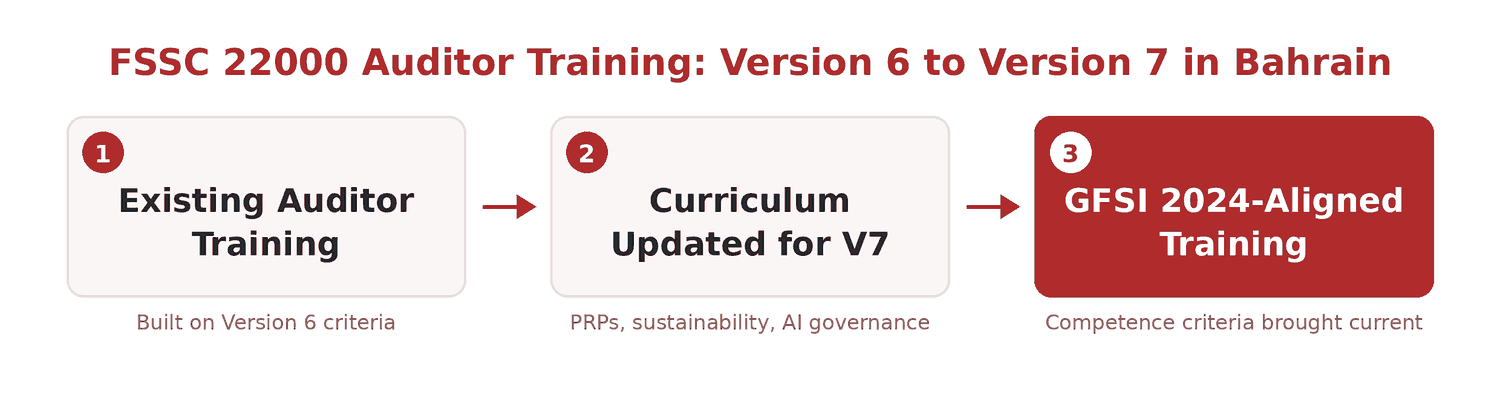
What Separates Real Version 7 Training From a Relabelled Version 6 Course
A genuine FSSC 22000 Version 7 course goes well beyond renaming a Version 6 programme. It needs to walk trainees through the updated auditor qualification and competence criteria, which are now aligned with the GFSI Benchmarking Requirements version 2024, and explain how these affect both lead auditors conducting third-party certification audits and internal auditors running an organisation’s own internal audit programme. A course that only touches on this briefly leaves trainees under-prepared for how audits are actually run under Version 7, and can leave a lead auditor candidate unable to explain scheme requirements accurately to a client.
It should also cover the shift in prerequisite programme references from the older ISO/TS 22002-x series toward the newer ISO 22002-x:2025 series of sector-specific standards, since PRP verification sits at the core of every FSSC 22000 audit. A course that skips this shift leaves trainees unable to correctly assess PRP compliance against the standard their next audit will actually use, which defeats much of the point of taking Version 7 training in the first place.
Finally, Version 7-specific training needs to address the scheme’s new Food Loss & Waste and ‘Save Food Packaging’ sustainability expectations, along with the new requirement that any AI used in certification-related activity be governed by an ethical, fair and compliant framework. These are entirely new subject areas that did not exist in any Version 6 curriculum, so trainees cannot simply rely on prior Version 6 knowledge here.
Lead Auditor vs. Internal Auditor Training for Version 7 in Bahrain
Lead Auditor training in Bahrain is aimed at professionals who plan to conduct or lead third-party FSSC 22000 certification audits, or who need certification-body-recognised auditor credentials reflecting the updated Version 7 competence criteria. This track is typically more intensive, covering audit planning, evidence-gathering and reporting to the standard a certification body expects from someone leading an external audit, in addition to the Version 7 content itself.
Internal Auditor training, by contrast, is built for staff inside a certified organisation — quality managers, food safety team members and site auditors — who need to run a compliant internal audit programme against the Version 7 requirements ahead of their site’s next external audit. Both course types matter for Bahrain-based food manufacturers, packaging producers and logistics operators, since a strong internal audit programme is typically the first line of defence in catching gaps before the external auditor arrives on site.
If you are unsure which track your team needs, our FSSC 22000 certification page for Bahrain outlines the broader set of Version 7 changes both audiences need to understand, which can help you decide whether your priority right now is external audit readiness, internal programme strength, or a combination of both.
Why Country-Specific Version 7 Training Matters in Bahrain
Much of the FSSC 22000 Version 7 training content available online is generic and global in scope, without reference to how the transition timeline, local certification body scheduling, or regional audit practices actually apply to Bahrain. A course delivered by a trainer familiar with Bahrain’s food manufacturing and certification landscape can connect the Version 7 changes directly to how audits are scheduled and conducted locally, rather than leaving trainees to work that out for themselves afterwards. This is especially useful for staff who have never sat through an FSSC 22000 audit before and need practical context, not just theory.
FSSC 22000 itself remains a GFSI-recognised scheme built on the ISO 22000 base standard, so good training reinforces that foundation while layering in exactly what has changed for Version 7, rather than re-teaching the whole scheme from scratch to auditors who already hold Version 6 qualifications and simply need an update. This targeted approach respects the time of experienced professionals while still covering every substantive change in full.
For Bahrain’s food sector specifically — spanning manufacturing, packaging and distribution — localised training also means trainees can ask questions about how the update affects their specific facility type, something a purely global, pre-recorded course cannot address in the same way. Live, locally delivered training also allows trainees to raise real scenarios from their own facilities during the course itself.
Common Mistakes When Choosing a Version 7 Course
One common mistake is enrolling in a course simply because it has ‘Version 7’ in the title without confirming the syllabus actually covers the updated auditor competence criteria, PRP references and new sustainability and AI governance content in any real depth. Asking to see a syllabus outline before enrolling is a reasonable request and a quick way to check.
Another mistake is assuming Lead Auditor training alone is sufficient preparation for a whole organisation. Internal auditors need their own Version 7-specific training too, since they are the ones who will identify gaps in day-to-day operations long before an external audit occurs, often months in advance. Overlooking this group leaves a genuine blind spot in an organisation’s audit readiness.
A third mistake is delaying training until close to the next scheduled audit. Because Version 7 introduces genuinely new subject areas, trainees benefit from having time to apply what they learn — reviewing PRP documentation and sustainability procedures — rather than absorbing it all at once under audit pressure with little chance to act on it.
Getting Your Bahrain Team Ready With IAS Gulf
Certified organisations in Bahrain should plan to have both their internal auditors and any lead auditor candidates briefed on the Version 7 changes well before their next scheduled surveillance or recertification audit, so the transition happens smoothly rather than under time pressure at the last minute.
IAS Gulf delivers FSSC 22000 Lead Auditor and Internal Auditor training in Bahrain that has been updated for Version 7, covering the auditor qualification, PRP, sustainability and AI governance changes in full. Both course pages are linked above — book your team in before the transition window closes.
Bahrain’s food manufacturing base spans multinational operators and smaller domestic producers alike, and both benefit equally from Version 7 training that translates the scheme’s global updates into practical, day-to-day audit preparation steps their teams can actually follow. Booking training well ahead of your next scheduled audit gives trainees time to apply what they learn rather than absorbing it all at once.
FSSC 22000 Version 6 vs Version 7: Training Content at a Glance
| Aspect | Version 6 | Version 7 |
|---|---|---|
| Auditor competence criteria | Based on pre-2024 GFSI Benchmarking Requirements | Aligned with GFSI Benchmarking Requirements version 2024 |
| PRP standard references | ISO/TS 22002-x series | ISO 22002-x:2025 series |
| Sustainability content | Not covered in the curriculum | Food Loss & Waste and ‘Save Food Packaging’ design-principle content included |
| AI governance content | Not covered in the curriculum | New module on ethical, fair and compliant AI governance |
| Food chain category content | General category overview only | Clearer category and sub-category definitions covered in depth |
| Course audience | Lead Auditor and Internal Auditor tracks based on Version 6 criteria | Both tracks rebuilt around Version 7 competence and content requirements |
Note: exact FSSC 22000 Version 6 to Version 7 transition and cascade dates should be confirmed directly with your certification body.
About the author
Adekoya Oluwatosin is a food safety consultant, trainer and FSSC 22000 v6 Lead Auditor with over eight years of hands-on experience across food manufacturing, packaging, storage and distribution, and catering. She has personally conducted more than 22 internal audits — including FSSC 22000 and ISO 9001:2015 audits — and led FSMS/QMS implementation projects that guided over ten organisations to certification.
Frequently Asked Questions
What is FSSC 22000 Version 7 training?
It is Lead Auditor or Internal Auditor training updated to cover Version 7’s changes, including new PRP standard references, GFSI 2024-aligned auditor competence criteria, and the new sustainability and AI governance requirements. A genuine Version 7 course teaches all of these together.
Is FSSC 22000 Version 7 training different from Version 6 training?
Yes. Version 7 training adds content on the updated auditor qualification criteria, revised PRP standards, food chain category clarifications, and new sustainability and AI governance clauses that did not exist under Version 6. A relabelled Version 6 course will not cover these areas.
Do I need Lead Auditor or Internal Auditor training for FSSC 22000 Version 7?
Lead Auditor training suits those conducting or leading certification audits, while Internal Auditor training suits staff running an organisation’s internal audit programme; many certified sites in Bahrain need both roles trained.
How do I know if a Version 7 course is actually updated?
Check that the syllabus explicitly covers GFSI 2024-aligned auditor competence, the ISO 22002-x:2025 PRP references, and the new sustainability and AI governance requirements, rather than just a renamed Version 6 course with a new title.
Where can I get FSSC 22000 Version 7 training in Bahrain?
IAS Gulf offers Bahrain-based Lead Auditor and Internal Auditor training courses updated to reflect the full set of FSSC 22000 Version 7 changes, for both external and internal auditor roles.
How far ahead of an audit should a Bahraini team book Version 7 training?
Far enough ahead that trainees can act on what they learn — reviewing PRP documentation and sustainability procedures before the auditor arrives, rather than sitting the course in the weeks immediately before the visit.


