


Independent third-party cGMP certification for manufacturers, packers and distributors operating in Bahrain — scoped to your products, audited against the applicable GMP/cGMP scheme, and backed by a fixed written quotation. Pharmaceuticals, nutraceuticals, food, cosmetics, or another product line entirely: IAS scopes the audit to fit.
- UQAS-accredited certification body
- Fixed written quotation, no hidden fees
- Certification scoped to a named scheme, not a generic label
- Open to every industry, not just pharma and food
Ready to scope your certification? Talk to the IAS Bahrain team and get a fixed written quotation — contact us.
At a glance
- Scope: audited against the applicable GMP/cGMP scheme for your product category, stated by name on the certificate itself — never a generic “cGMP” label.
- Eligible industries: pharmaceuticals, nutraceuticals, food, cosmetics, medical devices, and any other manufacturing, processing or handling operation.
- Certification cycle: initial audit, certificate issue, annual surveillance, then recertification.
- Pricing: one fixed written quotation once your facility and product lines are understood — no fixed price list, no hidden fees.
- Accreditation: IAS carries UQAS accreditation, and certifies under it.

Bahrain’s diversifying economy — beyond banking
Manama’s financial district still anchors Bahrain’s reputation, but the Kingdom has steadily widened into logistics, food processing, downstream aluminium, and pharmaceutical manufacturing and distribution.
- Geography helps. Khalifa Bin Salman Port and Bahrain International Airport sit close to production sites, giving manufacturers straightforward access to Saudi Arabia and the wider Gulf.
- Free zones lower the barrier. Low-cost setup has made the Kingdom attractive to manufacturers who might otherwise locate elsewhere in the region.
- New sectors have grown in. Halal food processors, contract packagers, nutraceutical blenders, and pharmaceutical repackaging and distribution operations.
- Certification backs the claim. For a facility competing on “made or handled in Bahrain, sold across the GCC,” a recognised GMP certificate is tangible third-party evidence, not a self-declared quality statement.
cGMP certification in Bahrain is not restricted to pharmaceuticals or food. Packaging converters, chemical blenders, animal feed producers, warehousing and logistics operators, and contract manufacturers across sectors can all apply. Each scopes certification to the products it actually handles.
cGMP meaning: what GMP and cGMP actually require
GMP (Good Manufacturing Practice) is a set of quality-system principles for consistent, controlled production. cGMP simply adds “current” — signalling that those principles should reflect present-day methods and technology, not a fixed historical checklist.
- Frameworks referenced. US FDA 21 CFR is relevant only to products entering the US market. The WHO GMP guidelines are a reference model many regulators and exporters draw on, and the PIC/S GMP Guide is followed by pharmaceutical regulators across dozens of countries. ISO 22716 is the cosmetics-specific GMP standard.
- Not one rulebook. A Bahraini contract manufacturer producing nutraceuticals for GCC export, a pharmaceutical repackager, and a cosmetics blender are not measured against the same rulebook. All three might still describe their target as “cGMP certification.”
- Named scheme, defined scope. IAS certification is always issued against a named scheme and a defined scope — stated on the certificate itself — rather than as a generic “cGMP” label with no reference point.
GMP vs cGMP — where the difference actually sits
The practical difference is currency. cGMP expects the same core quality controls as GMP. It assesses them against methods, equipment and data practices considered current at the time of audit, not practices acceptable a decade earlier. In pharmaceutical contexts this often extends to data integrity and computerised system controls; in lower-risk categories, the day-to-day gap is often narrower.
| Aspect | GMP | cGMP |
|---|---|---|
| Core intent | Documented, controlled, repeatable manufacturing | Same intent, measured against present-day practice |
| Technology expectation | Baseline systems and controls | Systems expected to reflect current industry norms |
| Typical use in Bahrain | Generic quality-system reference across sectors | More commonly invoked in pharma and nutraceutical scopes |
| Certification basis | Always tied to a named scheme and scope | Always tied to a named scheme and scope |
Not sure which scheme applies to your products? Contact us for a free scoping conversation.
Who does what: NHRA, BSMD, WHO, US FDA and IAS
A recurring point of confusion for Bahraini manufacturers is which body actually does what. Each plays a distinct, non-overlapping role.
| Body | Role in Bahrain / globally |
|---|---|
| National Health Regulatory Authority (NHRA) | Bahrain’s statutory regulator for pharmaceutical registration, manufacturing licensing and GMP inspection of licensed drug manufacturing and healthcare facilities operating in the Kingdom. |
| Bahrain Standards and Metrology Directorate (BSMD) | Under the Ministry of Industry, Commerce and Tourism; sets and administers national standards and conformity requirements for broader product categories such as food and consumer goods. |
| World Health Organization (WHO) | Publishes GMP guidelines used as a reference model worldwide. WHO does not regulate, inspect or certify any individual facility. |
| US Food and Drug Administration (US FDA) | Regulates products sold into the United States only. It has no jurisdiction over Bahraini domestic or GCC-export production and issues no certificates through third parties anywhere. |
| IAS | An independent third-party certification body. IAS assesses a facility against the applicable GMP/cGMP scheme and issues certification; it does not license, register or grant regulatory market access. |
- Not a substitute for NHRA or BSMD. An IAS certificate is a statement that a facility was assessed against a defined GMP/cGMP scheme and scope by an independent body — it never substitutes for NHRA licensing or BSMD conformity marking.
- Runs alongside, not in place of. Certification runs alongside regulatory obligations, not instead of them.
No single rulebook: how cGMP requirements differ by product category
Food, cosmetics, pharmaceuticals and medical devices are governed by different risk logic, so they do not share one identical cGMP framework. The exact scope is always confirmed against the client’s actual products before an audit is scoped.
| Product category | Frameworks commonly referenced |
|---|---|
| Pharmaceuticals | WHO GMP guidelines, PIC/S GMP Guide, NHRA licensing requirements where a drug manufacturing licence applies |
| Food and beverage / nutraceuticals | Codex Alimentarius GMP principles, WHO GMP guidance where product overlaps with health products |
| Cosmetics and personal care | ISO 22716 cosmetics GMP standard |
| Medical devices | ISO 13485 quality management requirements, device-specific GMP elements as applicable |
| Other manufacturing (packaging, chemicals, feed, contract packing, warehousing) | Scheme selected to match the client’s product family and buyer requirements — no single default framework applies |
A certificate for a nutraceutical line does not automatically extend to a cosmetics line at the same facility — certification scope always names both the standard and the product line it covers. Facilities with a medical-device line can pair this with ISO 13485 certification in Bahrain.
The IAS certification pathway for a Bahraini facility
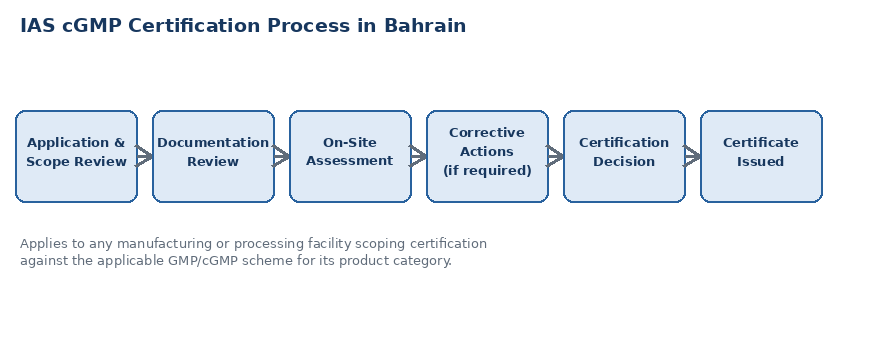
The route to certification follows a consistent sequence, though the specific evidence reviewed depends on the scheme and product category involved. The general shape of the assessment is set out in the IAS certification process.
- Application and scope review — confirming the applicable scheme, product category and site(s) to be covered.
- Documentation review — assessing quality-system records such as the quality manual, SOPs, batch or production records, CAPA and change-control logs, and validation records, as applicable.
- On-site assessment — auditors examine facility conditions, process controls and records against the applicable scheme, depending on category.
- Corrective actions — where nonconformities are identified, the facility addresses them before certification proceeds.
- Certification decision and issuance — once conformity is confirmed, the certificate is issued naming the scheme and scope assessed.
Areas typically examined during an on-site assessment — again, depending on the applicable scheme and product category:
- Facility layout and hygiene controls
- Equipment qualification
- Raw-material handling
- In-process and finished-product testing arrangements
- Labelling controls and record-keeping practices
None of these is a universal checklist; the actual scope is confirmed against the scheme selected.
Documentation an auditor will typically ask to see
What gets reviewed depends on the scheme and the product category, not a single universal document list. A facility new to formal certification does not need every item in place before the first conversation with IAS. Documentation gaps are a normal finding to work through during preparation. They are not a disqualifying condition.
| Document type | Typical purpose |
|---|---|
| Quality manual | Describes the facility’s overall quality-management approach and how it maps to the applicable scheme. |
| Standard operating procedures (SOPs) | Written instructions for controlled processes, calibration, cleaning and handling steps, where the scheme requires them. |
| Batch or production records | Traceable evidence of what was produced, when, and under what conditions — most relevant to pharmaceutical and food schemes. |
| Corrective and preventive action (CAPA) records | Evidence that identified issues are investigated and closed out, where applicable to the scheme. |
| Change-control records | Documentation of how process, formulation or equipment changes are evaluated before implementation. |
| Validation and qualification records | Evidence that equipment, processes or methods perform as intended, where the scheme calls for it. |
| Data integrity controls | Relevant chiefly to pharmaceutical and higher-risk categories where electronic records and audit trails come under scrutiny. |
Want to know exactly what your audit will look like? Contact us for a scoping conversation.
cGMP certification in Bahrain: what shapes cost and timeline
GMP certification cost in Bahrain is set facility by facility. IAS does not work from a fixed price list or a fixed number of weeks, because facilities rarely look alike. Every engagement receives a fixed written quotation once the following factors are understood.
| Driver | Why it affects cost and duration |
|---|---|
| Facility readiness | A site with an established, documented quality system typically requires less preparatory work before audit than one starting from a limited paper trail. |
| Number of product lines and schemes | A facility seeking certification across multiple product families (for example nutraceuticals and cosmetics) generally requires broader audit scope than a single-line operation. |
| Site footprint | Warehousing, contract packing and multi-building operations typically involve more area and processes to assess than a single production hall. |
| Existing regulatory standing | A facility already holding an NHRA manufacturing licence or comparable GCC approval may have some documentation already in place, which can streamline review. |
| Corrective action volume | Time to close out any nonconformities identified during audit directly affects when certification is finalised. |
The IAS commitment. IAS does not promise a specific timeline in weeks or months. It frames duration around these determinants plus the ongoing certification lifecycle below. IAS confirms both cost and an estimated schedule in writing before work begins.
Certification lifecycle: what happens after you are certified
Certification is not a one-time event. Once issued, a certificate is maintained through a recurring cycle.
- Initial certification audit — the assessment described above, ending in a certification decision.
- Certificate issued — naming the scheme, scope and product category assessed.
- Annual surveillance audit — confirms the facility continues to operate in conformity between full reassessments.
- Recertification audit — a fuller reassessment at the end of the certification cycle, after which the cycle renews.
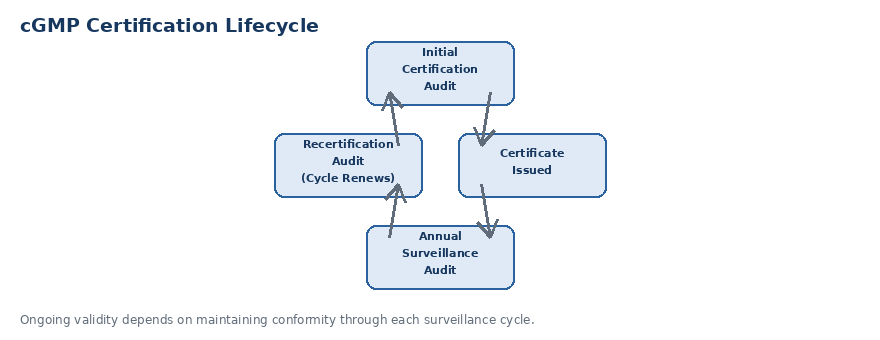
A lapsed surveillance or recertification audit puts continued validity at risk, which is why the cycle — not a one-off audit — is the real measure of an active certificate. Many facilities pair the cycle with cGMP internal auditor training in Bahrain so their own quality teams keep the system under review between IAS visits.
Which Bahraini sectors pursue cGMP certification in Bahrain
Demand for GMP/cGMP certification in Bahrain has followed the diversification trend described earlier — it is no longer limited to large pharmaceutical plants.
| Sector | Why certification is sought |
|---|---|
| Pharmaceutical manufacturing and repackaging | Supports NHRA licensing obligations and gives GCC and export buyers independent evidence of quality-system conformity. |
| Nutraceuticals and dietary supplements | A fast-growing category in Bahrain’s free zones, often required by regional distributors as a condition of listing. |
| Food processing and halal export | Complements existing food-safety certifications when a buyer specifically asks about manufacturing-practice controls. |
| Cosmetics and personal care formulation | Assessed against ISO 22716-referenced GMP practices rather than a pharma-oriented scheme. |
| Contract packaging and logistics operators | Facilities that pack, label or store product on behalf of brand owners can scope certification to those specific activities. |
| Chemical blending and industrial manufacturing | Open to certification scoped to their own product lines, independent of the food/pharma/cosmetics/device categories above. |
The common thread across all six rows: certification is scoped to what a facility actually produces or handles, not assumed from its industry label. Food and nutraceutical facilities often combine this with ISO 22000 certification in Bahrain or HACCP certification in Bahrain.
See where your products fit? Contact us for a free consultation — no obligation.
Gaps that commonly surface during a first audit
Facilities pursuing certification for the first time tend to encounter a similar handful of gaps, regardless of product category. Recognising them in advance shortens the corrective-action stage.
- Informal procedures — practised consistently on the floor but never written down in a form an auditor can review.
- Untraceable calibration or maintenance records — kept, but not linked clearly back to the equipment or process they cover.
- Verbal change-control decisions — no record of what was evaluated before a formulation, supplier or process change went into effect.
- Batch or production records with traceability gaps — particularly where a facility recently moved from manual to electronic record-keeping.
- Scope confusion — applying for certification across a broader set of product lines than the facility can currently evidence, rather than starting with the lines that are audit-ready.
None of these findings are unusual, and none typically prevent certification outright — they simply need to be closed out through the corrective-action step before the certification decision is finalised.
How cGMP certification in Bahrain is backed
- UQAS accreditation. IAS provides certification services under its UQAS accreditation, underpinning how assessments are conducted and how certificates are issued.
- A documented basis for credibility. This gives Bahraini clients and their GCC trading partners a documented basis for the certificate’s credibility.
- One relationship, many schemes. Run cGMP alongside ISO 9001 certification in Bahrain, ISO 22000 or HACCP as a single coordinated programme, which cuts duplicated audit effort. The full range is set out under ISO certification in Bahrain.
Quality teams preparing for any of these schemes can build internal audit capacity first through the IAS ISO training programme.
Quick definitions
- GMP. Good Manufacturing Practice — quality-system principles for consistent, controlled production.
- cGMP. Current Good Manufacturing Practice — the same principles, expected to reflect present-day methods and technology.
- Scheme and scope. The specific framework and product line an audit is measured against, named on the certificate itself.
- Surveillance audit. A shorter annual check confirming the facility continues to operate in conformity between full reassessments.
- Recertification. The fuller reassessment at the end of a certificate’s validity cycle, after which the cycle renews.
Your next step toward cGMP certification in Bahrain
You may run a pharmaceutical facility already licensed by NHRA, a nutraceutical or cosmetics line in one of Bahrain’s free zones, or a contract packer serving GCC distributors. In each case, IAS can confirm which GMP/cGMP scheme applies to your products, and provides a fixed written quotation before any audit is scheduled.
- Scoping commits you to nothing.
- The written quotation spans the whole assessment, with surveillance inside the cycle.
- Combine with ISO 9001, ISO 22000 or HACCP under one programme if useful.
Get started: contact us to reach the IAS Bahrain team and discuss your certification scope.
Frequently asked questions
Do we need cGMP certification to run a plant in Bahrain, or is NHRA licensing enough?
Certification itself is voluntary. What is mandatory is NHRA licensing for pharmaceutical manufacturers and BSMD conformity requirements for other regulated goods. cGMP certification is a separate, additional step. Many facilities take it to support those obligations and satisfy buyer requirements.
Does an IAS cGMP certificate mean NHRA has approved our facility?
No. NHRA licensing and IAS certification are separate processes run by different bodies. An IAS certificate confirms conformity to a named GMP/cGMP scheme; it does not grant, replace or imply an NHRA manufacturing licence.
We already hold an NHRA manufacturing licence — why pursue certification as well?
An NHRA licence confirms you meet Bahrain’s statutory requirements to operate. An independent cGMP certificate adds a separate reference point, naming the scheme it was assessed against, that GCC distributors and export buyers can verify without contacting the regulator directly.
Can a company operating only as a trader or free-zone distributor, with no manufacturing on site, apply?
Certification is built around manufacturing, processing, packing or similar hands-on activity. A pure trading operation with no such activity generally would not have a scope to certify against, though contract packing or repackaging carried out on its behalf can be.
Can manufacturers outside pharma and food be certified in Bahrain?
Yes. Any manufacturing, processing or handling operation — including cosmetics, chemicals, animal feed, packaging and logistics — can apply, with the certification scope matched to the specific products it handles.
What happens if nonconformities are found during the on-site assessment?
The facility is given the opportunity to implement corrective actions addressing the findings. Certification proceeds once those corrective actions are reviewed and conformity is confirmed.
How does certification help a Bahraini manufacturer sell into other GCC markets?
Distributors and retailers across the Gulf increasingly ask for independent quality-system evidence before listing a product — a certificate scoped to the applicable GMP/cGMP scheme provides that evidence in a form buyers recognise.
Once certified, what keeps the certificate active?
An annual surveillance audit confirms ongoing conformity, followed by a fuller recertification audit at the end of the certification cycle. Missing either step puts continued validity at risk.