


ISO 9001:2026 Is Near: Will Your Business Evolve in Time or Be Forced to Catch Up?
The business landscape is shifting faster than ever, and with it comes the next evolution in quality management—ISO 9001:2026. This upcoming revision is not just a routine update; it introduces a new way of thinking where agility, intelligence, and accountability define success.
For organizations in Bahrain, the message is clear: adapt early and gain momentum, or delay and risk operational inefficiencies, customer dissatisfaction, and competitive pressure. The new standard challenges businesses to move beyond traditional quality systems and embrace a smarter, more responsive approach.
This is not about fixing what is broken—it is about reimagining what is possible.
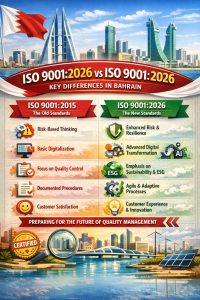
Rethinking Quality in a Fast-Changing World
The concept of quality has evolved. It is no longer limited to ensuring consistency—it now plays a direct role in shaping business outcomes.
ISO 9001:2026 encourages organizations to embed quality into every layer of operations. Instead of reacting to issues, businesses are expected to anticipate them. Instead of relying on static procedures, they must build systems that can evolve with changing demands.
For Bahrain’s diverse industries—from manufacturing to services—this means shifting from control-based systems to intelligence-driven frameworks that support growth and adaptability.
What Will Redefine Quality Management?
The upcoming revision introduces transformative elements that push organizations to think differently about performance and sustainability.
Outcome-Driven Systems
- Focus on achieving measurable business results rather than following rigid processes
- Encourages flexibility in how objectives are met
- Promotes continuous evaluation and refinement
Intelligent Use of Data
- Emphasis on collecting and analyzing meaningful data
- Supports faster, evidence-based decision-making
- Improves visibility across operations
Preventive and Predictive Thinking
- Moves beyond risk identification to risk anticipation
- Encourages scenario planning and early action
- Reduces disruptions and enhances stability
These shifts are designed to help organizations stay competitive in an unpredictable environment.
Digital Transformation as a Necessity
ISO 9001:2026 positions digital capability as a core requirement rather than an optional enhancement. Organizations must ensure that their systems can support real-time insights and seamless operations.
This involves:
- Integrating digital tools into quality processes
- Ensuring data accuracy and system reliability
- Aligning technology with business objectives
In Bahrain, where businesses are rapidly embracing innovation, this creates a strong foundation for smarter operations and improved performance.
People at the Center of Quality
Even in a technology-driven environment, people remain the most critical asset. ISO 9001:2026 highlights the importance of engagement, awareness, and accountability across all levels of the organization.
Key Focus Areas
- Empowering employees to take ownership of quality
- Providing continuous learning opportunities
- Encouraging collaboration and idea-sharing
When employees are aligned with organizational goals, quality becomes a shared responsibility rather than a separate function.
Managing Supply Chain Uncertainty
Modern supply chains are complex and often unpredictable. ISO 9001:2026 places strong emphasis on building resilience and ensuring consistency across suppliers and partners.
Essential Practices
- Continuous monitoring of supplier performance
- Identification of potential vulnerabilities
- Development of backup strategies and contingency plans
For businesses in Bahrain and other regions, strengthening supply chain reliability is essential to maintaining customer trust and operational continuity.
Sustainability as a Strategic Priority
Sustainability is no longer a trend—it is a requirement. The new standard integrates environmental and social considerations into quality management practices.
Core Principles
- Minimizing resource consumption and waste
- Addressing environmental risks proactively
- Aligning operations with long-term sustainability goals
Organizations that adopt sustainable practices not only improve efficiency but also enhance their reputation in the market.
Leadership: The Driving Force Behind Change
ISO 9001:2026 places greater responsibility on leadership to guide transformation. Leaders are expected to actively participate in shaping quality strategies and ensuring alignment with business objectives.
Leadership Actions
- Defining clear direction and priorities
- Monitoring progress and performance
- Creating a culture that supports innovation and accountability
Strong leadership ensures that quality management becomes a strategic advantage rather than a compliance requirement.
Why ISO 9001:2026 Matters More Than Ever?
Organizations that embrace the new standard early can unlock significant benefits, while those that hesitate may face challenges in maintaining competitiveness.
Business Advantages
- Increased efficiency and reduced operational waste
Organizations can streamline their processes by eliminating unnecessary steps, reducing duplication of work, and optimizing resource utilization. This leads to faster operations, lower costs, and improved productivity across departments. - Improved ability to respond to market changes
With a more flexible and data-driven system, businesses can quickly adapt to changing customer demands, industry trends, and economic shifts. This agility allows organizations to stay competitive and seize new opportunities without major disruptions. - Stronger alignment between strategy and execution
ISO 9001:2026 ensures that quality objectives are directly connected to business goals. This alignment helps organizations execute their strategies more effectively, ensuring that every process contributes to overall success.
Customer Impact
- More consistent and reliable products and services
By focusing on performance and continuous monitoring, organizations can maintain high levels of consistency in their offerings. This reduces errors, defects, and service gaps, leading to a more dependable customer experience. - Higher levels of satisfaction and trust
When customers receive reliable quality and timely delivery, their confidence in the organization increases. This trust translates into stronger relationships, repeat business, and positive word-of-mouth. - Improved brand reputation
Consistent quality and customer-focused practices enhance the organization’s image in the market. A strong reputation not only attracts new customers but also strengthens partnerships and stakeholder confidence.
Long-Term Value
- Enhanced resilience in uncertain environments
By adopting proactive risk management and flexible systems, organizations can better handle disruptions such as supply chain issues, market volatility, or operational challenges. This resilience ensures continuity and stability. - Better decision-making through data insights
Access to accurate and real-time data enables leaders to make informed decisions. Instead of relying on assumptions, organizations can use insights to identify trends, measure performance, and plan effectively. - Sustainable growth and scalability
A well-structured quality management system supports long-term expansion by creating a strong operational foundation. Organizations can scale their processes, enter new markets, and grow sustainably without compromising quality.
These outcomes make ISO 9001:2026 a critical tool for future success.
How to Prepare Without Disruption?
Transitioning to ISO 9001:2026 does not have to be overwhelming. With the right approach, organizations can integrate changes smoothly into existing systems.
Practical Steps
- Evaluate current processes and identify improvement areas
- Align quality objectives with strategic goals
- Strengthen digital capabilities
- Train teams to adapt to new expectations
Preparation is not just about compliance—it is about building a system that supports long-term performance.
Final Perspective
ISO 9001:2026 is not just a standard—it is a wake-up call for organizations to rethink how they operate, compete, and grow. It challenges businesses to move beyond traditional practices and embrace a smarter, more proactive approach to quality.
For organizations in Bahrain, the choice is clear: take the lead and transform quality into a competitive strength, or wait and risk falling behind in an increasingly demanding market.
Those who act now will not just meet the standard – they will define the future of quality in their industries.


