


Build Internal Audit Confidence for the New Era of Environmental Management
Organizations in Bahrain are entering a critical window of change. ISO 14001:2026, published in April 2026, has redefined how environmental management systems are structured, assessed, and improved from within. The pressure to transition is real — and internal auditors are at the heart of making it happen.
Internal auditors are the first line of assurance in any ISO 14001-certified organization. They identify gaps, verify compliance, and drive corrective action before external certification audits take place. As the standard evolves, so must the professionals responsible for auditing it internally.
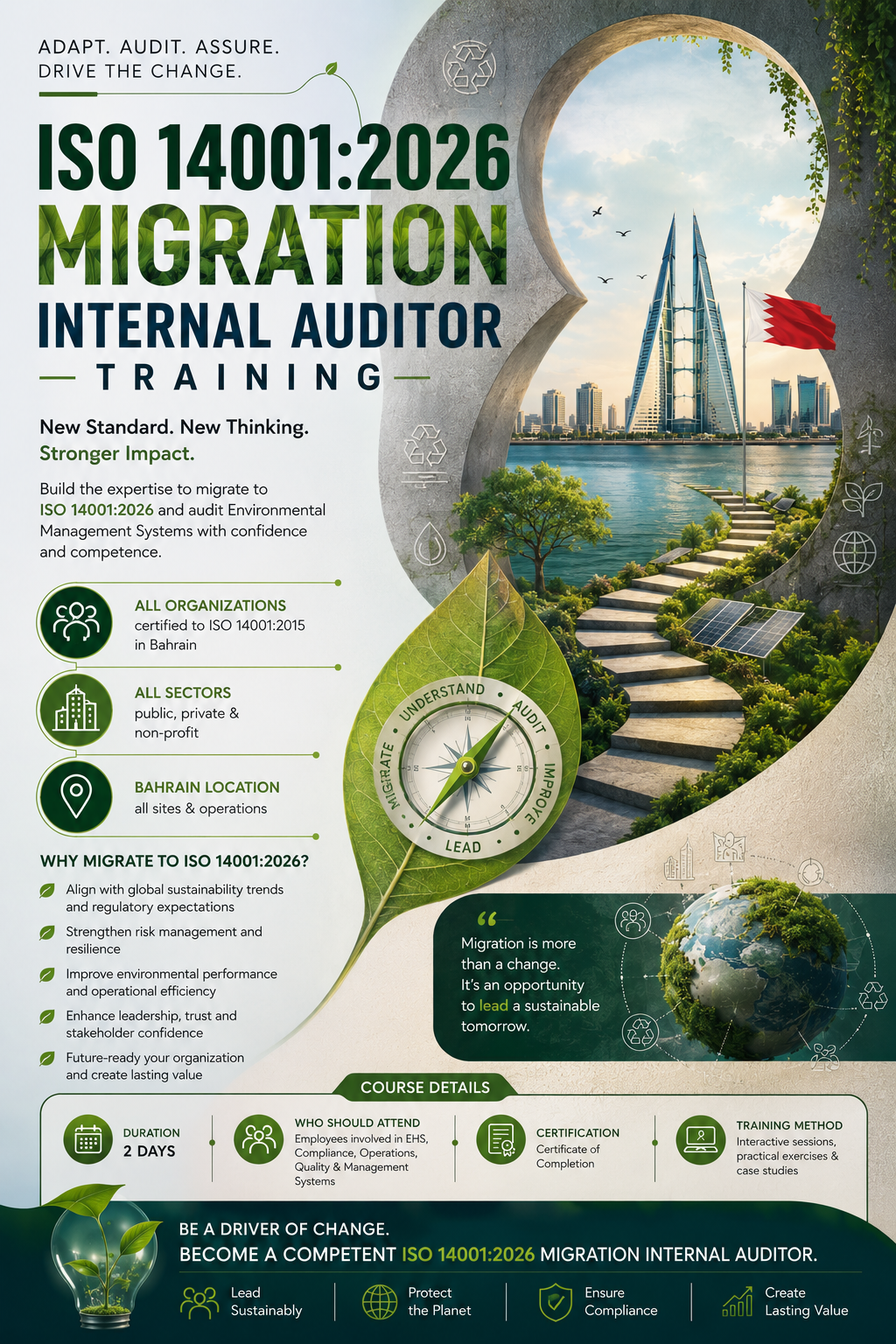
Our ISO 14001:2026 Migration Internal Auditor Training in Bahrain equips your team to audit confidently against the updated requirements — ensuring your organization’s EMS remains compliant, credible, and transition-ready.
Why Internal Auditors in Bahrain Need to Upgrade Now?
The transition from ISO 14001:2015 to ISO 14001:2026 is not simply a documentation exercise. The updated standard introduces new clauses, revised audit requirements, and a stronger focus on measurable environmental performance — all of which change what internal auditors are expected to look for and report on.
Bahrain’s expanding environmental regulatory landscape, combined with growing ESG expectations from investors, clients, and government bodies, means organizations can no longer rely on outdated internal audit practices. An internal auditor still working to the 2015 framework will miss critical non-conformities that a 2026-aligned audit would catch.
The 2015 version becomes obsolete in May 2029. Organizations that retrain their internal auditors now will complete their transition smoothly. Those that delay risk scrambling through gap analysis, failed surveillance audits, and compliance disruptions at the worst possible time.
What Has Changed in ISO 14001:2026 That Internal Auditors Must Know?
Internal auditors need a working knowledge of every updated clause — not just an overview. The 2026 revision introduces changes that directly affect what auditors must examine, what evidence they must gather, and how they must report findings.
- Climate and environmental conditions — Internal auditors must now verify that climate change, biodiversity, pollution risks, and ecosystem health have been explicitly evaluated in the organization’s context analysis — not merely referenced
- Leadership and accountability — The standard now requires top management to support all relevant roles, not just management positions. Auditors must gather evidence of genuine leadership involvement at all levels
- Change management (new Clause 6.3) — A structured process for planning and managing EMS-related changes is now mandatory. Internal auditors must verify that changes are being identified, assessed, and controlled systematically
- Revised risks and opportunities (Clause 6.1.4) — Organizations must now determine, plan, and manage risks and opportunities in a more formalized way. Internal auditors must assess whether this process is robust and documented
- Internal audit objectives — Under the 2026 standard, each internal audit must have clearly defined objectives in addition to scope and criteria. This changes how internal audit programmes are planned and recorded
- Lifecycle perspective in scope — The lifecycle perspective must now be applied when setting the EMS scope, not just during aspect identification. Auditors must verify this is reflected in scope documentation
- ESG and performance alignment — The EMS effectiveness is now placed front and centre in performance evaluation. Internal auditors must assess whether the organization is measuring and demonstrating real environmental outcomes
What This ISO 14001:2026 Internal Auditor Training in Bahrain Covers?
This is a focused one-day migration training programme designed specifically for professionals already familiar with ISO 14001:2015 internal auditing. It concentrates on what has changed, what it means in practice, and how to apply it immediately within your organization’s audit programme.
Session 1 – From 2015 to 2026: Understanding the Migration
- Overview of ISO 14001:2026 and its position within the Annex SL framework
- Clause-by-clause comparison of ISO 14001:2015 versus ISO 14001:2026
- New and revised requirements and their practical auditing implications
- Understanding updated EMS terminology and documentation standards
- How internal audit objectives, scope, and criteria change under the new standard
Session 2 – Applying the 2026 Requirements in Internal Audits
- Planning an internal audit programme aligned with ISO 14001:2026
- Developing updated audit checklists that reflect new and revised clauses
- Gathering and evaluating objective evidence for updated requirements
- Identifying non-conformities and opportunities for improvement under the 2026 framework
- Reporting findings clearly and linking them to continual improvement processes
- Practical exercises using real Bahrain industry audit scenarios