


UAE Auditors Get Clearer Rules: FSSC 22000 V7’s Category Overhaul
FSSC 22000 Version 7 replaces the food chain (sub)category structure carried over from Version 6 with more precisely worded category and sub-category definitions, so that auditor competence and certification scope map consistently to what a site actually does. For food manufacturers, packaging producers, and storage and distribution operators certified or applying in the UAE, the change does not add a new certification step, but it does affect how your scope is documented and how your certification body selects an auditor for your next visit. Here is what UAE-based organisations need to know about the shift from Version 6 to Version 7, and how to prepare for it without disrupting your existing certification cycle.

Key Changes at a Glance
- FSSC 22000 Version 7 tightens the food chain (sub)category definitions inherited from Version 6.
- The update harmonises competency and auditor-assignment criteria across every certification body worldwide.
- UAE sites keep their existing category in most cases; the wording is simply clarified.
- Mixed-activity facilities, such as sites that both manufacture and store product, may see refined scope wording.
- No new certification cycle is triggered; the review happens naturally at your next scheduled audit.
- The change reinforces GFSI’s requirement that auditors hold competence matching a site’s specific category.
- New UAE applicants will be classified directly under the clearer Version 7 category structure from day one.
What the Food Chain Category Overhaul Actually Changes
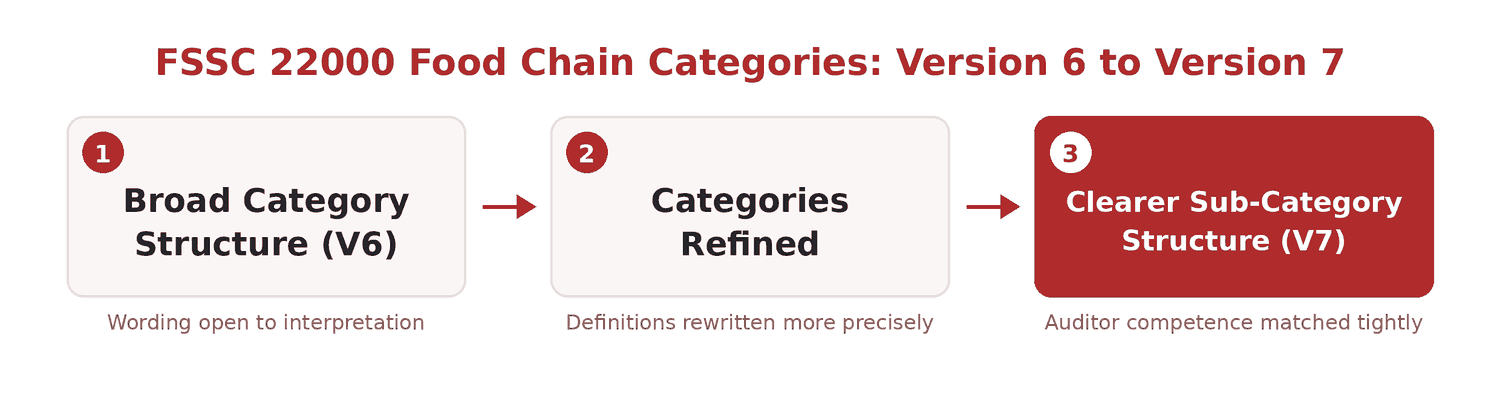
FSSC 22000 uses a food chain category (FCC) framework, aligned with GFSI’s own classification approach, to describe the type of activity a certified site performs — for example food manufacturing, food packaging material production, storage and distribution, or catering. Under FSSC 22000 Version 6, the boundaries between some of these categories and their sub-categories were broad enough that wording and interpretation could vary between certification bodies and even between auditors within the same certification body. FSSC has used the Version 7 release as the opportunity to close that gap rather than leave it for a future revision.
Version 7 narrows that variability by rewriting the category and sub-category definitions with more specific language. The goal is not to reclassify sites into entirely new groups, but to make sure the category label attached to a site describes its activity precisely enough that the right auditor competence can be matched to it every time. A clearer definition also reduces the chance of a certificate being questioned by a customer or retailer over inconsistent category wording between different suppliers in the same supply chain.
For a UAE facility, this typically means the category you already hold will simply be confirmed under clearer wording. Sites with activities that straddle two categories — a plant that manufactures product and also runs its own cold storage and distribution, for instance — are the ones most likely to see their sub-category description refined for accuracy. Certification bodies are expected to communicate any wording change clearly in advance, so there should be no surprises when the audit itself takes place.
Why FSSC Revisits Category Definitions Between Scheme Versions
FSSC 22000 is a GFSI-recognised certification scheme built on the ISO 22000 food safety management system standard, layered with sector-specific prerequisite programme requirements and FSSC’s own additional criteria. GFSI benchmarking requires every recognised scheme to demonstrate that the auditors it assigns hold competence relevant to the specific part of the food chain being audited, from primary production and manufacturing through to packaging, storage and distribution. That requirement exists because an auditor unfamiliar with a site’s specific activity is far less likely to catch genuine food safety risks during an audit.
Because FSSC 22000 is used across such a wide range of food chain activities worldwide, keeping category definitions current is part of how the scheme maintains that GFSI alignment over time. The Version 7 category clarification sits alongside the scheme’s other Version 7 updates — including revised auditor qualification criteria and updated prerequisite programme references — as part of the same broader alignment effort. It also gives certification bodies a clearer basis for training and assigning their own auditor pool consistently, wherever in the world a given site happens to be located.
If you want the fuller picture of everything changing under Version 7 rather than this single update in isolation, our FSSC 22000 certification page for the UAE walks through the complete set of changes certified and certifying organisations across the region need to plan for. Reading it alongside this page gives your UAE team the full context behind why the category wording changed in the first place, rather than treating it as an isolated technical footnote.
What UAE Certified and Applicant Organisations Should Do
If your organisation is already FSSC 22000 certified in the UAE, your certification body will review your assigned food chain category and sub-category as part of your next scheduled audit — whether that is a surveillance or recertification visit — rather than requiring any separate review process. It is reasonable to ask your certification body directly whether your category label or your sub-category description is the part expected to change, since the two are reviewed slightly differently.
It is worth raising your site’s activity profile with your certification body proactively, especially if your UAE facility’s operations have expanded or changed since your last audit cycle, for example adding a storage or distribution function to an existing manufacturing scope. Flagging this ahead of time helps your certification body schedule an auditor with the right competence the first time, rather than needing a follow-up visit. Keeping your certification body informed of operational changes as they happen, rather than only at audit time, is good practice regardless of this specific update.
Organisations applying for FSSC 22000 certification in the UAE for the first time will be classified directly under the Version 7 category structure, so there is no transition step to manage — the clearer definitions simply apply from day one of the certification process. This also means new applicants avoid any confusion about which version’s category wording applies to their initial certificate.
Common Misconceptions About the Category Change
The most common misconception is that the food chain category update requires a brand-new certification audit. It does not — it is assessed and, where needed, refined at whichever surveillance or recertification audit comes next in your normal cycle. Confirming this directly with your certification body ahead of time is usually enough to put the concern to rest for your UAE team.
A second misconception is that this change only matters to large, multi-site groups with complex operations. In practice, any UAE site whose activities sit near a category boundary — even a single-site business — can be affected, so it is worth checking your own scope statement rather than assuming the update does not apply to you. A quick internal review of your current scope wording against your actual site activities is a low-effort way to check before the audit.
A third misconception treats the category update as an isolated, standalone item. In reality it is one part of a broader Version 7 package that also touches PRP references, auditor qualification, sustainability expectations and a new AI governance requirement, and UAE teams get the most value from understanding the full set together rather than reacting to each change separately as it comes up.
Preparing Your UAE Team With IAS Gulf
Understanding exactly how your site’s category and sub-category are defined under Version 7 is easier when your internal food safety and quality team has had proper exposure to the updated scheme requirements, rather than picking it up for the first time during an external audit. Training that walks through real examples of category and sub-category wording, rather than definitions alone, tends to make the update far easier for a team to apply internally.
IAS Gulf works with certified and certifying organisations across the UAE on Version 7 transition planning, including how the food chain category clarifications interact with your existing scope. If your team needs to get ahead of the full set of Version 7 changes before your next audit, the FSSC 22000 Lead Auditor and Internal Auditor Training courses for UAE teams are delivered by EAS through isoleadauditor.com — book your audit team in before the transition window closes.
FSSC 22000 Version 6 vs Version 7: Food Chain Category Structure at a Glance
| Aspect | Version 6 | Version 7 |
|---|---|---|
| Category definitions | Broader category and sub-category wording, open to some variation in interpretation between certification bodies | More precisely worded category and sub-category definitions applied consistently worldwide |
| Auditor assignment | Auditor competence matched to a broadly defined category | Auditor competence matched more tightly to the specific category and sub-category |
| Scope consistency | Scope wording could vary between certification bodies for similar activities | Scope wording is more consistent across certification bodies for similar activities |
| Mixed-activity sites | Category could be ambiguous for sites combining multiple activities | Sub-category wording clarifies mixed-activity scope more precisely |
| Review trigger | Category assigned at initial certification, rarely revisited afterwards | Category confirmed or refined at the next scheduled surveillance or recertification audit |
| New applicants | Classified under Version 6 category wording | Classified directly under the clearer Version 7 category structure |
Note: exact FSSC 22000 Version 6 to Version 7 transition and cascade dates should be confirmed directly with your certification body.
About the author
Adekoya Oluwatosin is a food safety consultant, trainer and FSSC 22000 v6 Lead Auditor with over eight years of hands-on experience across food manufacturing, packaging, storage and distribution, and catering. She has personally conducted more than 22 internal audits — including FSSC 22000 and ISO 9001:2015 audits — and led FSMS/QMS implementation projects that guided over ten organisations to certification.
Frequently Asked Questions
What is the food chain category structure in FSSC 22000?
It is the classification system FSSC 22000 uses, aligned with GFSI’s category approach, to describe a certified site’s activity — such as manufacturing, storage, or packaging production — and to match auditor competence to that activity. It applies to every FSSC 22000 certified site, including those in the UAE.
Does the Version 7 food chain category change affect my certificate scope in the UAE?
For most sites the underlying category stays the same and only the wording becomes clearer; sites with mixed activities are more likely to see their sub-category description refined at the next audit.
Do I need a new audit just for the food chain category update?
No. It is reviewed as part of your existing surveillance or recertification audit cycle, not as a standalone requirement or a separate visit.
How is the category update related to the other FSSC 22000 Version 7 changes?
It is one part of a broader package that also updates PRP standard references, auditor qualification criteria, sustainability expectations and a new AI governance requirement.
Where can I get FSSC 22000 Version 7 training in the UAE?
Through isoleadauditor.com’s UAE Lead Auditor and Internal Auditor course pages, delivered by EAS, which cover the full set of Version 7 updates including the food chain category changes.
What should a mixed-activity UAE site check before its next audit?
Compare your current certificate scope wording against what the site actually does today. Where a manufacturing site has added storage or distribution since the last audit, that is exactly the case the refined sub-category wording is meant to describe more accurately.