


Independent third-party cGMP certification for UAE-based manufacturers, formulators, contract packers and free-zone re-exporters — scoped to your products and sites, and backed by a fixed written quotation. Mainland, free zone, or a re-export operation with no local manufacturing: IAS scopes the audit to fit.
- UQAS-accredited certification body
- Fixed written quotation, no later additions
- Nearly two decades of assessment experience
- Named scheme and defined scope stated on every certificate
Ready to scope your certification? Give us your free-zone or mainland details for a fixed written quotation — contact IAS today.
At a glance
- Scope: audited against the applicable GMP/cGMP scheme for your product category and site type — never a single generic checklist.
- Eligible operations: mainland manufacturers, free-zone manufacturers, free-zone re-exporters and traders, and contract packers serving multiple brand owners.
- Eligible industries: open to producers and handlers alike, across medicines, cosmetics, food, nutraceuticals and medical devices.
- Certification cycle: Stage 1 and Stage 2 audit, certificate, annual surveillance, recertification.
- Pricing: a fixed written quotation once scope is confirmed; no rate card is published and no fees are added.
- Accreditation: IAS works under its UQAS accreditation when certifying.

The UAE’s role as the Gulf’s re-export and free-zone manufacturing gateway
The UAE does not manufacture solely for its own market. A dense network of free zones and mainland industrial areas makes UAE producers, formulators, contract packers and traders the re-export and distribution point for the region. Goods move onward into Africa, South Asia, the wider GCC and beyond; most output rarely stays inside the UAE.
- The re-export problem is this. A buyer in Lagos, Nairobi, Karachi or Riyadh cannot easily verify a UAE facility’s day-to-day manufacturing discipline in person. A shipment may also pass through several hands before it reaches a shelf.
- What buyers ask for instead. One piece of credible, independently verified evidence that the originating facility runs a disciplined, current manufacturing-practice system — regardless of which national GMP code the destination market applies.
- What this page covers. What cGMP certification does and does not mean in a UAE context, how oversight is distributed across federal regulators, emirate-level authorities and free-zone administrations, which frameworks apply to which product categories, and how IAS certifies UAE-based applicants under its UQAS accreditation.
cGMP meaning: the “current” in current Good Manufacturing Practice
cGMP, or current Good Manufacturing Practice, asks that a manufacturer’s quality systems, equipment and procedures keep pace with the latest version of the applicable GMP framework. Compliance is continuous, not a one-off exercise.
cGMP is not a single worldwide certificate or a fixed rulebook. It is a term used across several distinct frameworks, each with its own scope and its own owner:
- US FDA 21 CFR Parts 210/211 and related regulations — applicable only within the United States regulatory system.
- WHO GMP guidelines — reference guidance widely cited by pharmaceutical regulators across the Middle East, though WHO itself neither inspects facilities nor issues certificates.
- PIC/S GMP Guide — a harmonised pharmaceutical GMP framework referenced by many national regulators, including several UAE trading partners.
- ISO 22716 — the internationally recognised GMP framework specific to cosmetics and personal-care products.
- National and sector-specific GMP codes — including requirements referenced by MOHAP for pharmaceutical products and various food-safety codes for food-category manufacturers.
An IAS cGMP certificate always states the specific scheme and scope it was issued against — there is no generic, scheme-less “cGMP certificate.”
GMP vs cGMP — where the UAE distinction matters
GMP defines the baseline manufacturing-practice requirements a facility must meet. cGMP is that same discipline held to continuously. A UAE-based manufacturer’s systems therefore evolve alongside scheme revisions instead of freezing at the date of a past inspection.
| Aspect | GMP (baseline) | cGMP (current) |
|---|---|---|
| Reference point | Requirements in force at time of initial compliance | Requirements as they stand today, including recent scheme revisions |
| Documentation approach | Fixed procedures produced for a point-in-time review | Living procedures reviewed and updated on an ongoing cycle |
| Typical evidence | Quality manual and SOPs exist | Quality manual, SOPs, change control and training records show active use and revision |
| Certification implication | Demonstrates baseline conformity at assessment | Demonstrates baseline conformity plus a functioning system for staying conformant between assessments |
In practice: a facility that treats its quality manual, validation records and training logs as living documents — updated as equipment, suppliers, formulations or the referenced GMP guideline change — is operating on a “current” basis. A facility that produced procedures for one audit and never revisited them has GMP on paper, not a demonstrably current system.
One term, many playbooks: cGMP requirements by product category
Food, cosmetics, pharmaceuticals and medical devices manufactured or handled in the UAE do not sit under one identical cGMP framework. The applicable scheme is agreed with IAS before assessment begins, based on the applicant’s declared products and markets.
| Product category | Commonly referenced framework(s) |
|---|---|
| Pharmaceuticals and active ingredients | WHO GMP guidelines and/or PIC/S GMP Guide, alongside MOHAP registration requirements |
| Cosmetics and personal care | ISO 22716 (cosmetics GMP) |
| Food, beverages and nutraceuticals | Codex/HACCP-aligned food-safety principles combined with applicable national food-manufacturing codes |
| Medical devices | Device-specific GMP elements referenced alongside a quality-management-system standard such as ISO 13485 |
| Other industries (packaging, chemicals, animal feed, contract packing, warehousing) | GMP principles scoped to the specific product and process, agreed case by case |
IAS also certifies against related management-system standards, including ISO certification in UAE, ISO 13485 certification for medical devices, and HACCP certification for food-safety management — schemes frequently combined with a cGMP scope for a single facility. Certification itself is open to any industry: packaging converters, chemical producers, animal-feed manufacturers, contract packers and warehousing operations can all apply, scoped to their own products and processes.
Who regulates what across the emirates and free zones
The UAE’s regulatory landscape for manufacturing and trade is layered. It includes a federal pharmaceutical regulator, emirate-level authorities for food, health products and cosmetics, and a national standardisation body. Free-zone authorities license the business, but they do not themselves assess manufacturing practice. IAS certification sits alongside all of these — it never substitutes for a licence any of them issues.
| Body | Role |
|---|---|
| UAE Ministry of Health and Prevention (MOHAP) | Federal registration and licensing of pharmaceutical products and manufacturing facilities |
| Dubai Municipality / Dubai Health Authority | Emirate-level oversight of food establishments, health products and cosmetics within Dubai |
| Emirates Authority for Standardization and Metrology (ESMA) | National product-conformity standards and metrology, applied depending on emirate and product category |
| Free-zone authorities (individual free-zone administrations) | Business licensing and operational permits within the free zone; they do not issue GMP certificates |
| World Health Organization (WHO) | Publishes GMP guidance referenced by regulators; sets no requirements directly and issues no certificates |
| US FDA | Regulates only the US market; issues no certificates through IAS or any other third party |
| IAS | Independent third-party certification body, providing certification services under its UQAS accreditation |
- Not a regulatory approval. An IAS cGMP certificate is never presented as MOHAP approval, an ESMA conformity mark, FDA approval, or a replacement for any regulatory licence.
- Complements, never substitutes. Certification sits alongside — and never in place of — an applicant’s existing regulatory obligations.
Not sure which scheme applies to your products? Contact IAS for a free scoping conversation, or read the frequently asked questions.
Free zone or mainland: why the regulatory path is not one size fits all
A facility’s regulatory touchpoints depend heavily on where it sits. It may be in mainland Dubai or Abu Dhabi, or inside a free zone. It may also operate as a pure re-export or trading entity with no local manufacturing. cGMP certification is designed to sit consistently across all of these, giving buyers one comparable form of evidence regardless of the underlying licensing structure.
| Operating model | Typical regulatory touchpoint | What cGMP certification adds |
|---|---|---|
| Mainland manufacturer (Dubai / Abu Dhabi) | MOHAP and/or Dubai Municipality/DHA licensing depending on product | Independent verification of manufacturing-practice discipline alongside the mainland licence |
| Free-zone manufacturer | Free-zone trade licence; product-specific approvals where applicable | Evidence a distant buyer can rely on, since the free-zone licence itself does not assess manufacturing practice |
| Free-zone re-exporter or trading entity (no local manufacturing) | Free-zone trade licence for import/export activity | Applies where the entity also handles, repacks or private-labels product, scoped to those activities |
| Contract packer serving multiple brand owners | Facility-level trade licence; may hold multiple product approvals | One certificate covering the packer’s own process, usable across all client brands it serves |
Areas an IAS audit typically reviews
The exact assessment checklist depends on the applicable scheme and product category; IAS auditors typically look at areas such as:
- Facility layout, environmental controls and contamination-prevention measures, as applicable to the product
- A documented quality management system covering the certified scope
- Process and equipment validation, where relevant to the scheme
- Batch, production or lot records, as applicable to the product category
- Change control and corrective/preventive action (CAPA) practices
- Data integrity practices for records generated during production and testing
- Personnel training, competence and hygiene practices
- Incoming material and supplier-control procedures
- Calibration and maintenance of production and testing equipment
None of the above is a universal, mandatory checklist — the applicable scheme and the applicant’s declared scope determine which elements are assessed and to what depth.

cGMP certification in the UAE: who is certifying beyond pharma and food
Because the UAE’s manufacturing base is built around re-export and contract production rather than a single dominant sector, IAS sees applications from a wide spread of operations:
- Pharmaceutical and API repackaging or third-party logistics operations based in free zones
- Cosmetics and personal-care formulators and private-label manufacturers
- Food, beverage and nutraceutical manufacturers and repackers
- Medical device assemblers, sterilisers and distributors
- Packaging converters supplying food-grade or pharma-grade packaging
- Chemical formulators and animal-feed producers
- Contract manufacturers and private-label houses operating across multiple free zones
Several of these operations also pursue product certification alongside cGMP certification, where a specific product rather than the manufacturing process alone needs independent evaluation. The list is illustrative, not exhaustive — cGMP certification is open to any UAE-based operation whose product or process falls within an agreed scope, whatever its sector.
See where your operation fits? Get a free consultation — no obligation.
cGMP certification in the UAE: the IAS assessment pathway
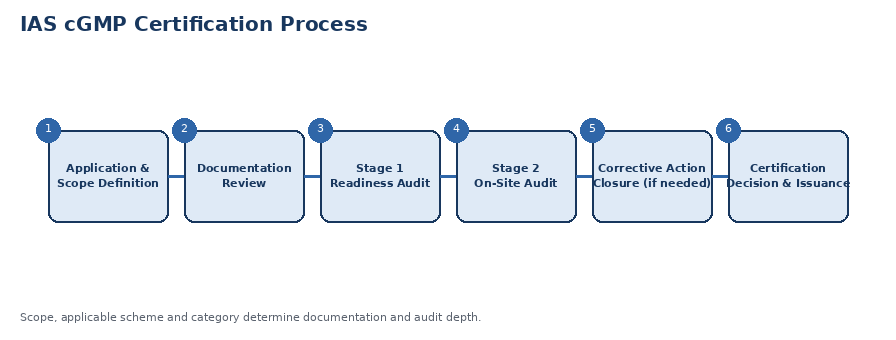
IAS provides certification services under its UQAS accreditation, following a structured certification process common to management-system and product-practice certification:
- Application and scope definition — the applicant confirms product category, site(s) (mainland, free zone or both) and the GMP/cGMP scheme to be assessed against.
- Documentation review — IAS reviews the quality manual, procedures and records relevant to the declared scope.
- Stage 1 readiness audit — confirms the management system is developed enough to proceed to an on-site assessment.
- Stage 2 on-site audit — auditors assess the facility, records and practices against the applicable scheme.
- Corrective action closure — where nonconformities are identified, the applicant addresses them before certification is finalised.
- Certification decision and issuance — once requirements are satisfied, IAS issues the certificate stating the specific scheme and scope.
Facility personnel intending to build or manage an in-house cGMP or quality-management programme may also benefit from cGMP internal auditor training in the UAE, or from the wider ISO lead auditor training range, which develops audit competence ahead of an IAS assessment.
From certification to renewal: the ongoing lifecycle
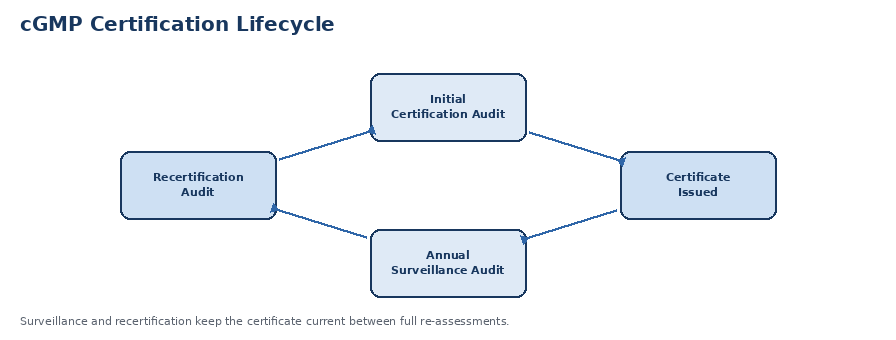
Certification is not a single event. Once issued, a certificate is maintained through a recurring cycle:
- Initial certification audit — the full Stage 1 and Stage 2 assessment described above.
- Certificate issued — scoped to the confirmed product category, site(s) and scheme.
- Annual surveillance audit(s) — periodic checks confirm the management system remains current between full reassessments.
- Recertification audit — a fuller reassessment carried out before the certification cycle renews.
How long each stage takes depends on facility readiness, the breadth of the declared scope, and how many product families or sites it covers. No fixed calendar period applies uniformly to every UAE applicant.
What shapes cost and timeline for a UAE applicant
GMP certification cost in the UAE is quoted per applicant. IAS does not set a standard fee or duration, because the work involved varies by applicant. Instead, IAS provides a fixed written quotation once the scope is understood. The main variables that shape that quotation and the assessment timeline include:
| Driver | Why it matters |
|---|---|
| Facility size and number of production lines | Larger or more complex sites require more audit time to cover fully |
| Number of product families and scheme complexity | A pharmaceutical scope typically requires deeper review than a single-category packaging scope |
| Number of sites included (mainland, free zone, or both) | Multi-site applicants covering both mainland and free-zone locations require coordinated assessment across each site |
| Current documentation and QMS maturity | A facility with an established, well-maintained system generally needs less remediation before Stage 2 |
| Existing certifications already held | A facility already certified to ISO 9001 or a related standard may have overlapping evidence that streamlines the review |
The IAS commitment. One fixed written quotation after scoping, covering the full assessment.
Want a real number, not a range? Request your fixed written quotation — the application form and cGMP brochure are in the panel alongside.
Why UAE manufacturers, re-exporters and free-zone operators choose IAS
- Assessment by an independent third party, carried out under IAS’s UQAS accreditation.
- Nearly two decades of assessment experience across management-system and product-practice certification.
- A certificate structured to be understood and verified by buyers, distributors and importing-country partners across Africa, the GCC and South Asia.
- Scope built around the applicant’s actual products and sites — mainland, free zone, or both.
IAS also supports UAE applicants pursuing complementary schemes, including system certification for broader management-system needs, and offers ongoing learning through the online ISO training platform.
Quick definitions
- GMP. Good Manufacturing Practice — the baseline manufacturing-practice requirements a facility must meet.
- cGMP. Current Good Manufacturing Practice — the same discipline held to continuously, so systems evolve alongside scheme revisions.
- Scheme and scope. Which framework applies, and to which products — both fixed at application.
- Surveillance audit. A periodic check between full reassessments confirming the certified system remains current.
- Recertification. The fuller reassessment carried out before a certification cycle renews.
Take the next step toward cGMP certification in the UAE
Your facility may sit in a Dubai free zone or on the Abu Dhabi mainland. It may also run as a re-export and contract-packing operation across several sites. In each case, IAS can scope a cGMP certification programme to match your actual products, markets and regulatory context.
- No obligation to proceed after scoping.
- The written quotation covers the full assessment.
- Combine with ISO, ISO 13485 or HACCP certification under one programme if useful.
Get started: contact us to scope your certification. Follow IAS in the UAE on Facebook, Instagram and YouTube for certification updates.
Frequently asked questions
Is cGMP certification legally mandated for manufacturers operating in the UAE?
cGMP certification itself is not a blanket legal mandate; it is an independent, voluntary certification that sits alongside whatever registration or licensing MOHAP, Dubai Municipality/DHA or ESMA already require for a given product. Some buyers or export markets may, however, request it as a condition of doing business.
Does an IAS cGMP certificate mean MOHAP has approved my product for registration?
No. An IAS certificate confirms that a facility’s manufacturing-practice system was assessed against a stated scheme and scope. It is never presented as MOHAP product registration, approval or any other regulatory clearance, and it does not replace the registration process.
We already hold a Dubai Municipality or DHA trade licence and product permit — why add cGMP certification?
A trade licence and product permit confirm that you may operate and sell. Neither verifies the ongoing discipline of your manufacturing-practice system the way a scoped third-party cGMP assessment does — and that assessment is often what an overseas buyer asks to see.
Our facility operates inside a free zone — does cGMP certification still apply to us?
Yes. Free-zone trade licences cover business authorisation, not manufacturing-practice assessment. A free-zone-based manufacturer, formulator or contract packer can therefore apply for cGMP certification scoped to its products, in the same way a mainland facility can.
Can a re-export or contract-packing operation with no local manufacturing apply for cGMP certification?
Yes. Where the operation handles, repacks, relabels or private-labels product, certification can be scoped to those specific activities rather than to full manufacturing, reflecting exactly what the facility does.
Does cGMP certification in the UAE extend beyond food and pharmaceutical producers?
Yes. Pharmaceuticals, food and cosmetics are common applicants, but cGMP certification is open to any industry, including packaging, chemicals, animal feed, contract packing and warehousing. The scope covers the applicant’s own products and processes.
How does a cGMP certificate help a UAE-based exporter selling into Africa, the GCC or South Asia?
It gives distant buyers and importing-country partners a single, independently verified reference point for a facility’s manufacturing-practice discipline. That discipline is otherwise difficult for them to assess directly, given the distances involved in re-export trade.
For how long does an IAS certificate run before renewal is due?
The certification cycle keeps validity alive. Periodic surveillance audits confirm the system is still current, and a fuller recertification audit follows before the cycle renews. The certificate does not simply expire on a fixed date with nothing happening in between.