


The course prepares manufacturing and quality teams to audit their own operation against current Good Manufacturing Practice requirements. Participants learn how to decide what to examine, how much of it to examine, what to record as evidence, how to raise findings, and how to confirm that corrective actions worked.
One question separates a useful internal audit from a superficial one: how much did you actually look at? An auditor who checks a single batch record and moves on has confirmed nothing. An auditor who tries to check all of them never finishes. The skill sits between those two, and it is learnable.

Training a team in the UAE? Contact IAS with your site location, product categories and participant numbers for a delivery proposal.
What cGMP internal auditor training covers
Participants are prepared to audit the organisation employing them, measuring practice against GMP and cGMP requirements alongside the company’s own procedures.
The “c” in cGMP stands for current. A quality system is expected to keep pace with how the plant actually runs, not with how it ran when the SOPs were written. Internal auditing is how that gap gets found, which is why manufacturers treat auditor competence as part of the quality system rather than as optional professional development.
Participants leave able to plan an audit, prepare a checklist, sample records defensibly, gather objective evidence, classify and word nonconformities, write a report, and verify corrective action. Having the facility assessed by an outside body is a different exercise altogether, and the cGMP certification in UAE page deals with that.
Sampling: the judgement that defines an audit
Every internal audit is a sample. You cannot review a year of batch records in a day, so you look at some of them and reason from what you find. How you choose that sample, and what you do when something turns up in it, is where audit quality lives.
The training teaches a simple escalation. Start with a small sample sized to the risk. If it is clean, record what you checked and move on. If it is not, widen — and keep widening until you can tell the difference between an isolated slip and a system that is not working.
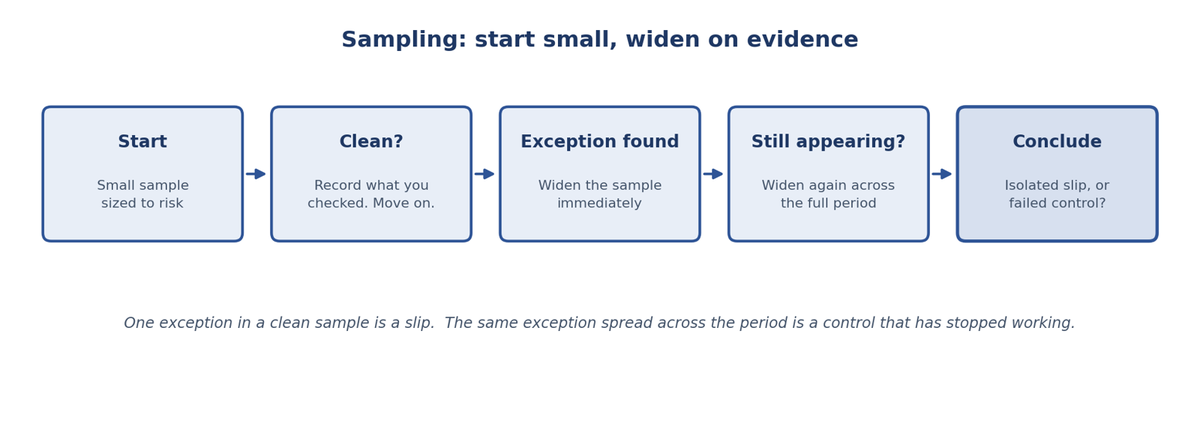
That last distinction matters more than anything else in the finding. One missing signature on one cleaning record is a lapse; the area corrects it and moves on. Nine missing signatures across thirty records is a control that has stopped functioning, and it needs a different response entirely. An auditor who stops at the first record never learns which one they are looking at.
Choosing a sample that represents the period
Convenience sampling is the most common weakness in internal auditing. The auditor asks for records, receives the ones nearest the top of the file, checks them, and finds them satisfactory. Those records were the most recent — and the most recent are usually the best kept.
| Sampling approach | What it tells you | When to use it |
|---|---|---|
| Across the period | Whether performance is consistent over months, not just this week | Default for routine documentation and record reviews |
| Around a known event | Whether a change, shutdown or staff turnover disturbed the control | After a line modification, new product introduction or reorganisation |
| Targeted at previous findings | Whether last year’s corrective action actually held | Follow-up audits and any area with a repeat history |
| Highest-risk product or line | Whether the control holds where failure would matter most | Risk-weighted audits with limited time |
| Random within a defined set | Whether performance is uniform when you have no reason to suspect otherwise | Large volumes of similar records |
The important habit is naming the sample in advance. “I will review five batch records spread across the last quarter, including one from each production line” is a decision an auditor can defend. “I looked at some records” is not, and it collapses the moment a finding is challenged.
Reading what the sample is telling you
| What you find | What it usually means | Appropriate response |
|---|---|---|
| One exception in a clean sample | An isolated human error | Note it, confirm correction, no system finding |
| Exceptions clustered in one period | Something changed then — staffing, equipment, workload | Widen around that period; investigate the trigger |
| Exceptions clustered on one shift or line | The control depends on individuals rather than the system | Finding against training, supervision or procedure clarity |
| Exceptions spread evenly throughout | The control is not functioning at all | System-level finding, likely major |
| No exceptions anywhere, ever | Verify the records are genuine before concluding all is well | Check for retrospective completion or identical handwriting |
That last row is not cynicism. Records that are too perfect are a recognised signal. The training covers how to test them without accusing anyone: auditors compare entry times against production schedules, check for corrections that should exist, and ask an operator to complete an entry in front of them.
What an internal auditor does on the floor
Sampling is not only about paperwork. The same logic applies to observation and to the people you speak with.
An auditor watching a single changeover has seen one changeover. If the SOP requires line clearance and the operator performs it correctly, that is encouraging but not conclusive. Watching a second changeover on a different shift, or asking a second operator to describe the same step, tests whether the control depends on the procedure or on one conscientious individual.
The same applies to interviews. Speaking only to the supervisor tells you what the supervisor believes happens. Speaking to two operators as well tells you whether that belief survives contact with the line.
Everything an auditor concludes is written down with references — the document number and revision, the batch numbers examined, the equipment ID, the date, the shift. A finding without references is an assertion, and assertions get argued away.
Who should attend cGMP internal auditor training
The course is aimed at people who will conduct internal audits, and at those who will be audited and want to understand what a competent auditor will do.
| Role | Relevance |
|---|---|
| QA officers and managers | Own the audit programme and decide sampling strategy |
| QC and laboratory staff | Test records, calibration and out-of-specification handling draw sustained sampling |
| Production supervisors | Audit other areas; also act on findings raised against their own |
| Engineering and validation | Calibration status, qualification records and change control |
| Warehouse and materials | Receipt, quarantine, release, storage conditions and traceability |
| Regulatory and compliance | Add practical audit method to existing requirements knowledge |
| Contract manufacturers | Face frequent client audits; also audit their own suppliers |
Previous audit experience is not assumed. Staff already working inside a GMP system apply the material fastest. Anyone new to manufacturing quality will find a cGMP foundation course an easier entry point before tackling audit technique, and teams auditing to other standards alongside cGMP can look at the wider ISO internal auditor training range on this site.

Skills developed
- Deciding sample size from risk rather than convenience
- Spreading a sample across a period so it represents more than last week
- Recognising when to widen a sample and when to stop
- Distinguishing an isolated exception from a failed control
- Recording references precisely enough for another person to verify
- Observing an operation more than once before concluding it is controlled
- Testing records that look too clean, without accusing anyone
- Wording findings so they state requirement, evidence and gap
- Judging whether a corrective action addresses cause or symptom
- Reporting in a form the area owner can act on
Why manufacturers in the UAE build this capability
Companies supplying regional distributors, export markets and multinational buyers face a steady flow of second-party audits. Each one asks broadly the same questions. A site with competent internal auditors has already asked them, already found the weak points, and already closed them — so the visit becomes routine rather than a risk.
There is a quieter benefit too. Sampling discipline changes behaviour. When people know records are read properly rather than glanced at, records get completed properly. That effect is worth more over a year than any single finding.
For wider background on how manufacturing-quality requirements are structured, IAS maintains an overview of GMP certification and an article on cGMP standards written for the region.
Training and certification are different
| cGMP internal auditor training | cGMP certification | |
|---|---|---|
| Subject | Individual employees | The company and its manufacturing facility |
| Audit type | First-party, run internally | Third-party, run by an independent body |
| Outcome | Competent auditors and a training record | A certificate covering a defined scope |
| Cadence | Continuous, following the internal audit programme | Initial assessment, then surveillance and recertification |
The relationship runs one way: a certified system is expected to audit itself, so trained auditors support certification. Attending a course does not certify a company, and no certificate removes the obligation to run internal audits.
cGMP internal auditor training in the UAE: course details
Fees and duration for cGMP internal auditor training in the UAE are quoted together once numbers and delivery route are known. Everyone finishing receives a certificate of completion listing the syllabus and date — the record showing auditor competence when your site is next assessed. Upcoming open sessions appear on the IAS training schedule.
Report writing is practised: wording a finding from your audit sampling so it survives challenge, and reaching a recurring problem’s root cause without naming anyone.
- Objective. Enable participants to plan, conduct, report and follow up internal audits of GMP and cGMP quality systems.
- Coverage. GMP and cGMP fundamentals, audit criteria and scope, planning, checklist preparation, sampling strategy. Record review, observation and interviewing, objective evidence, nonconformity classification. Finding and report writing, corrective-action review and effectiveness verification, auditor conduct and independence.
- Outcomes. Participants should be able to define a sample and defend it, conduct an audit against stated criteria, record referenced evidence, raise and word nonconformities, produce a report, and evaluate corrective actions.
Delivery formats
Available as classroom, live virtual, self-paced online, or in-house delivery at your UAE site. Companies training several people at once often use online cGMP internal auditor training for breadth and follow it with an in-house workshop on their own records; virtual cGMP training is the middle option where travel is the obstacle. The syllabus is set out in detail on the IAS GMP internal auditor training page, and other standards run through the same online ISO training programme.
Send your site location, product categories and the number of participants and we will recommend a format. Stated plainly, because it is often blurred: IAS trains auditors and certifies management systems. It does not license facilities or approve products, and no course changes that.
Ready to book? Browse IAS training in the UAE or send us your group size and preferred delivery route.
Frequently asked questions
Can an auditor examine everything instead of sampling?
Only in very small operations, and rarely usefully. Attempting full review usually means the audit runs out of time before it reaches the areas that matter. Sampling is not a compromise forced by time pressure — it is the correct method, provided the sample is chosen deliberately and widened when evidence calls for it.
What references should be recorded during the audit?
Enough for another person to reach the same conclusion without repeating your work. That means document numbers and revisions, batch or lot numbers, and equipment identifiers. It also means dates and shifts, the number of items sampled, and the specific observation. Notes recorded this way survive challenge at the closing meeting; notes written from memory afterwards generally do not.
Does the training apply to auditing suppliers as well?
The sampling logic transfers directly to second-party audits. Auditing a contract manufacturer or a material supplier uses the same reasoning about sample size, period coverage and escalation. What changes is your standing — you are a customer rather than a colleague — and the criteria, which come from your supply agreement as well as from GMP.
Who should audit which areas?
Auditors examine areas they are independent of. That usually means training a small cross-functional group so that no one reviews records they are responsible for. Independence is not a formality: an auditor with a stake in the outcome samples differently, often without realising it.
Does sampling strategy change between product categories?
The reasoning does not, but where the sample is spent does. A sterile manufacturer concentrates sampling on environmental monitoring, validation and batch documentation; a food producer on hygiene records, allergen changeovers and traceability; a cosmetics plant on formulation and batch control. The escalation logic is identical in all three.
How is a finding classified once the sample has been read?
By how far the evidence shows the system is affected, not by how many items were involved. A departure from a stated requirement is a nonconformity, graded major or minor according to whether the control has broken down or slipped once. A practice that currently meets the requirement but is heading for failure is raised as an observation or opportunity for improvement, so it is tracked without being overstated.
What happens if a corrective action does not work when it is verified?
The finding is reopened rather than quietly closed. A verification that fails usually means the original investigation reached a symptom instead of a cause — retraining an operator when the form itself was unworkable, for example. The course covers how to say that in a way that sends the investigation back to the right question instead of repeating the same action.
Who receives the internal audit report, and what happens next?
The report goes to the area audited and to the management responsible for it, and the findings enter the site’s corrective-action system. Each is investigated for cause, an action is agreed with an owner and a date, and the auditor later verifies that the action was implemented and held. Internal audit results are also a standing input to management review.