


Step into the Next Era of Environmental Management
Environmental responsibility is no longer optional — it's a core business priority. With the release of ISO 14001:2026, organizations are expected to take a more proactive, risk-based, and sustainability-driven approach to environmental management.
Our ISO 14001:2026 Migration Lead Auditor Training is designed to help professionals transition seamlessly from ISO 14001:2015 to the latest version. This course goes beyond theory, focusing on practical auditing skills, real-world application, and confidence-building exercises.
Whether you're an experienced auditor or involved in environmental compliance, this training prepares you to lead audits aligned with the latest environmental management system (EMS) standards.
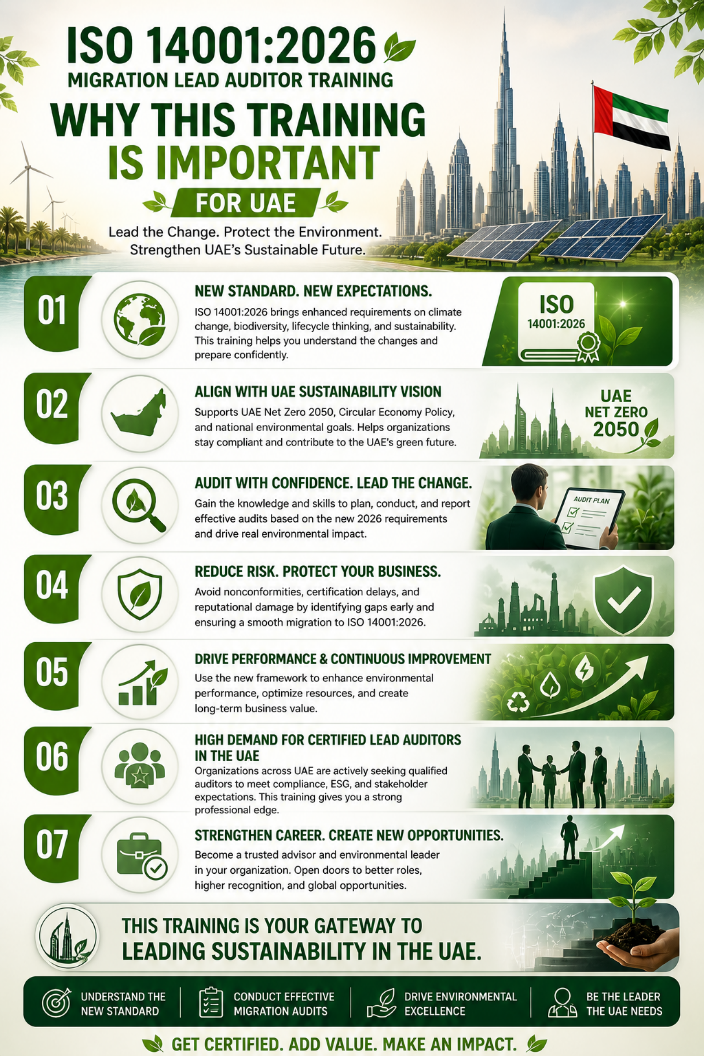
Why This Course is Important?
The updated ISO 14001:2026 standard introduces stronger emphasis on:
- Climate change and environmental risks
- Lifecycle thinking and sustainability
- Leadership accountability
- Risk-based environmental decision-making
- Integration with global ESG practices
This means auditors must evolve too. This ISO 14001 migration training ensures you stay ahead, relevant, and capable of auditing modern environmental systems effectively.
What This ISO 14001:2026 Training Covers?
This is a 2-day intensive ISO 14001 lead auditor course built around practical learning and real audit scenarios.
Day 1 – Understanding the Standard & Auditing Requirements
You'll build a strong foundation in:
- Key differences between ISO 14001:2015 and ISO 14001:2026
- Annex SL (Harmonized Structure) and its importance
- Context of the organization and EMS scope
- Leadership roles, environmental policy, and responsibilities
- Risk & opportunity management in environmental planning
- Environmental aspects, compliance obligations, and change management
- Documentation, communication, and awareness requirements
- Operational control and emergency preparedness
Hands-on activities include:
- Auditing clauses step-by-step
- Understanding EMS terminology
- Preparing audit checklists
- Evaluating real-life scenarios
Day 2 – Practical Auditing & Certification
The second day focuses on real auditing experience:
- Audit role plays (simulated audit situations)
- Interview techniques and evidence gathering
- Identifying and reporting non-conformities
- Writing professional audit reports
- Final written examination (Lead Auditor Certification)
By the end of Day 2, you'll feel confident conducting a complete ISO 14001:2026 audit.
Who Should Attend This Course?
This ISO 14001 certification training is ideal for:
- Existing ISO 14001 Lead Auditors upgrading to 2026
- Environmental Managers & Sustainability Professionals
- Internal Auditors and Compliance Officers
- EMS Consultants and Trainers
- Anyone involved in ISO 14001 implementation or transition
What You Will Gain?
After completing this ISO 14001:2026 lead auditor training, you will:
- Understand the latest ISO 14001:2026 requirements in depth
- Gain practical skills in environmental auditing and compliance
- Learn how to conduct migration audits effectively
- Improve your ability to assess environmental risks and impacts
- Enhance your career with a globally relevant EMS auditor certification
Training Approach
We keep the training highly engaging and practical:
- Real-world case studies
- Group discussions and activities
- Audit simulations and role plays
- Hands-on exercises for risk assessment
- Guidance from experienced auditors
This ensures you don't just learn — but actually apply what you learn.
Course Duration
- Total Duration: 2 Days
- Total Hours: 16 Hours
- Effective Training: ~14 Hours
Certification
Participants who successfully complete the training and examination will receive a recognized ISO 14001:2026 Lead Auditor Certificate, validating their competence in auditing environmental management systems.
Why Choose Us?
- Experienced trainers and real-time auditors
- Practical, activity-based learning approach
- Industry-relevant case studies
- Focus on ISO 14001 transition training
- Strong support for certification and career growth
Key Differences Between ISO 14001:2015 and ISO 14001:2026 — What Auditors Must Know
One of the most searched topics among environmental professionals is understanding exactly what has changed. Auditors transitioning from the 2015 version need clarity on the structural and requirement-level updates before stepping into any 2026 audit.
- Climate change is now explicitly addressed— ISO 14001:2026 requires organizations to consider climate change as a relevant environmental condition when determining their EMS context and setting objectives.
- Stronger lifecycle perspective— The 2026 revision deepens the lifecycle thinking requirement, expecting auditors to verify that organizations assess environmental impacts from raw material sourcing through to end-of-life disposal.
- Heightened leadership accountability— Top management responsibilities are more defined and auditable, with clearer expectations around environmental policy integration into business strategy.
- ESG and sustainability alignment— The new standard formally connects EMS requirements to broader Environmental, Social, and Governance (ESG) reporting frameworks, which is increasingly relevant for multinational organizations.
- Revised Annex SL alignment — Updates to the Harmonized Structure (Annex SL) ensure better compatibility with ISO 9001, ISO 45001, and other management system standards during integrated audits.
Understanding these changes is foundational to conducting a compliant and value-adding migration audit.
Contact Us
How to Prepare for the ISO 14001:2026 Migration Audit - A Practical Checklist for Organizations?
Organizations preparing for a migration audit often search for guidance on what to have ready before an external auditor arrives. Auditors trained in this program are equipped to assess readiness across all key areas.
- Gap analysis completed - Verify that the organization has formally compared its existing 2015-aligned EMS against 2026 requirements and documented identified gaps.
- Updated environmental policy - Confirm the policy references climate change considerations and is communicated across all levels of the organization.
- Revised context and scope documentation - Check that interested parties, external issues, and climate-related risks have been reassessed and updated.
- Lifecycle assessments in place - Review whether the organization has extended its environmental aspect register to include upstream supplier impacts and downstream product use.
- Competency and training records - Ensure all personnel with environmental responsibilities have been briefed on the 2026 changes and that records are maintained.
- Internal audit program updated - Confirm that internal audits have been revised to reference 2026 clauses and that at least one internal audit cycle under the new standard has been completed before the migration audit.
Career Benefits of Becoming a Certified ISO 14001:2026 Lead Auditor
Professionals searching "ISO 14001:2026 certification career value" are looking for concrete reasons to invest in this credential. Here is what the certification delivers:
- Global recognition— ISO 14001 is implemented in over 300,000 organizations across 170+ countries, making lead auditor certification a universally valued credential.
- Higher earning potential— certified lead auditors command premium rates in consulting, third-party certification bodies, and corporate EHS functions.
- Relevance in the ESG era— as companies face mounting pressure from investors, regulators, and customers on sustainability performance, ISO 14001:2026 auditors are in growing demand.
- Expanded audit scope— the 2026 standard's alignment with Annex SL allows certified auditors to conduct integrated audits across multiple ISO management systems, broadening their service offering.
- Regulatory compliance advantage— Organizations operating under environmental legislation increasingly use ISO 14001 certification to demonstrate due diligence, creating steady demand for qualified auditors.
Enquire Now
Ready to upgrade your skills and become a certified ISO 14001:2026 Lead Auditor?
Email us: enquiry@iascertification.com
Call us for batch schedules and fees
You can also request the application form and reserve your seat for upcoming batches.