


Independent third-party GMP/cGMP certification for Kuwaiti manufacturers, scoped to your products and backed by a fixed written quotation — provided by IAS under its UQAS accreditation. A GMP certificate issued this way names the scheme and scope it was assessed against, so a tender evaluator or distributor can see exactly what was covered.
- UQAS-accredited certification body
- Fixed written quotation, no hidden fees
- Nearly two decades of assessment experience across the Gulf
- Open to every industry, not just pharma and food
Want a figure you can budget against? Talk to an auditor and receive a fixed written quotation covering the whole assessment — contact IAS today.
At a glance
- Scope: audited against the applicable GMP/cGMP scheme for your product category — never one universal checklist.
- Eligible industries: manufacturing, processing and handling operations of every kind — medicines, food and drink, cosmetics, devices, nutraceuticals.
- Certification cycle: application, audit, certificate, annual surveillance, recertification.
- Pricing: one fixed written quotation before work begins — no flat price list, no hidden fees.
- Accreditation: IAS provides GMP/cGMP certification services under its UQAS accreditation.

Why Kuwait’s buyers are asking for documented manufacturing evidence
Kuwait’s procurement environment has grown more document-driven. Its manufacturing base covers food and beverage, pharmaceuticals, cosmetics, packaging and chemical processing. These producers now sell into government tenders, private distributor networks and export markets across the GCC.
- Not one universal certificate. Buyers use “cGMP” loosely, but it refers to good-manufacturing-practice requirements across several distinct frameworks. Certification is always issued against the specific scheme and scope named on the certificate.
- What it practically solves. A facility may be preparing a tender submission or qualifying for a distributor’s approved-supplier list. It may also be responding to a brand owner’s due-diligence questionnaire. In each case, it needs independently verified documentation to point to when asked.
- Not a substitute. An IAS certificate is never presented as approval, registration or clearance by any government authority, and does not replace any licence a Kuwaiti manufacturer is required to hold.
- A comparable form of evidence. Tender evaluation committees, distributors building approved-vendor lists, and hospital procurement offices all look for consistent, comparable evidence across bidders. A scoped, third-party certificate supplies exactly that.
Mapping Kuwait’s regulatory and standards landscape
Several bodies touch manufacturing quality in Kuwait, each with a distinct and non-overlapping role. Understanding who does what avoids the confusion that sometimes surrounds third-party certification.
| Body | Primary role in Kuwait | Relationship to IAS certification |
|---|---|---|
| Ministry of Health – Drug and Food Control Division | Registers and licenses pharmaceutical products, medicines and select food and cosmetic categories; conducts its own GMP-based inspections as part of licensing | Operates independently — an IAS certificate does not substitute for Drug and Food Control Division registration or licensing |
| Public Authority for Industry (PAI) | Issues industrial establishment licences and classifies industrial land use for manufacturing facilities | Addresses industrial licensing and land classification, not product-level GMP assessment |
| GCC and Kuwaiti standards bodies | Develop and apply regional technical regulations and product specifications | Set baseline product and labelling requirements, separate from third-party GMP/cGMP certification |
| World Health Organization (WHO) | Publishes GMP guidelines referenced by manufacturers and regulators internationally | A standard-setter only — WHO does not inspect facilities, regulate markets or issue certificates |
| US Food and Drug Administration (US FDA) | Regulates products manufactured for, or sold into, the United States market | Has no authority over Kuwaiti domestic or GCC-regional operations, and issues no certificates through third parties |
| IAS | Independent third-party body that assesses a facility’s documented manufacturing practices against the applicable GMP/cGMP scheme and scope | Provides certification services under its UQAS accreditation |
- Not FDA approval. FDA approval, registration and clearance lie beyond the reach of any certification body.
- Not a substitute for Drug and Food Control Division registration. Licences and registrations remain between you and the regulator.
Not sure which scheme applies to your products? Read the frequently asked questions or ask for a free scoping conversation.
One term, several rulebooks: matching cGMP requirements to your product category
cGMP is not a single certification standard — it is shorthand for good-manufacturing-practice requirements that differ by product category and by the framework a manufacturer chooses or is required to follow.
| Product category | Framework(s) commonly referenced | Typical Kuwaiti context |
|---|---|---|
| Pharmaceuticals and active ingredients | WHO GMP guidelines; PIC/S GMP Guide provisions | Referenced alongside Drug and Food Control Division product registration |
| Food and beverage | Codex Alimentarius GMP principles; HACCP-aligned GMP practices; regional food technical regulations | Relevant to Kuwait’s dates, dairy, bottled water and packaged-food producers |
| Cosmetics and personal care | ISO 22716 good manufacturing practice guideline | A growing personal-care manufacturing and repackaging segment |
| Medical devices | GMP principles aligned with ISO 13485 quality management requirements | Applicable to device assemblers, kitting operations and importer-repackers |
| Nutraceuticals and dietary supplements | Blended food- and pharma-referenced GMP principles, scoped case by case | Increasingly requested by GCC distributors and retail chains |
| Other industries (packaging, chemicals, animal feed, contract manufacturing, warehousing) | Scope defined against the client’s own quality system and general GMP principles applicable to its processes | Certification is available regardless of sector, scoped to the specific products and processes involved |
GMP/cGMP certification is not restricted to food, pharma, cosmetics or medical devices. Packaging converters, chemical processors, animal-feed producers, contract packers and warehousing operators can all apply, scoped to the products and processes actually carried out at their site. Device manufacturers often run this alongside ISO 13485 certification in Kuwait.
cGMP meaning: GMP vs cGMP in the Kuwaiti market
GMP and cGMP describe the same underlying discipline of documented, controlled manufacturing. The added “c” signals that practices are expected to be current: up-to-date methods, equipment and controls, not a fixed checklist adopted once and left unchanged.
Most Kuwaiti manufacturers encounter the two terms used interchangeably by buyers, distributors and tender documents, even though a certificate itself will name the specific scheme it was assessed against.
Areas typically examined
Depending on the applicable scheme and product category:
- Premises and environment — layout, hygiene design and environmental controls appropriate to the products handled.
- Equipment — qualification, calibration and maintenance documentation.
- Raw materials and suppliers — control including incoming inspection where applicable.
- Process control — in-process checks and batch or production record-keeping.
- Change control — handling of deviations or nonconformities.
- Personnel — training records and documented responsibilities.
- Storage and traceability — labelling and traceability through to dispatch.
Documentation commonly reviewed
As applicable to the scheme and product category — never treated as a universal checklist:
- Quality manual and SOPs — controlled and current.
- CAPA and change-control logs — corrective and preventive action records.
- Validation or qualification records — where the scheme requires them.
- Batch or production records — contemporaneous and complete.
- Data-integrity controls — where electronic systems are used.
How to get a GMP certificate in Kuwait: the IAS assessment journey
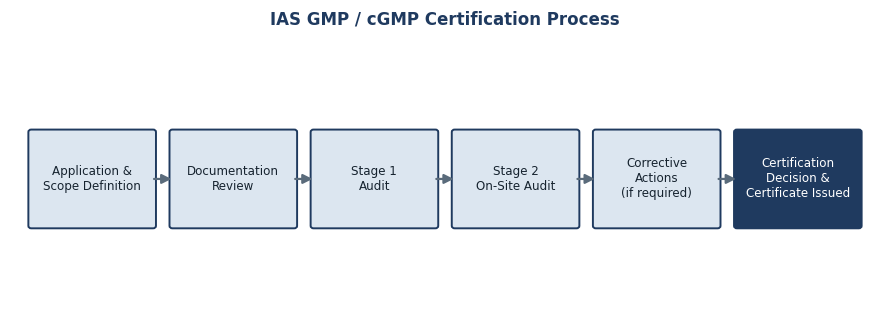
IAS follows a structured assessment sequence, scoped to the GMP/cGMP framework agreed with the client at the outset.
- Application and scope definition — the client and IAS agree the applicable scheme, product families and sites to be covered.
- Documentation review — the quality manual, SOPs and supporting records relevant to the agreed scope are reviewed.
- Stage 1 audit — readiness and documentation completeness are checked ahead of the on-site assessment.
- Stage 2 on-site audit — assessors examine the facility’s actual manufacturing practices against the agreed scheme.
- Corrective actions, if required — any nonconformities identified are addressed and evidenced before the decision is finalised.
- Certification decision and certificate issued — an independent review confirms the outcome and the certificate, naming its scheme and scope, is issued.

GMP certification cost in Kuwait: what determines cost and duration
GMP certification cost in Kuwait is quoted per facility. IAS does not apply a flat price list or a fixed week-by-week timeline. Facility size, product scope and existing documentation maturity vary enormously between a small contract packer and a multi-line food or pharmaceutical plant. Every applicant receives a fixed, written quotation before work begins.
| Factor | Effect on cost | Effect on timeline |
|---|---|---|
| Facility size and number of production lines | More lines and areas mean more audit time to assess | Longer on-site audit duration |
| Number and complexity of product families in scope | Broader scope increases assessment depth required | Affects document review and audit scheduling |
| Current state of the documented quality system | A less mature system generally means more preparation effort outside IAS’s own fee | Extends time needed before the facility is audit-ready |
| Number of sites or locations covered | Each additional site adds audit scope | Additional coordination and audit days |
| Applicable scheme(s) selected | Some frameworks require a more extensive document and process review | Can lengthen the review and decision stages |
The IAS commitment. Cost is known and agreed in advance, in writing, rather than estimated after the fact.
Certification timeline and validity
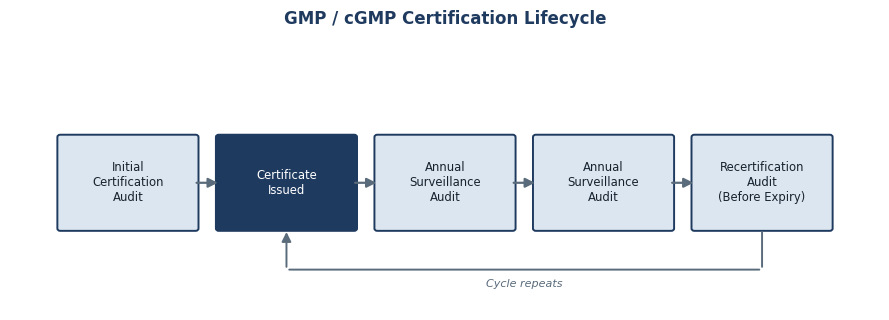
Rather than a fixed calendar timeline, certification follows a lifecycle:
- Initial certification audit — scoped to the agreed scheme and product families.
- Certificate issuance — naming the scheme and scope it was assessed against.
- Periodic surveillance audits confirm practices remain in control. They matter to a tender evaluator or distributor as much as the initial certificate, because they show documented practices have held up under scrutiny rather than a one-time snapshot.
- Recertification audit — before the certificate’s period ends.
Quality teams often keep the cycle steady between IAS visits by developing their own auditors through cGMP internal auditor training in Kuwait.
Want a real number, not a range? Request your fixed written quotation.
Tender and supply-chain documentation: what Kuwaiti buyers are actually asking for
Beyond regulatory licensing, government procurement, hospital supply contracts and private distribution agreements each look for a slightly different piece of documented assurance. A certificate that names its scheme and scope functions as a compact, independently verified summary — reusable across multiple procurement relationships instead of a fresh due-diligence questionnaire for every buyer.
| Buyer / procurement context | What is typically requested | How certification supports it |
|---|---|---|
| Government ministries and public-sector tenders | Evidence of a documented, auditable manufacturing quality system alongside required licences | An IAS certificate gives an independently verified reference point to include in a bid file |
| Ministry of Health Central Medical Stores and hospital supply contracts | Manufacturing traceability, batch control and corrective-action records | The certificate’s scope confirms these elements were independently assessed |
| Private distributors and GCC re-export partners | Assurance that the exporting facility’s practices are documented and consistently applied | The certificate and its scope statement can be shared directly with distributors and downstream buyers |
| Multinational brand owners using Kuwaiti contract manufacturers | A recognised third-party assessment rather than the manufacturer’s own self-declaration | Reduces the buyer’s own on-site audit burden and supports vendor approval |
cGMP certification in Kuwait: who is pursuing it
Certification is open to any manufacturing, processing or handling operation prepared to have its documented practices independently assessed — not limited to a fixed list of sectors. Kuwait’s own re-export and distribution role across the GCC means both local producers and importer-repackers look for the same documented reassurance. Applicants typically include:
- Pharmaceutical manufacturers and repackagers registered with the Drug and Food Control Division
- Food, beverage and dairy producers, including bottled-water and date-processing facilities
- Cosmetics and personal-care manufacturers and private-label formulators
- Nutraceutical and dietary-supplement producers supplying regional retail and pharmacy chains
- Medical-device assemblers, kitting operations and importer-repackers
- Contract manufacturers and third-party packers serving multiple brand owners
- Packaging converters, chemical processors, animal-feed producers and warehousing/distribution operators
For all of these, the certificate’s value lies in what it independently confirms about documented practice — not in replacing any licence, registration or inspection the operator is already required to hold. Food and beverage sites commonly pair it with HACCP certification in Kuwait or ISO 22000 certification in Kuwait.
See where your operation fits? Get a free consultation — no obligation.
Quick definitions
- GMP. Good Manufacturing Practice — the general term for documented, controlled manufacturing.
- cGMP. Current Good Manufacturing Practice — the same discipline, with the explicit expectation that methods, equipment and controls stay up to date.
- Scheme and scope. The standard used as the yardstick, and the product range it is applied to.
- Surveillance audit. A recurring check on whether the certified system remains in use.
- Recertification. The complete reassessment that renews the cycle.
Your next step toward GMP/cGMP certification in Kuwait
IAS brings nearly two decades of assessment experience to manufacturers across the Gulf, providing GMP/cGMP certification services under its UQAS accreditation. Whether you are preparing a government tender submission, qualifying for a distributor’s approved-supplier list, or formalising documented practice across a growing product line, the process starts with a conversation about your facility’s scope.
- Explore related options on the IAS ISO certification in Kuwait hub, including ISO 9001 certification in Kuwait.
- Browse the product certification and system certification schemes available across the region.
- For self-study on the topic, IAS also offers online ISO training.
Ready to discuss GMP/cGMP certification for your facility? Contact IAS today.
Frequently asked questions
Is GMP or cGMP certification a legal requirement for manufacturers in Kuwait?
No single law makes third-party GMP/cGMP certification mandatory across all sectors; regulatory licensing through bodies such as the Drug and Food Control Division is the legal requirement. Certification is a voluntary, independent addition many manufacturers pursue to support tenders, exports and buyer due diligence.
Does an IAS GMP/cGMP certificate replace Kuwait Ministry of Health GMP registration with the Drug and Food Control Division?
No. An IAS certificate is an independent assessment of documented manufacturing practice. It never substitutes for Drug and Food Control Division registration or licensing, nor for any other regulatory approval a Kuwaiti manufacturer is required to hold.
Our facility already underwent a Ministry of Health inspection — why pursue separate certification?
A regulatory inspection confirms compliance with licensing conditions for that authority’s own remit. Third-party certification is a separate, independently verified assessment that can be presented directly to tender evaluators, distributors and overseas buyers who are not privy to the regulator’s inspection file.
Does GMP/cGMP certification improve our standing in Kuwait government and semi-government tenders?
It can strengthen a bid by providing independently verified documentation of manufacturing quality practices alongside required regulatory licences, which many tender evaluators and hospital supply contracts increasingly look for as supporting evidence.
Is GMP/cGMP certification only available to pharmaceutical, food and cosmetics manufacturers?
No. Certification is open to any industry, including packaging, chemicals, animal feed, contract manufacturing and warehousing, with the assessment scope defined around the applicant’s own products and processes.
How does certification help a Kuwait-based company that re-exports or distributes goods across the GCC?
A certificate and its stated scope give regional distributors and re-export partners a documented, independently verified reference. They can rely on it instead of accepting the manufacturer’s own declarations, which can simplify onboarding across neighbouring GCC markets.
What happens if the audit team identifies nonconformities at our facility?
Nonconformities are documented with a defined timeframe to submit corrective action evidence. Certification proceeds once the evidence is reviewed and accepted; unresolved major nonconformities will delay or prevent certification until addressed.
Can a distribution or trading company without its own manufacturing site pursue GMP/cGMP certification?
Certification is scoped to the activities actually carried out at a site, such as storage, repackaging or labelling. A pure trading operation with no such activities would need to define a relevant scope with IAS before an assessment can proceed.
