


Kuwait’s New FSSC 22000 PRP Playbook: Version 6 vs Version 7 Explained
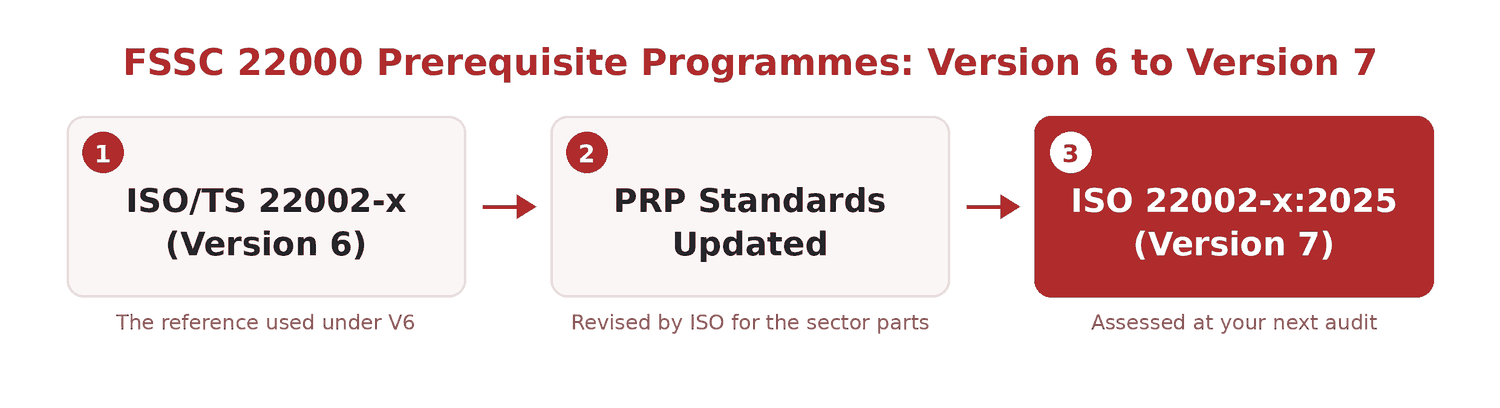
The core PRP change between FSSC 22000 Version 6 and Version 7 is that prerequisite programme references move from the older ISO/TS 22002-x series to the newer ISO 22002-x:2025 series of sector-specific standards. For food manufacturers, packaging producers and other certified sites in Kuwait, this means the sector PRP standard your food safety management system is verified against is being updated, and your next audit will assess PRP compliance against the updated 2025-series references instead of the Version 6 wording. This guide walks Kuwait-based teams through exactly what changed, why it changed, and what to do about it before the next audit.
Key Changes at a Glance
- PRP references shift from the ISO/TS 22002-x series to the ISO 22002-x:2025 series under Version 7.
- The relevant sector standard (manufacturing, catering, packaging, transport, storage) depends on your category.
- Kuwait sites are assessed against the updated references at their next scheduled audit, not a new cycle.
- Reviewing current PRP documentation against the 2025 wording ahead of time closes gaps proactively.
- PRPs remain the operational foundation that HACCP-based food safety management systems are built on.
- The PRP update keeps FSSC 22000 aligned with evolving, GFSI-recognised industry practice worldwide.
- Internal auditors trained on Version 7 PRP references can catch gaps before an external audit does.
What Are PRPs and Why the Standard References Changed
Prerequisite programmes are the basic operational and environmental conditions — hygiene practices, pest control, cleaning and sanitation, facility design and maintenance, among others — that a food business needs in place before its HACCP-based food safety management system can function effectively. FSSC 22000 has always required certified sites to implement PRPs aligned with a recognised sector-specific technical specification rather than leaving PRP content generic or self-defined, which is part of what distinguishes it from less structured food safety programmes. Auditors verify PRPs first precisely because a weak operational foundation undermines everything built on top of it.
Under FSSC 22000 Version 6, those sector PRP requirements were referenced against the ISO/TS 22002-x series of technical specifications. FSSC 22000 Version 7 updates this reference to the newer ISO 22002-x:2025 series, reflecting the formal revision of these sector-specific PRP standards by ISO, and bringing the referenced language up to date with how the sector standards themselves have evolved.
The ‘x’ in ISO 22002-x covers different sectors — food manufacturing, catering, packaging, and transport and storage, among others — so the exact standard that applies to a given site in Kuwait depends on its specific sector category rather than being a single one-size-fits-all reference. Knowing which specific part applies to your operation is the first step in any PRP gap review, and your certification body can confirm this if your site’s activities are not clear-cut.
What Kuwait-Based Certified Sites Need to Do
If your organisation in Kuwait is already FSSC 22000 certified, you do not need to overhaul your PRPs overnight. The PRP reference update is assessed at your next scheduled surveillance or recertification audit as part of your site’s move to Version 7, rather than triggering a separate certification cycle of its own or an additional unscheduled visit.
That said, it is worth reviewing your current PRP documentation against the relevant ISO 22002-x:2025 sector standard well ahead of that audit, so any gaps between your existing procedures and the updated wording can be closed proactively rather than flagged as a nonconformity during the audit itself, which is a more disruptive way to discover the same gap.
This is particularly relevant for Kuwait’s food manufacturing and food packaging sectors, where PRP scope tends to be broad and detailed, covering everything from supplier approval through to pest management and equipment maintenance procedures, all of which can be affected by clause-level changes in the updated 2025 series. Involving operations staff, not only the quality team, in this review tends to surface practical gaps that a document-only review can miss.
PRPs in Context: FSSC 22000, ISO 22000 and GFSI Recognition
FSSC 22000 combines the ISO 22000 food safety management system base standard with these sector-specific PRP technical specifications and FSSC’s own additional scheme requirements. This combination is precisely what allows FSSC 22000 to be recognised under GFSI benchmarking, giving certified organisations in Kuwait a certificate that is accepted by major retailers and food businesses internationally, not just within the domestic market. Losing that recognition, or letting PRP compliance lapse against the current reference standard, would undermine the value of the certificate for export-focused Kuwaiti businesses in particular.
Keeping PRP references current with the latest ISO 22002-x:2025 series is one of the ways FSSC keeps the scheme aligned with evolving industry practice, alongside the other Version 7 updates to auditor qualification, food chain category definitions and sustainability requirements. Each of these changes reinforces the same underlying goal of keeping FSSC 22000 credible against GFSI’s own benchmarking cycle.
For a fuller view of how the PRP update fits into the rest of the Version 7 changes, our FSSC 22000 certification page for Kuwait covers the complete set of updates certified organisations across the region are working through right now, which is worth reviewing alongside your PRP-specific preparation.
Mistakes to Avoid With the PRP Transition
One common mistake is assuming the PRP reference change is purely a documentation formality. In practice, the ISO 22002-x:2025 series can include revised or expanded requirements in specific clauses, so a straight relabelling exercise without a genuine content review risks missing real gaps that an auditor will still find, sometimes in areas the team assumed were already covered.
Another mistake is waiting for the certification body to identify PRP gaps during the audit itself. Because PRPs are foundational to the whole food safety management system, nonconformities found here can be more disruptive to resolve under time pressure than issues caught and corrected internally beforehand with no audit clock running. Corrective action plans agreed under pressure tend to be less thorough than changes made with adequate lead time.
A third mistake is treating PRP content as identical across every sector standard. Kuwait sites with more than one activity type — manufacturing and storage, for example — need to confirm which specific part of the ISO 22002-x:2025 series applies to each part of their operation, since applying the wrong sector reference can itself become a finding. When in doubt, your certification body can confirm which part of the series governs each activity.
Preparing Your Kuwait Site With IAS Gulf
Because the PRP change is technical and sector-specific, it is one of the areas where trained internal auditors make the biggest difference — someone on your team needs to actually compare your current PRP procedures against the new ISO 22002-x:2025 wording before the external audit does it for you and turns a gap into a formal finding.
IAS Gulf supports FSSC 22000 certified organisations in Kuwait with training that covers this PRP transition in detail, alongside the rest of the Version 7 changes. To get your team ready, explore the FSSC 22000 Lead Auditor and Internal Auditor Training programmes and book your audit team in before the transition window closes.
Because Kuwait’s food manufacturing and packaging sectors often operate to tight production schedules, resolving PRP documentation gaps well before the audit date, rather than during it, helps avoid unplanned corrective action timelines that can disrupt normal operations. A structured internal review, guided by staff who understand the updated ISO 22002-x:2025 wording, is the most efficient way to get there.
FSSC 22000 Version 6 vs Version 7: PRP Standards at a Glance
| Aspect | Version 6 | Version 7 |
|---|---|---|
| PRP reference standard | ISO/TS 22002-x series | ISO 22002-x:2025 series |
| Sector coverage | Manufacturing, catering, packaging, transport and storage under ISO/TS 22002-x | Same sectors, now under the revised ISO 22002-x:2025 parts |
| Assessment trigger | Assessed at every surveillance and recertification audit | Assessed against 2025-series wording starting with each site’s Version 7 audit |
| Documentation review | Aligned to older ISO/TS 22002-x clause wording | Requires review and realignment to updated 2025-series clause wording |
| Certification cycle impact | Not applicable | No new certification cycle triggered; assessed at next scheduled audit |
| Relation to GFSI recognition | Supports GFSI-recognised status via ISO/TS-based PRPs | Supports GFSI-recognised status via current ISO 22002-x:2025-based PRPs |
Note: exact FSSC 22000 Version 6 to Version 7 transition and cascade dates should be confirmed directly with your certification body.
About the author
Dr. C.D. Mohana Priya is a molecular geneticist, Associate Professor (Research) at Sri Ramachandra Institute of Higher Education and Research, Chennai, and an ISO 22000:2018 Lead Auditor, ISO 9001:2015 Lead Auditor and ISO 15189:2022 Internal Auditor. With 15+ years spanning laboratory quality management, food-safety systems and management-system training, she brings a scientific, standards-based rigour to FSSC 22000 auditor education.
Frequently Asked Questions
What is the main PRP change in FSSC 22000 Version 7?
PRP references move from the ISO/TS 22002-x series used under Version 6 to the newer ISO 22002-x:2025 series of sector-specific PRP standards. This is one of several substantive Version 7 changes.
Do I need new PRPs for FSSC 22000 Version 7 in Kuwait?
You need to review and align your existing PRPs with the relevant ISO 22002-x:2025 sector standard; this is assessed at your next scheduled surveillance or recertification audit, not immediately.
Which ISO 22002-x standard applies to my site?
It depends on your sector — separate parts of the ISO 22002-x series cover food manufacturing, catering, packaging, and transport and storage, among others. Confirm the correct part with your certification body if in doubt.
Is FSSC 22000 still based on ISO 22000 under Version 7?
Yes. FSSC 22000 Version 7 remains built on the ISO 22000 food safety management system base standard, combined with sector PRP standards and FSSC’s additional requirements.
Can my internal audit team check PRP compliance before the external audit?
Yes, and it is recommended. A trained internal auditor can compare current PRP procedures against the ISO 22002-x:2025 wording and flag gaps well ahead of the external audit, reducing the risk of nonconformities.
Who should be involved in a PRP gap review at a Kuwait site?
Operations staff as well as the quality team — pest control, cleaning and maintenance procedures are usually run day to day by people outside the quality function, and a document-only review tends to miss how those procedures actually work on the floor.


