


Half of what an internal auditor learns is how to hold a useful conversation. cGMP internal auditor training covers auditing a manufacturing operation against current Good Manufacturing Practice requirements, and questioning technique is one of the skills it builds. Auditors ask the people who run the process to explain what they do, then listen carefully enough to notice when the answer does not match the procedure.
Records tell you what was written down. Observation tells you what happened once, while you were watching. Talking to the person doing the job tells you whether the system has been understood well enough to be used when nobody is watching. That third source is the one new auditors handle least well, and it is entirely teachable.

Training a team in Kuwait? Contact IAS with your site, product categories and participant numbers for a delivery proposal.
What cGMP internal auditor training covers
Staff are prepared to examine their own organisation against GMP and cGMP requirements and against the procedures the company has documented for itself.
cGMP emphasises that a quality system must stay current: procedures, training and records are expected to track how the plant actually runs. Interviews are often where that gap first becomes visible. An operator describing a workaround they have used for months is telling you the SOP no longer matches reality, long before the records will show it.
The course covers GMP fundamentals, the full audit method from planning to follow-up, and auditor conduct. Assessment of the site by an outside body is something different, and the cGMP certification in Kuwait page explains it.
Asking questions that produce evidence
Most poor interviews fail in the first sentence. A closed question invites a one-word answer, and a one-word answer is not evidence of anything.
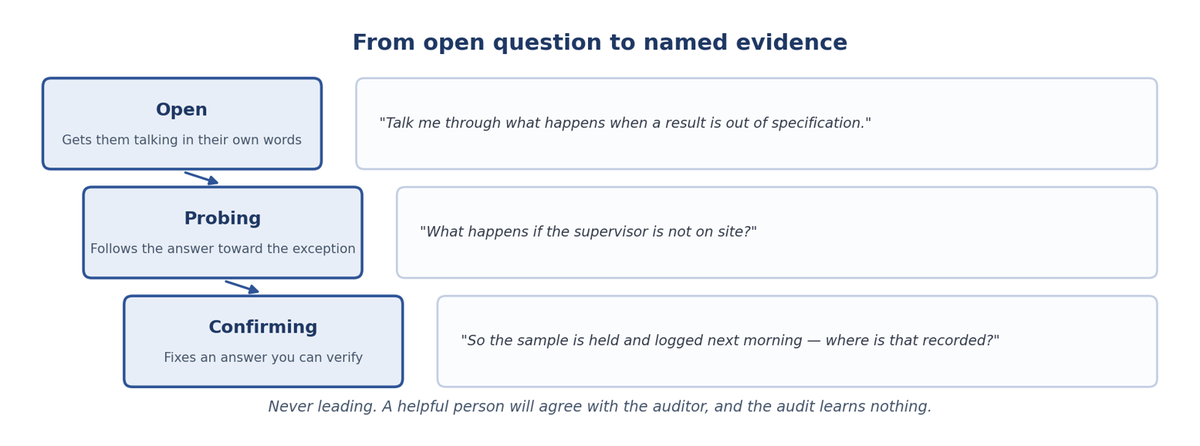
The pattern works because each stage does a different job. The opening question gets the person talking in their own words about what they actually do. The probing question follows whatever they said toward the detail that matters. The confirming question fixes the answer in a form the auditor can record and reference.
An example runs like this. “Talk me through what happens when a result falls outside specification.” The analyst describes the process. “You mentioned you inform the supervisor — what happens if the supervisor is not on site?” The analyst explains the actual practice, which may or may not match the SOP. “So the sample is held and logged the following morning — where would I see that recorded?” Now there is something specific to examine.
Three questions, and the auditor has moved from a general topic to a named record they can request.
Question types and what they are for
| Question type | Example | What it produces |
|---|---|---|
| Open | “Show me how you record a line clearance.” | The person’s own account, in their own words |
| Probing | “What happens if the previous batch record is not signed off yet?” | The exceptions and workarounds that procedures rarely describe |
| Confirming | “So you hold the line until QA releases it — is that right?” | An answer the auditor can quote and check against records |
| Closed | “Do you follow the cleaning SOP?” | Almost nothing; the answer is yes |
| Leading | “You always verify the weight, don’t you?” | Worse than nothing; it teaches the person what you want to hear |
The last two are the ones to avoid. Closed questions waste the opportunity. Leading questions actively contaminate the evidence, because a helpful person will agree with the auditor and the audit learns nothing.
Listening for what is not said
Interviewing is mostly listening, and the training covers what to attend to.
Hesitation before an answer is not evidence of anything wrong, but it marks a place worth exploring. So does an answer that describes the procedure in the procedure’s own words — that often means the person has read it recently rather than that they perform it that way. So does a workaround mentioned casually and then withdrawn.
The auditor’s response to all of these is the same: stay neutral, ask an open follow-up, and go and look. An interview identifies where to look; records and observation confirm what is there. A finding never rests on a conversation alone.
Tone, and why an anxious interviewee is a worse source
People being interviewed by a colleague from another department are often anxious about consequences, and anxious people give worse information. The training covers how to open an interview: the auditor explains that the audit examines the process rather than the person, and that findings are written against systems. A settled interviewee is a more useful one.
Observation, and what counts as genuine
The companion skill is watching. An auditor should see an activity happening for its own reasons, not performed for their benefit.
A staged demonstration shows how an operator behaves when observed by someone with a clipboard, which is reliably better than normal practice. Where an activity is scheduled — a changeover, a batch start, a weighing operation — the audit should be timed to catch it. Where an activity is genuinely infrequent, the auditor relies more on records and interviews and says so in the report rather than pretending otherwise.
What an internal auditor does overall
The interview sits inside a larger routine. The auditor prepares by reading the relevant procedures, the previous report and any open corrective actions, and drafts a checklist that names sources and samples. During the audit they observe, interview and review records, comparing all three against the criteria and recording referenced evidence as they go. Findings are drafted and classified before the closing meeting, written as requirement, evidence and gap. Afterwards, the corrective action is reviewed and its effectiveness verified.
Who should attend cGMP internal auditor training
| Participant | Why the questioning focus helps |
|---|---|
| QA officers and managers | Conduct most internal interviews and set the tone for the programme |
| Production supervisors | Both interview others and are interviewed; understanding both sides helps |
| QC and laboratory personnel | Out-of-specification and deviation handling is best explored through conversation |
| Engineering and maintenance | Equipment history often lives in people’s heads before it reaches records |
| Warehouse and materials staff | Receipt and storage practices vary between shifts more than records suggest |
| Compliance and regulatory staff | Add interview technique to requirements knowledge |
| Newly appointed internal auditors | Questioning is the skill new auditors most often lack |
No previous audit experience is assumed. Employees already working in a GMP environment progress quickest; those new to manufacturing quality generally start with a cGMP foundation course. Teams auditing to other standards alongside cGMP can look at the wider ISO internal auditor training range on this site.

Skills participants develop
- Opening an interview so the person is willing to talk openly
- Asking open questions instead of closed ones, consistently
- Following an answer with a probing question rather than moving to the next checklist item
- Confirming an answer in words the auditor can record and verify
- Avoiding leading questions that hand the answer to the interviewee
- Noticing when someone is reciting a procedure rather than describing their work
- Treating a conversation as a pointer to evidence, never as the evidence itself
- Timing observation so activities are seen genuinely rather than demonstrated
- Recording referenced evidence during the audit rather than afterwards
- Wording findings against processes rather than the people interviewed
What sites gain
Interviews surface the things records cannot. A document review will not show a procedure that nobody can follow as written. Nor will it show a step everyone skips because the equipment makes it impractical. It will also miss a handover that works only because one experienced operator remembers to do it. They appear when someone asks.
Finding them internally is considerably cheaper than having a customer auditor find them. It is also more useful, because the fix can be designed with the people who identified the problem rather than imposed after an external report.
For readers who want the requirements context behind all of this, the IAS overview of GMP certification and the regional piece on cGMP standards are useful starting points.
Training compared with certification
| cGMP internal auditor training | cGMP certification | |
|---|---|---|
| Subject | Individual employees | The organisation and its facility |
| Audit type | First-party, conducted internally | Third-party, conducted independently |
| Outcome | Trained auditors and a training record | A certificate covering a defined scope |
| Continues as | An ongoing internal audit programme | Surveillance and recertification |
Certification bodies expect to see internal audits being run competently, so developing auditors strengthens a certified system. It does not, however, produce a certificate — and a company holding one still has to audit itself.
cGMP internal auditor training in Kuwait: course details
The duration of cGMP internal auditor training in Kuwait depends on the delivery route chosen, and fees are quoted alongside it rather than separately. Those finishing receive a certificate of completion naming what the course covered, which is what an assessor asks for when reviewing auditor competence. Upcoming open sessions appear on the IAS training schedule.
Report writing is included: wording a finding that stands up to challenge, and reaching a recurring problem’s cause without naming anyone interviewed.
- Objective. This cGMP internal audit course prepares participants to plan, conduct, interview, report and follow up internal audits of GMP and cGMP quality systems.
- Coverage. GMP and cGMP fundamentals; criteria and scope; planning and checklist preparation; questioning technique and interview conduct; observation; record review; objective evidence; nonconformity classification; findings and report writing; corrective-action review and verification; auditor independence.
- Outcomes. Participants should be able to plan and run an internal audit, and to interview personnel productively without leading them. They should gather referenced evidence from observation and records, and raise and word nonconformities. They should also produce a report and evaluate corrective actions.
Delivery formats
Sessions run in classroom, live virtual, self-paced online and in-house form. Questioning technique benefits from live practice, so groups often combine online cGMP internal auditor training for the knowledge component with a live session for the interview exercises; virtual cGMP training supports those exercises remotely. The full syllabus for Kuwait sessions sits on the IAS GMP internal auditor training page, and other standards run through the same online ISO training programme.
Send us your site location, product categories and participant numbers and we will suggest a format. Stated directly, since it is often assumed otherwise: IAS trains auditors and certifies management systems. It does not license facilities or approve products — those remain with regulators.
Ready to book? Contact the IAS Kuwait team with your group size and preferred delivery route.
Frequently asked questions
What if an operator gives an answer that contradicts the supervisor?
That contradiction is useful information rather than a problem to resolve on the spot. It usually means the procedure is understood differently at different levels, which is itself worth examining. The auditor notes both accounts, then goes to the records and the floor to establish which reflects actual practice.
Is it appropriate to interview operators, or should audits stay with supervisors?
Operators should be included. Supervisors describe how the system is intended to work; operators describe how it works on a Tuesday afternoon when a machine has stopped. Both perspectives are needed, and an audit that speaks only to management consistently misses the practical departures that matter most.
Should an interview be conducted with a supervisor present?
Usually not, for the operator’s sake as much as the audit’s. People describe their actual practice more openly without their manager listening, and the workarounds an audit needs to find are exactly what gets left unsaid. Supervisors are interviewed separately about the same process, and any difference between the two accounts is itself worth investigating.
What if someone refuses to answer or defers everything to their manager?
That is usually anxiety rather than obstruction, and it is handled by re-establishing the framing — the audit looks at the process, not at the person. If it persists, the auditor moves to records and observation, notes that the interview was not productive, and does not press. Pressure produces compliant answers, which are worse than no answers.
Can an internal auditor audit their own department?
No. Internal audit depends on the auditor being independent of the activity under review, which is why sites train people across several functions and pair them across departments. Someone from QC can audit production and vice versa; nobody audits work they perform, supervise or approve themselves.
How many people should be interviewed, and how are they chosen?
Enough to cover the shifts and roles the process actually runs on, rather than whoever is available at the time of the visit. A process worked by three shifts is not represented by one day-shift conversation, and the auditor selects across roles so that the account of the work does not come only from the people who wrote the procedure.
Is every finding raised during an audit a nonconformity?
No. Findings are classified, and the classification is part of what the training covers. A departure from a stated requirement is a nonconformity, graded by how far the system is affected. A practice that currently meets the requirement but is likely to fail is normally raised as an observation or opportunity for improvement, so it is tracked without being overstated.
Who receives the internal audit report, and what happens after it is issued?
The report goes to the area audited and to the management responsible for it, and the findings enter the site’s corrective-action system. Each is investigated for cause, an action is agreed with an owner and a date, and the auditor later verifies that the action was implemented and worked. A finding is closed on evidence, not on a promise.
