


Build the Audit Capability Your Organization Needs - From the Inside
Environmental responsibility is no longer optional — it's a core business priority. As ISO 14001:2026 reshapes the expectations placed on environmental management systems, organisations cannot afford to rely solely on external auditors to identify gaps and drive improvement. The first line of defence is a capable, well-trained internal auditor who understands the updated requirements and knows how to apply them on the ground.
Our ISO 14001:2026 Migration Internal Auditor Training is a focused, two-day programme designed for professionals already working within or alongside an Environmental Management System (EMS). This is not a generic auditing course — it is built specifically for the transition from ISO 14001:2015 to ISO 14001:2026, giving internal auditors exactly what they need to update their skills without retraining from scratch.
If your organisation is preparing for a migration audit, surveillance visit, or simply wants its internal audit programme to reflect the 2026 requirements, this training is the right starting point.
What Makes ISO 14001:2026 Internal Auditing Different?
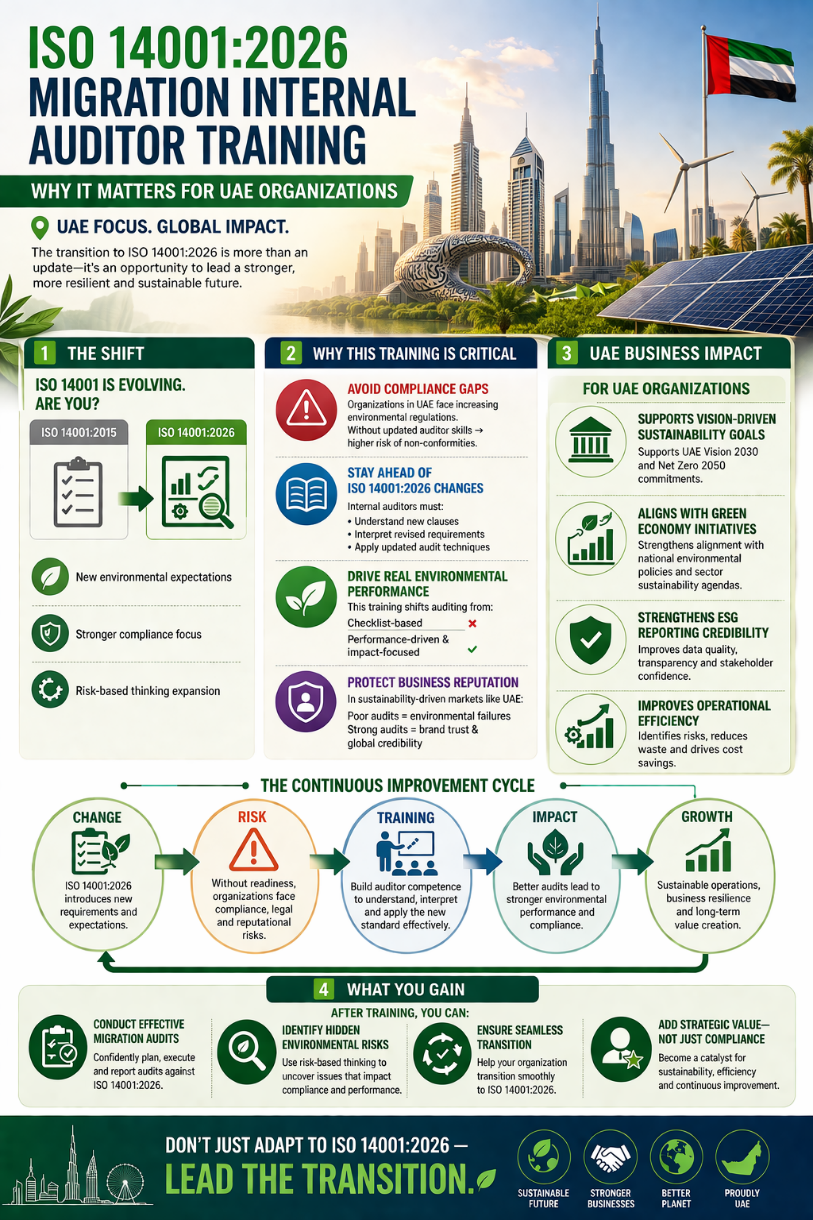
The shift from the 2015 to the 2026 version is not cosmetic. Internal auditors operating under the updated standard must now evaluate areas that were either absent or less defined in the previous version:
- Climate change integration— Internal auditors must now verify that climate-related environmental risks and opportunities are formally considered in the organisation's context, planning, and objectives.
- Lifecycle thinking in practice— The 2026 version requires a traceable, documented approach to lifecycle considerations. Internal auditors need to check whether aspect registers extend from supplier inputs through to product end-of-life.
- Leadership and accountability— Top management's environmental commitments are more auditable under the new standard. Internal auditors must be equipped to assess policy communication, resource allocation, and strategic integration.
- ESG-aligned performance evaluation— Organisations are increasingly expected to demonstrate environmental performance through ESG metrics. Internal auditors need to understand how EMS outputs connect to sustainability reporting obligations.
- Updated Annex SL alignment— The harmonised structure in ISO 14001:2026 makes integrated auditing with ISO 9001 and ISO 45001 more straightforward — but only for auditors who understand how the structures map across.
What This ISO 14001:2026 Training Covers?
This is a two-day intensive programme structured to maximise practical application. Every session is grounded in real audit scenarios drawn from EMS environments across manufacturing, services, logistics, and public sector organisations.
Day 1 — Standard Requirements and the 2026 Transition
You will build a strong foundation in:
- Overview of ISO 14001:2026 structure and Annex SL alignment
- Clause-by-clause comparison: what changed from 2015 and why it matters for internal auditors
- Understanding environmental aspects, lifecycle considerations, and compliance obligations under the new standard
- Assessing context, interested parties, and climate-related risks as auditable requirements
- Reviewing leadership accountability, environmental policy, and objectives against 2026 expectations
- Documentation and record-keeping requirements — what internal auditors must look for
Hands-on activities include:
- Clause mapping exercise comparing 2015 vs 2026 requirements
- Developing an updated internal audit checklist aligned to 2026 clauses
- Evaluating real-life EMS scenarios against the new standard
- Group discussion on common nonconformity patterns under the 2026 requirements
Day 2 — Conducting the Internal Audit
The second day focuses on real auditing practice:
- Internal audit programme planning: updating your existing audit schedule for 2026 compliance
- Evidence gathering techniques — observation, document sampling, and structured interviewing
- Identifying nonconformities versus opportunities for improvement: understanding the difference
- Writing audit findings that are factual, traceable, and useful for corrective action
- Communicating results to management and supporting the corrective action process
- Audit role play: simulated internal audit walkthrough using a live 2026-aligned scenario
- Final written assessment (Internal Auditor Certification)
By the end of Day 2, participants will be fully equipped to plan, conduct, and report an ISO 14001:2026 internal audit within their organization.
Contact Us
Who This Course Is For
This training is built for professionals who are already embedded in their organization's environmental or compliance function and need to upgrade their internal auditing capability to align with the 2026 standard:
- Existing ISO 14001 Internal Auditors updating their knowledge from the 2015 version
- Environmental Health and Safety (EHS) Officers responsible for internal compliance
- Sustainability Coordinators involved in EMS maintenance and reporting
- Quality and HSEQ professionals supporting integrated management system audits
- EMS Documentation Controllers and Compliance Administrators
- Operations Managers with environmental responsibilities within their department
No prior external auditing qualification is required. Participants are expected to have a working familiarity with ISO 14001:2015 or to have attended an ISO 14001:2026 Requirements Awareness session prior to this course.
What You Will Be Able to Do After This Training?
This course is outcome-focused. By the end of the two days, participants will be able to:
- Identify and explain the key changes between ISO 14001:2015 and ISO 14001:2026 as they apply to internal auditing
- Update an existing internal audit programme to reflect 2026 requirements
- Plan and execute an internal EMS audit against the updated standard clauses
- Gather objective audit evidence through observation, document review, and structured interviews
- Raise clear and actionable nonconformity reports aligned to 2026 clause references
- Support the organisation's corrective action process and contribute to continual improvement
- Communicate audit findings effectively to departmental managers and top management
Training Approach
We keep the training highly engaging and practical:
- Real-world EMS case studies drawn from multiple industry sectors
- Group discussions on clause interpretation and audit scenarios
- Audit simulations and structured role plays
- Hands-on checklist development and nonconformity writing exercises
- Guidance from experienced practising EMS auditors
This ensures participants do not just learn the standard — they leave knowing how to apply it in their own organisation.
Course Duration
- Total Duration: 2 Days
- Total Hours: 16 Hours
- Effective Training: ~14 Hours
- Delivery: Classroom or Virtual Instructor-Led
- Maximum Group Size: 16 participants
Certification
Participants who successfully complete the two-day training and pass the final written examination will receive a recognised ISO 14001:2026 Migration Internal Auditor Certificate, validating their competence to plan and conduct EMS internal audits aligned with the 2026 standard.
Why Choose Us?
- Trainers are practising EMS auditors with active field experience — not classroom-only instructors
- Course content is written directly against ISO 14001:2026 clause requirements
- Small group sizes ensure every participant receives individual feedback during practical exercises
- Flexible delivery: on-site at your organisation or via live virtual instructor-led sessions
- Post-training support available for audit programme review and checklist development
What Internal Auditors Must Verify Before the Organization’s Migration Audit?
Organizations preparing for a third-party migration audit rely heavily on the quality of their internal audits to identify and close gaps before the certification body arrives. Trained internal auditors should be verifying the following ahead of any external review:
- EMS context and scope are updated— Confirm that the organization's context analysis has been formally reviewed and updated to include climate change as an external issue, with records of the review retained.
- Aspect register reflects lifecycle considerations— Verify that significant environmental aspects include upstream and downstream impacts, not only direct operational activities.
- Environmental objectives are measurable and linked to 2026 requirements— Check that objectives address climate-related risks where relevant and that progress is being tracked against defined indicators.
- Internal audit programme itself is updated— Ensure the audit schedule references ISO 14001:2026 clauses, not 2015 clauses, and that all clauses are covered within the programme cycle.
- Management review inputs reflect 2026 requirements— Review the most recent management review record to confirm it addresses all required inputs under the updated standard, including climate risk considerations.
- Corrective actions from previous audits are closed— Verify that any open nonconformities from 2015-era internal audits have been resolved and that their corrective actions remain effective.
Enquire Now
Ready to equip your internal audit team for ISO 14001:2026?
Email us: enquiry@iascertification.com
Call us for upcoming batch schedules, group rates, and in-house delivery options