


ISO 14001:2026 — Are You Ready for the Environmental Reality Check?
Sustainability is no longer a future goal—it is becoming a present-day business requirement. With the emergence of ISO 14001:2026, organizations are entering a new era where environmental performance must be real-time, transparent, and intelligently managed.
In a region known for rapid development, global trade, and ambitious sustainability goals, this standard introduces a powerful shift. It challenges businesses to move beyond traditional compliance and adopt systems that are predictive, data-driven, and continuously improving.
For businesses operating in the UAE, this is not just about meeting a standard—it is about staying relevant in a world where environmental accountability is directly linked to business success.
Why ISO 14001:2026 Is Creating Immediate Pressure?
The urgency around ISO 14001:2026 is growing quickly, especially in regions with strong sustainability ambitions. Businesses are now expected to demonstrate environmental responsibility with clear data and measurable results.
Rising Regulatory and Sustainability Expectations
Environmental policies are becoming stricter, pushing organizations to rethink how they manage sustainability.
- Organizations must show measurable environmental performance, not just intent – Businesses are now required to provide clear data and proof of their environmental impact rather than relying on policies or commitments alone.
- Regulatory frameworks are becoming more aligned with global sustainability goals – This increases the need for organizations to meet international standards and maintain consistent environmental practices.
- Compliance now requires continuous monitoring and reporting – Periodic checks are no longer sufficient, and businesses must track and report environmental performance regularly.
Global Business Exposure and Market Pressure
Companies today operate in highly competitive international markets, where sustainability plays a major role.
- Global clients demand transparent and verifiable sustainability practices – Businesses must provide clear evidence of their environmental efforts to maintain partnerships and credibility.
- Investors prioritize companies with strong environmental governance – Sustainable performance is now a key factor in attracting funding and long-term investment.
- Companies risk losing opportunities if they fail to meet expectations – Falling behind on environmental standards can impact market access and business growth.
Technology Is Raising the Benchmark
Advanced digital systems are redefining how environmental management is handled.
- Real-time environmental monitoring is becoming a standard expectation – Businesses are expected to track performance continuously rather than relying on delayed data.
- Data-driven decision-making is replacing manual processes – Organizations must use accurate data insights to guide actions and improve outcomes.
- Faster response systems are required to handle environmental risks – Immediate action is necessary to prevent small issues from becoming major problems.
A Shift Toward Predictive Environmental Management
The biggest transformation is the move from reactive to predictive systems. Businesses must now anticipate risks before they occur, making environmental management more proactive and strategic.
This shift is especially relevant for organizations in the UAE, where innovation and sustainability are rapidly evolving together.
The Core Changes That Will Impact Businesses the Most
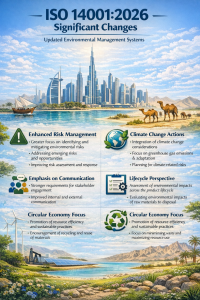
- Environmental management shifts from reactive compliance to predictive intelligence – Organizations must anticipate environmental risks and act before issues occur, rather than responding after damage is done.
- Risk management focuses on future environmental scenarios – Businesses are expected to evaluate potential risks such as climate changes and supply chain disruptions in advance.
- Real-time monitoring replaces periodic audits – Continuous tracking ensures better control and faster responses compared to traditional review methods.
- Data transparency becomes essential for trust and compliance – Accurate and accessible data is required to demonstrate environmental performance to stakeholders.
- Lifecycle impact assessment expands across supply chains – Companies must consider environmental impact from sourcing to product disposal.
- Leadership accountability becomes more visible and direct – Top management must actively participate in driving sustainability strategies.
- Alignment with ESG and global sustainability frameworks becomes critical – Businesses must ensure their environmental practices meet international expectations.
How AI Is Transforming Environmental Management
Artificial intelligence is becoming a key enabler for meeting ISO 14001:2026 requirements, helping organizations improve efficiency and accuracy.
Smarter Monitoring and Instant Response
- Real-time tracking of emissions, waste, and energy usage – This ensures continuous visibility into environmental performance, helping organizations quickly identify inefficiencies and maintain control.
- Instant alerts for environmental deviations – Automated systems notify teams immediately when limits are exceeded, allowing faster response and preventing escalation.
- Faster corrective actions to prevent escalation – Businesses can act quickly to resolve issues, reducing environmental impact and avoiding compliance risks.
Intelligent Insights for Better Decision-Making
- Automated data collection and reporting – Digital systems capture and organize data automatically, reducing manual effort and improving reporting accuracy.
- Reduced human error in environmental assessments – Automation minimizes mistakes, ensuring more reliable evaluations and better decision-making.
- Continuous improvement through system-generated insights – Advanced analytics provide recommendations that help organizations enhance performance over time.
Why ISO 14001:2026 Creates Opportunity?
While the standard introduces new challenges, it also offers significant advantages for organizations that adapt early.
Building Competitive Advantage Through Sustainability
- Stronger brand reputation in global markets – Demonstrating sustainability builds credibility and enhances customer trust.
- Increased trust from investors and stakeholders – Transparent environmental practices attract more investment and strengthen relationships.
- Better positioning in international trade – Compliance with global standards improves market access and business opportunities.
Driving Efficiency and Cost Optimization
- Improved resource utilization reduces operational costs – Efficient use of energy and materials lowers expenses and increases productivity.
- Real-time data helps identify and eliminate inefficiencies – Continuous monitoring allows businesses to detect and fix issues quickly.
- Preventive actions reduce the risk of costly disruptions – Addressing problems early avoids major operational and financial losses.
Strengthening Long-Term Resilience
- Better preparedness for environmental and regulatory changes – Businesses can adapt faster to new requirements and challenges.
- Stronger risk management capabilities – Predictive systems help organizations anticipate and handle potential risks effectively.
- Sustainable growth supported by continuous improvement – Ongoing enhancements ensure long-term stability and competitiveness.
What Businesses Should Do Now?
- Conduct a gap analysis of existing environmental systems – Evaluate current processes to identify gaps and areas that need improvement for compliance.
- Invest in real-time monitoring and digital tools – Implement systems that provide continuous data tracking and support faster decision-making.
- Train teams on data-driven and AI-supported processes – Equip employees with the skills needed to use modern tools effectively.
- Align environmental objectives with business strategy – Integrate sustainability goals into overall planning for better outcomes.
- Strengthen leadership involvement in sustainability initiatives – Ensure top management actively drives and supports environmental strategies.
How Long Will It Take to Implement ISO 14001:2026?
The timeline for implementing ISO 14001:2026 depends on the size, complexity, and readiness of the organization. Businesses with existing environmental management systems may transition faster, while others may require more time to build digital capabilities and align processes.
Typically, implementation is not a one-time effort but a phased process that involves system upgrades, employee training, and continuous improvement. Organizations that start early can spread the effort over time, reducing operational disruption and ensuring smoother adoption.
What Mistakes Should Businesses Avoid During Transition?
One of the most common mistakes is treating ISO 14001:2026 as a documentation exercise rather than a system transformation. Businesses that focus only on meeting minimum requirements often struggle to sustain compliance in the long run.
Another critical mistake is delaying technology adoption. Without real-time monitoring and data-driven tools, organizations may find it difficult to meet the new expectations. Lack of leadership involvement can also slow down progress, as strong direction and accountability are essential for successful implementation.
Final Insight
ISO 14001:2026 is not just a standard—it is a business transformation framework.
Organizations that act early will gain a strong advantage, while those who delay may struggle to keep pace in an increasingly sustainability-driven world. The future is not just sustainable—it is intelligently sustainable.
Contact Us