


Independent third-party cGMP certification for manufacturers operating from Muscat, Nizwa and Oman's industrial and free zones. Certification is scoped to your product category and audited against the applicable scheme. A fixed written quotation is provided before any assessment begins.
✓ UQAS-accredited certification body | ✓ One fixed quotation, in writing | ✓ Nearly two decades of assessment experience | ✓ Open to every manufacturing sector across the Sultanate
At a Glance
- Scope: your product category determines the applicable scheme, and that scheme determines what assessors examine.
- Eligible industries: food & beverage, pharmaceuticals & nutraceuticals, cosmetics, packaging & chemicals, animal feed, and contract manufacturing/logistics.
- Certification cycle: audit first, certificate next, surveillance every year, recertification at the end.
- Pricing: one fixed written quotation before assessment begins — no flat fee, no hidden costs.
- Accreditation: IAS operates this service under UQAS accreditation.

Why Manufacturing Quality Standards Are Rising in Oman
Manufacturing, food processing, pharmaceuticals, nutraceuticals, logistics and downstream industry are all growing parts of Oman's export economy, competing for contracts with buyers across the GCC, East Africa, the Indian subcontinent and beyond. Manufacturers in Muscat's industrial estates, Nizwa and zones around the country are finding that price and location are no longer enough. Buyers, distributors and regulators increasingly expect documented proof that production is controlled, consistent and traceable.
- The credibility gap. Current Good Manufacturing Practice — cGMP — certification closes that gap. An independent assessor examines the plant, and the resulting certificate shows buyers, regulators and export partners that it runs a documented, disciplined quality system suited to what it makes.
- Building on what's already required. Local content and Omanisation requirements already push manufacturers to formalise internal processes. Extending that discipline into a recognised quality-management framework is often the more efficient next step. The alternative is building a parallel system solely to satisfy one buyer's checklist.
This page explains what cGMP certification means for Omani businesses, who regulates what inside the Sultanate, and how the IAS certification process works — without pretending cGMP is a single, one-size-fits-all standard.
Industries Where Quality Certification Is Gaining Traction in Oman
Growth in non-oil manufacturing has widened the range of Omani businesses seeking third-party quality credentials well beyond the traditional food and pharma space:
- Food and beverage processing — date processing, fisheries and seafood processing, dairy and bottled water, much of it aimed at GCC and international export markets.
- Pharmaceuticals and nutraceuticals — an emerging segment as Oman looks to reduce import reliance on medicines and health supplements.
- Petrochemical-linked plastics and packaging — downstream of the domestic refining and petrochemical sector, feeding regional packaging and industrial supply chains.
- Contract manufacturing and logistics — warehousing, blending, filling and re-export operations based in Oman's free zones and industrial areas.
- Animal feed and agro-processing — supporting Oman's fisheries and livestock sectors and their export ambitions.
The table below links these growth sectors to the reason cGMP-type certification is becoming relevant to each one. The point is not that one certificate covers them all. Each sector faces its own buyer and regulatory expectations.
| Growth sector | Why quality certification is increasingly requested |
|---|---|
| Food & beverage exporters | GCC and international retailers and importers increasingly require documented process control before listing a new supplier. |
| Pharma & nutraceutical producers | Distributors and regional buyers look for evidence of a disciplined quality system alongside Ministry of Health registration. |
| Plastics & packaging | Industrial and food-contact packaging customers request quality assurance evidence as part of vendor approval. |
| Free-zone operators | Free-zone tenants competing for re-export and contract-manufacturing work use certification to differentiate from regional peers. |
| Animal feed & agro-processing | Export buyers and regional distributors ask for process documentation as part of consignment approval. |
Newer entrants to re-export markets illustrate the shift. A facility serving these markets often competes directly against established manufacturers in the UAE, Saudi Arabia and further afield. Those competitors frequently already carry recognised quality certifications. For a newer Omani entrant, an independently issued cGMP certificate can be one of the fastest ways to close that credibility gap with an unfamiliar overseas buyer.
Who Oversees What: Regulatory and Standard-Setting Roles in Oman
An independent certification body issues cGMP certification in Oman — not a government regulator — and the certificate replaces no licence a regulator requires. Several bodies play distinct roles in and around manufacturing quality in the Sultanate, and it is important not to blur them together.
| Body | Role |
|---|---|
| Ministry of Health (MOH), Oman | Registers and licenses pharmaceutical products and manufacturers, and inspects licensed facilities for GMP compliance as part of its regulatory mandate. |
| Directorate General for Standards & Metrology (DGSM) / Ministry of Commerce, Industry and Investment Promotion (MOCIIP) | Administers national product standards, conformity assessment and metrology oversight for broader industrial and consumer goods, outside the pharmaceutical licensing remit. |
| Gulf Health Council (GHC) / GCC-DR GMP guidance | A regional body whose GCC harmonised pharmaceutical GMP guidance is a reference point for manufacturers across GCC states, including Oman — it issues guidance, not certificates. |
| World Health Organization (WHO) | Publishes globally referenced GMP guidelines used as a technical benchmark; WHO does not regulate, license or certify any facility. |
| US FDA | Regulates only products intended for the US market; it has no licensing or certification role over Omani facilities selling elsewhere. |
| IAS | Issues independent third-party cGMP certification against the applicable scheme and scope, under IAS's UQAS accreditation. |
- Not MOH approval. An IAS certificate is never presented, marketed or relied upon as MOH approval, product registration, or any other regulatory clearance.
- Not a substitute for the licence. Certification also never substitutes for the licence the law requires a manufacturer to hold.
- Complements, doesn't replace. Certification sits alongside those regulatory obligations, evidencing the discipline of the underlying quality system to buyers, auditors and trading partners.
No Single Rulebook: How cGMP Requirements Shift by Product Category
cGMP is not one universal international standard — it is a general term for current good-manufacturing-practice requirements, and those requirements take different forms across several distinct frameworks depending on the product. A pharmaceutical tablet plant, a date-processing facility and a cosmetics filler answer to different rulebooks. Each is assessed against the scheme relevant to its product category and stated scope, and the certificate names that scheme.
| Product category | Commonly referenced frameworks |
|---|---|
| Pharmaceuticals | WHO GMP guidelines, PIC/S GMP guide, and GCC-DR harmonised GMP guidance, alongside applicable MOH licensing requirements. |
| Food & beverage | Codex Alimentarius-aligned GMP principles and national food-safety codes, often paired with HACCP-based process controls. |
| Cosmetics & personal care | ISO 22716 good manufacturing practice guidance for cosmetics. |
| Medical devices | GMP principles embedded within quality management frameworks such as ISO 13485, scoped to the device category. |
| Other industries (packaging, chemicals, feed, contract packing, warehousing, etc.) | General GMP principles adapted to the product and process, scoped by IAS to the applicant's own operation. |
cGMP certification is open to every industry. Packaging converters, chemical formulators, animal feed producers, contract packers and warehousing or logistics operators handling GMP-sensitive goods can all pursue it. Each is scoped to its own products and processes, not to a category built for someone else.
cGMP Meaning: GMP vs cGMP, Clearing Up the Terminology
GMP describes the general body of good-manufacturing-practice principles. cGMP, or "current" GMP, emphasises that a facility's systems, equipment and controls are kept up to date with present-day practice. They are not left static after initial implementation.
- Used interchangeably day to day — Oman's manufacturing sector treats the two terms as the same thing in ordinary conversation.
- The distinction matters on the certificate. It should always state the specific scheme and scope assessed, such as WHO GMP, GCC-DR guidance, ISO 22716, or a general GMP framework tailored to the applicant's operation. It should not carry an unqualified claim of "cGMP compliance."
Inside the IAS Certification Journey
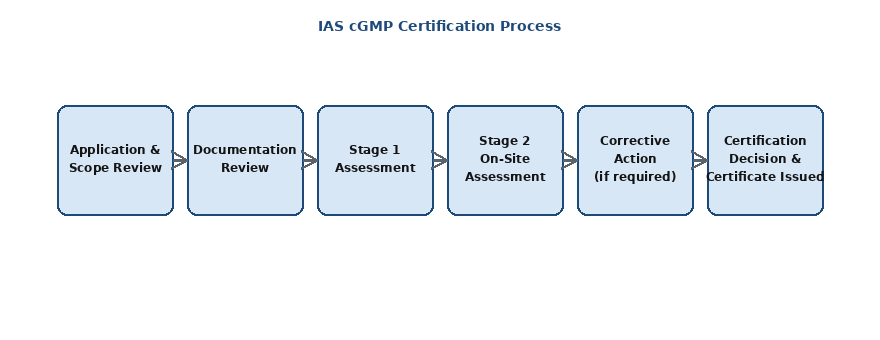
IAS follows the same structured assessment sequence for every applicant, whatever the sector. IAS agrees the scope, depth and applicable scheme with the manufacturer before the assessment begins.
- Application and scope review — the manufacturer's products, processes and applicable GMP scheme are confirmed with IAS.
- Documentation review — quality manual, SOPs, and other records relevant to the agreed scheme and product category are reviewed for completeness.
- Stage 1 assessment — readiness of the documented quality system is evaluated against the applicable scheme.
- Stage 2 on-site assessment — auditors examine the facility, records and practices in operation, in the areas relevant to the agreed scope.
- Corrective action, if needed — you close any nonconformity with evidence before certification proceeds.
- Certification decision and certificate issue — once conformity is confirmed, IAS issues the certificate naming the scheme and scope assessed.
Assessors examine the areas that apply to the agreed scheme and product category — batch records, change control, CAPA and validation evidence among them. No universal checklist is applied identically to every facility.
From Certificate to Recertification: The Ongoing Compliance Cycle
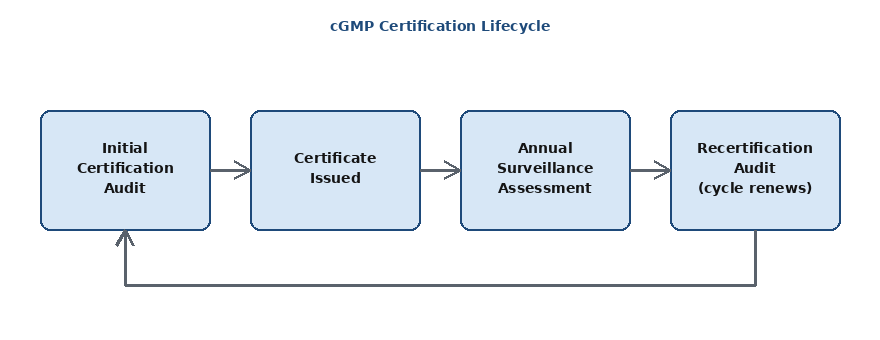
Certification is not a one-time event. Once issued, a certificate is maintained through an ongoing cycle that keeps it meaningful to buyers and regulators over time:
- Initial certification audit — establishes conformity and results in the certificate being issued.
- Annual surveillance assessments — confirm the quality system continues to operate as certified.
- Recertification audit — takes place at the end of the certification cycle, renewing the certificate where conformity continues.
Facility readiness, product-family scope, number of sites and the complexity of the applicable scheme all vary from one Omani manufacturer to the next. IAS therefore quotes no fixed number of weeks or months for any stage of the cycle. Those four factors set the timeline, not a standard calendar.

cGMP Certification Cost in Oman: What Shapes Timeline and Cost
Cost and duration for cGMP certification in Oman are driven by the specifics of each operation rather than by a flat fee or a generic schedule. Every applicant receives a fixed written quotation from IAS before any assessment work begins, so cost is known in advance rather than estimated afterward.
| Cost / timeline driver | Why it matters |
|---|---|
| Applicable GMP scheme and scope | A pharmaceutical scope assessed against WHO/GCC-DR guidance typically involves more documentation review than a general industrial GMP scope. |
| Facility readiness | A quality system already partly in place needs less corrective-action time than one being built from scratch. |
| Number of product families | A facility manufacturing several distinct product lines requires broader sampling during on-site assessment. |
| Number of sites | Manufacturers with operations split between, for example, a mainland facility and a free-zone site require assessment coverage across each location. |
| Logistics and site access | Free-zone access arrangements and facility location can affect on-site assessment scheduling. |
The IAS commitment: one fixed written quotation before assessment work begins.
What This Adds for Buyers, Auditors and Trade Partners
An IAS cGMP certificate does not change what a manufacturer is legally required to hold — it changes how quickly an outside party can trust what that manufacturer already does. In practice, certified Omani facilities report that the credential is most useful in these situations:
- Vendor approval and tender pre-qualification — many GCC and international buyers now ask for a recognised quality credential before a supplier reaches the shortlist stage.
- Reduced repeat buyer audits — a documented, independently verified quality system can shorten or simplify a buyer's own on-site vendor audit.
- Internal consistency across shifts and sites — the discipline required to prepare for and maintain certification tends to reduce variation between production runs and between multiple facilities.
- A defensible answer during regulatory inspection. Certification is not a substitute for a licence. Even so, a well-documented quality system built for certification is generally easier to present. That applies during an MOH or other regulatory inspection.
Is cGMP Certification Right for Your Operation?
cGMP certification in Oman is open to any manufacturer or processor able to demonstrate conformity to an applicable GMP scheme, not only companies in food, pharmaceuticals, cosmetics or medical devices. Businesses across Oman commonly consider certification when they:
- Export food, beverage, pharmaceutical, nutraceutical or cosmetic products to GCC or international markets.
- Operate as a contract manufacturer, filler or packer producing for multiple brand owners.
- Manufacture packaging, chemicals or animal feed and are asked by customers for quality-system evidence.
- Run warehousing, blending or re-export operations inside a free zone handling GMP-sensitive goods.
- Already hold an MOH licence or other regulatory approval and want independent evidence of ongoing system discipline for buyers and auditors.
Quick Definitions
- GMP: Good Manufacturing Practice — the general body of good-manufacturing-practice principles.
- cGMP: Current Good Manufacturing Practice — the same discipline, emphasising that systems, equipment and controls are kept up to date with present-day practice.
- Scheme & scope: the specific framework and product range an audit is measured against, named on the resulting certificate.
- Surveillance assessment: an annual check confirming the certified quality system continues to operate as certified.
- Recertification: the audit at the end of a certification cycle that renews the certificate where conformity continues.
Frequently Asked Questions
Does Omani law oblige a manufacturer to be cGMP certified?
No. Regulatory licensing is the legal requirement, such as Ministry of Health registration for pharmaceutical manufacturers. cGMP certification is a voluntary, independent credential that demonstrates quality-system discipline alongside that licence. Buyers often request it rather than the law mandating it.
Does an IAS cGMP certificate mean the Ministry of Health has approved my facility or products?
No. An IAS certificate is independent third-party certification against an agreed GMP scheme and scope. It is never MOH approval, product registration or any other regulatory clearance. It does not replace the licence a manufacturer is required to hold.
We already hold an MOH manufacturing or registration licence — why apply for cGMP certification too?
An MOH licence confirms regulatory approval to operate or register a product. IAS certification gives buyers, distributors and export partners independent, documented evidence of the quality system behind that licence. Many contracts and tenders specifically ask to see it.
Can a facility operating inside a free zone use cGMP certification to support export contracts?
Yes. Free-zone manufacturers and re-export operators are certified on the same basis as mainland facilities, scoped to their own products and processes, and the resulting certificate can support tender submissions and buyer due-diligence requests.
Is cGMP certification only available to food, pharmaceutical, cosmetic and medical device manufacturers in Oman?
No. Certification is scoped to the applicant's own products and processes, so packaging converters, chemical formulators, animal feed producers, contract packers and logistics operators handling GMP-sensitive goods can also apply.
How does IAS certification relate to the Gulf Health Council's GCC-DR GMP guidance?
GCC-DR GMP guidance, issued through the Gulf Health Council, is a regional technical reference that pharmaceutical manufacturers across GCC states may align with. IAS can certify against this guidance where it is the applicable scheme for the applicant's scope; the Gulf Health Council itself does not issue certificates.
Can one cGMP certificate cover multiple product lines or more than one manufacturing site in Oman?
Scope can extend to multiple product lines or sites where each is assessed and found conformant. You agree this with IAS during the application stage. It is then stated clearly on the certificate rather than assumed automatically.
How long does an IAS cGMP certificate remain valid, and how can a buyer verify it?
Validity is maintained through the certification lifecycle of annual surveillance assessments and a recertification audit at the end of the cycle, rather than a one-time award. Buyers and partners can verify an active certificate by contacting IAS directly through its listed contact channels.
Take the Next Step Toward cGMP Certification in Oman
Whether you manufacture in Muscat or elsewhere in Oman, IAS can help you scope a cGMP certification pathway. The pathway is matched to your product category and export goals. It is backed by independent assessment under IAS's UQAS accreditation and nearly two decades of assessment experience.
Explore related credentials: ISO Certification, ISO 13485 Certification in Oman for medical devices, HACCP Certification in Oman for food safety, and Product Certification for wider product-scheme options.