


ISO 9001:2026 – The Biggest Updates in Quality Management
ISO 9001:2026 is set to bring a significant transformation in how organizations manage quality in an increasingly dynamic business environment. With rising expectations around digital performance, environmental responsibility, and operational transparency, the updated standard is designed to align quality management systems (QMS) with modern business realities.
This revision focuses on improving adaptability, efficiency, and long-term sustainability. For organizations aiming to strengthen their processes and compete globally, including those in Oman, ISO 9001:2026 offers a valuable opportunity to upgrade their quality framework and stay ahead of industry expectations.
Why the ISO 9001 Standard Is Evolving?
The ISO 9001:2015 version introduced important concepts such as risk-based thinking and process alignment. While these principles remain relevant, they no longer fully address the complexities of today’s business landscape.
ISO 9001:2026 builds upon this foundation by incorporating broader considerations such as technological advancements, environmental factors, and supply chain dependencies. This evolution ensures that quality management systems are not only consistent but also resilient and responsive to change.
Organizations are now expected to take a forward-looking approach, identifying potential risks early and adapting their processes accordingly.
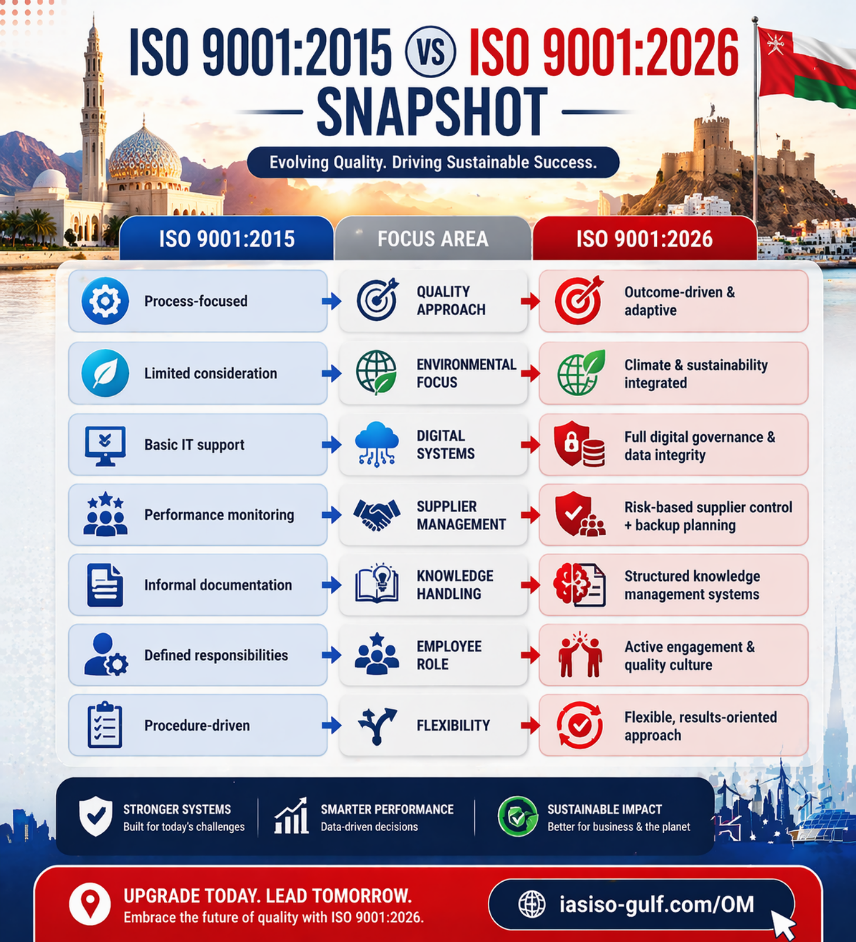
Key Enhancements in ISO 9001:2026
Environmental Responsibility within Quality Planning
Organizations are now expected to adopt a structured and proactive approach in evaluating how environmental and climate-related factors influence their operations. This includes assessing risks such as regulatory changes, resource limitations, and environmental disruptions that could impact product or service quality.
When these factors are identified as relevant, they must be integrated into strategic planning, risk management, and continuous improvement processes. By aligning sustainability with quality objectives, businesses can not only ensure compliance but also build long-term resilience, improve brand reputation, and support responsible growth.
Digital Systems and Data Integrity
With the rapid adoption of automation, artificial intelligence, and digital platforms, ISO 9001:2026 places strong emphasis on the governance and reliability of these systems. Organizations must ensure that digital processes consistently deliver accurate, secure, and traceable outcomes.
This requires establishing clear controls, validating system performance, and maintaining transparency in data handling. Additionally, businesses must invest in employee training to ensure teams are capable of managing evolving technologies effectively.
Important areas include:
- Monitoring automated processes for consistency and accuracy
- Ensuring data protection, security, and integrity
- Maintaining well-structured and accessible digital documentation
- Training employees to confidently handle advanced technologies
Enhanced Supplier and External Provider Control
In today’s interconnected business environment, supply chains play a vital role in maintaining quality standards. ISO 9001:2026 requires organizations to adopt a more strategic and risk-based approach to managing suppliers and external providers.
This involves evaluating supplier performance, identifying vulnerabilities within the supply chain, and implementing contingency plans to handle potential disruptions. Strengthening communication and collaboration with suppliers ensures reliability, improves consistency, and supports uninterrupted operations.
Knowledge as a Strategic Asset
Organizational knowledge is now recognized as a critical factor in achieving efficiency and consistency. ISO 9001:2026 encourages businesses to treat knowledge as a valuable asset that must be actively managed and protected.
Organizations should implement systems to capture key insights, document best practices, and facilitate knowledge sharing across teams. This not only ensures operational continuity but also enhances decision-making, reduces dependency on individuals, and supports continuous improvement.
Employee Involvement in Quality Processes
The effectiveness of a quality management system is strongly influenced by the people who implement it. ISO 9001:2026 highlights the importance of employee engagement, awareness, and accountability in achieving quality objectives.
Organizations are encouraged to foster a culture where employees understand their roles, contribute ideas, and take ownership of quality outcomes. This leads to improved collaboration, higher motivation, and a more proactive approach to problem-solving and innovation.
Flexible and Outcome-Oriented Approach
A key shift in ISO 9001:2026 is the move from rigid, procedure-based requirements to a more flexible, results-driven approach. Organizations are no longer restricted to predefined methods but are instead evaluated based on the effectiveness of their outcomes.
This flexibility allows businesses to design processes that align with their unique operations while still meeting the standard’s objectives. It encourages innovation, adaptability, and continuous improvement, making quality management more practical and aligned with real-world business needs.
What Should Organizations Focus on First?
One of the key questions businesses ask is how to begin preparing for ISO 9001:2026. The most effective starting point is understanding the differences between the current system and the updated requirements.
Organizations should prioritize reviewing their processes, identifying gaps, and focusing on areas such as digital systems, environmental factors, and supplier management. Early planning ensures a smoother transition and minimizes disruptions.
Organizations in Oman and other growing markets are already taking proactive steps to align with these changes and strengthen their quality systems.
How ISO 9001:2026 Improves Business Performance?
The updated standard is designed to deliver tangible business benefits beyond certification. By adopting ISO 9001:2026, organizations can enhance their overall performance and competitiveness.
Key benefits include:
- Improved risk management and operational stability
- Stronger supplier relationships and reliability
- Enhanced efficiency through digital integration
- Increased employee engagement and productivity
- Higher customer satisfaction and trust
These improvements help organizations build a strong foundation for long-term growth.
What Actions Should Businesses Take Immediately?
Preparing for ISO 9001:2026 requires a structured approach. Organizations should begin by evaluating their current systems and planning necessary updates.
Recommended actions include:
- Conducting a detailed gap analysis
- Updating documentation and procedures
- Training employees and internal auditors
- Integrating new requirements into daily operations
Taking these steps early helps organizations stay ahead and ensures a smooth transition process.
Final Thoughts: Preparing for the Next Phase of Quality Management
ISO 9001:2026 represents a forward-thinking approach that integrates sustainability, digital transformation, and people into quality management systems. It reflects the realities of modern business and provides a framework for continuous improvement.
Organizations that prepare early will not only achieve compliance but also gain a competitive advantage. By embracing these changes, businesses can build stronger systems, improve performance, and position themselves for future success.


