


ISO 14001:2026 Is Not Optional Thinking Anymore
Sustainability is no longer a long-term aspiration—it is becoming a core operational expectation. With the introduction of ISO 14001:2026, businesses are entering a phase where environmental management must be continuous, measurable, and driven by real-time insights.
In Oman, where economic diversification and environmental responsibility are progressing together, this shift is especially meaningful. Organizations are now expected to move beyond compliance and demonstrate clear environmental performance supported by data, transparency, and accountability.
ISO 14001:2026 is not just an update—it represents a new way of managing environmental impact, where strategy, technology, and performance are closely connected.
Why Businesses Must Respond Without Delay?
The urgency around ISO 14001:2026 is driven by increasing environmental challenges, evolving regulations, and stronger expectations from stakeholders. Businesses must now prove their sustainability efforts with consistent and verifiable results.
For organizations in Oman, this urgency is also linked to global market expectations. Companies that fail to align with modern environmental standards risk losing opportunities, while those that adapt early can strengthen their position and credibility.
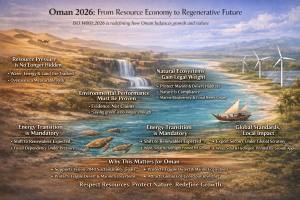
A Shift Toward Continuous Environmental Awareness
ISO 14001:2026 introduces a major transformation in how environmental management is handled. Instead of relying on periodic reviews, businesses must adopt a continuous and proactive approach.
- Real-time monitoring becomes essential – Organizations must track environmental performance continuously to ensure accuracy and immediate response.
- Preventive strategies replace reactive actions – Businesses are expected to identify risks early and address them before they escalate.
- Data becomes central to decision-making – Reliable insights help improve both operational performance and long-term planning.
How Technology Is Driving the New Standard?
Technology plays a key role in enabling businesses to meet the expectations of ISO 14001:2026. Digital tools allow organizations to manage environmental performance with greater precision and efficiency.
- Continuous data tracking improves control – Businesses gain better visibility into emissions, waste, and resource usage.
- Automation simplifies complex processes – Reduces manual effort and improves the accuracy of reporting.
- Faster response systems minimize environmental impact – Immediate action helps prevent small issues from becoming major problems.
What Challenges Should Organizations Prepare For?
Transitioning to ISO 14001:2026 requires more than adopting new tools—it involves a change in mindset and operational approach. Many organizations may find it challenging to integrate environmental management into core business processes.
The need for real-time systems, combined with the requirement for cross-departmental coordination, can increase complexity. Leadership involvement becomes critical to ensure alignment, accountability, and effective execution.
Turning Sustainability Into a Competitive Strength
ISO 14001:2026 offers more than compliance—it provides an opportunity to create long-term value. Businesses that adopt the standard early can improve efficiency, reduce waste, and enhance overall performance.
Transparency in environmental practices builds trust with stakeholders, which is essential in competitive markets. Organizations that demonstrate strong environmental performance can differentiate themselves and gain a strategic advantage.
What Should Be Your Starting Point?
Preparing for ISO 14001:2026 requires a structured and proactive approach. Organizations must begin by understanding their current position and identifying areas for improvement.
- Conduct a gap analysis of current systems – Identify weaknesses and align processes with new requirements.
- Invest in real-time monitoring solutions – Enable continuous tracking and faster decision-making.
- Train employees on modern environmental practices – Build internal capability for effective implementation.
- Align sustainability goals with business strategy – Ensure environmental objectives support long-term growth.
- Strengthen leadership commitment – Drive accountability and ensure consistent execution.
How Will ISO 14001:2026 Influence Local Industries?
The impact of ISO 14001:2026 will vary across sectors in Oman. Industries such as energy, construction, and manufacturing will face more significant changes due to their environmental footprint.
These sectors will need to adopt advanced monitoring systems and strengthen risk management practices. Service industries will also need to improve transparency and demonstrate responsible environmental behavior.
How Can Businesses Build Long-Term Readiness?
To stay ahead, businesses must adopt a forward-looking approach. This includes investing in technology, improving processes, and building a culture of sustainability.
- Strengthen real-time environmental visibility – Implement systems that provide continuous insights into performance and enable faster decisions.
- Integrate sustainability into daily operations – Ensure environmental practices are part of routine workflows across departments.
- Use predictive insights for better planning – Leverage data to anticipate risks and improve long-term strategies.
- Improve transparency and stakeholder communication – Provide clear, data-backed reporting to build trust and credibility.
- Continuously develop employee skills – Train teams to adapt to new tools and evolving environmental requirements.
What Are the Key Benefits Businesses Can Expect?
- Improved operational efficiency through resource optimization – Organizations can reduce waste and energy consumption, leading to lower operational costs and better productivity.
- Stronger compliance and reduced regulatory risks – Continuous monitoring ensures that businesses stay aligned with environmental regulations and avoid penalties.
- Enhanced brand reputation and stakeholder trust – Transparent environmental performance builds credibility with customers, investors, and partners.
- Better risk management and resilience – Proactive identification of environmental risks helps prevent disruptions and ensures business continuity.
- Increased competitive advantage in global markets – Businesses that demonstrate strong sustainability practices are more attractive to international partners.
How Can Organizations Ensure Successful Implementation?
- Establish clear environmental objectives and KPIs – Defining measurable goals helps track progress and ensures accountability across the organization.
- Adopt scalable digital solutions – Flexible systems allow businesses to expand capabilities as requirements evolve.
- Encourage cross-functional collaboration – Involving all departments ensures consistency and better integration of environmental practices.
- Monitor performance continuously and review regularly – Ongoing evaluation helps identify improvement areas and maintain effectiveness.
- Commit to continuous improvement – Regular updates and enhancements ensure long-term success and alignment with evolving standards.
Is ISO 14001:2026 Worth the Investment?
While implementing ISO 14001:2026 requires resources, the long-term benefits make it a valuable investment. Organizations can achieve cost savings through improved efficiency and reduced waste.
Stronger environmental performance also enhances reputation and opens new opportunities for growth. Businesses that view this standard as a strategic investment are better positioned for sustainable success and resilience.
Final Thought
ISO 14001:2026 is more than a standard—it is a shift toward smarter, more responsible, and more resilient business practices.
Organizations that act early will gain a competitive advantage, while those that delay may struggle to keep up in a rapidly evolving sustainability landscape.


