


A course is where an internal auditor starts, not where they arrive. cGMP internal auditor training supplies the method for auditing a manufacturing operation against current Good Manufacturing Practice requirements. The first few real audits are what turn that method into judgement.
Companies sometimes expect a course to produce a finished auditor. It does not, and no honest provider claims otherwise. A cGMP internal audit course gets someone to the point of conducting a useful audit under guidance, with a framework for improving each time. Understanding that progression is what stops a new audit programme stalling after its first cycle.

What cGMP Internal Auditor Training Covers
The course equips employees to audit the organisation they work for, measuring it against GMP and cGMP requirements together with the company’s own documented system.
The “c” in cGMP means current. Procedures, training and records are expected to keep pace with how the plant actually runs, and internal auditing is the routine check that they have. That check is only as good as the person performing it, so internal auditor competence sits inside the quality system rather than beside it.
Content spans GMP fundamentals, the audit cycle from planning to verified closure, and auditor conduct. Should the company also want the site examined by an outside body, that is a different process, laid out on the cGMP certification in Oman page.
How an Internal Auditor Develops
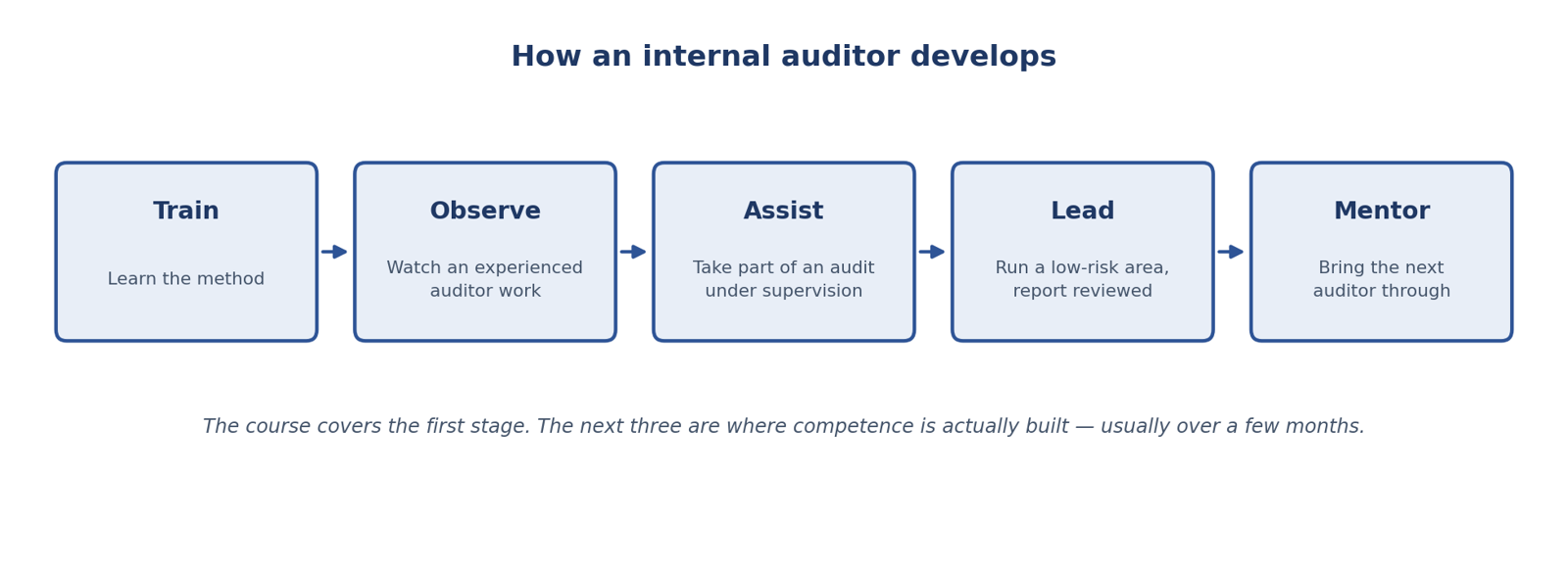
How an internal auditor develops — the course covers the first stage; competence is built across the next three.
The progression above is how most manufacturers build capability, and it usually takes a few months rather than a few weeks.
Training supplies the method: scope and criteria, checklists, sampling, evidence, classification, reporting and follow-up. At the end of it a participant knows what an audit consists of and why each step exists.
Observing an audit run by someone experienced converts that knowledge into recognition. The new auditor sees how a checklist item turns into a request, how an evasive answer is handled, how a finding is worded in real time. This stage is short — one or two audits — but skipping it costs more time later.
Assisting means taking part of the audit under supervision. Typically the new auditor handles record review or one process area while the lead handles the rest, and they draft findings together afterwards. This is where wording discipline is learned, because a first attempt at a finding is almost always too vague or too strongly worded.
Leading starts with a low-risk area — a support function, a straightforward document review — before moving to production or laboratory areas. The lead auditor prepares, runs and reports the audit; someone experienced reviews the report before issue.
Mentoring completes the cycle. An auditor who can bring the next person through the same progression is what makes the programme survive staff turnover, which is the point at which most internal audit programmes quietly fail.
What Competence Actually Consists Of
Competence is not attendance. The training covers what a company should be able to evidence about each of its auditors.
| Element | What it means in practice | How it is demonstrated |
|---|---|---|
| Method knowledge | Understands the audit cycle, evidence and classification | Course completion and assessment |
| Technical grounding | Knows enough GMP to recognise adequate control in the area audited | Role experience, or additional training for unfamiliar areas |
| Independence | Does not audit areas they work in or are responsible for | Audit programme assignment records |
| Applied practice | Has conducted audits and produced usable reports | Audit reports issued, reviewed by an experienced auditor |
| Judgement | Grades consistently and words findings factually | Consistency of classification across auditors; report review |
| Currency | Keeps up as procedures and the audit programme change | Periodic refresher and participation in the ongoing programme |
Most companies record these in a simple auditor competence file. It matters more than it appears: when a customer auditor asks who conducts your internal audits and how you know they are competent, that file is the answer.
The First Three Audits
New auditors benefit from being told what to concentrate on rather than being left to absorb everything at once.
| Audit | Focus on | Do not worry yet about |
|---|---|---|
| First | Preparation and checklist quality — arriving knowing where to look | Covering the full scope; depth beats breadth |
| Second | Evidence discipline — recording references as you go, not afterwards | Speed; a slow, well-referenced audit is a good audit |
| Third | Finding wording and classification — requirement, evidence, gap | Handling disagreement; the lead auditor still carries that |
By the fourth or fifth audit these become habit, and attention shifts to the harder parts. Those parts include knowing when to widen a sample and judging whether a corrective action addresses the cause. They also include holding a classification when someone senior disputes it.
What an Internal Auditor Does
The underlying work does not change with experience, only the speed and confidence with which it is done. Reading comes first — procedures, the last report, whatever corrective actions remain open — and produces a checklist that names what will be looked at and how much of it. On the day, the auditor watches the activity, talks to the people running it, and pulls the records that should describe it. The auditor holds all three against the criteria and notes references as they go.
Findings are drafted and classified before the closing meeting and worded as requirement, evidence, then gap, without adjectives and without naming individuals. Afterwards the auditor reviews the corrective action and returns to verify that it worked.
Who Should Attend cGMP Internal Auditor Training
| Participant | What the progression view gives them |
|---|---|
| Newly appointed internal auditors | A realistic picture of how competence develops, and what to focus on first |
| QA managers building a programme | A structure for developing auditors rather than training and hoping |
| Production and QC supervisors | Understanding of what an auditor is trained to do and why |
| Engineering and validation staff | Coverage of calibration, qualification and change-control evidence |
| Warehouse and materials personnel | Receipt, storage, release and traceability records |
| Management representatives | A defensible answer when asked how auditor competence is assured |
| Contract manufacturers | Evidence of auditor competence is itself examined during client audits |
No prior audit experience is assumed. Employees already working inside a GMP system move through the progression fastest, since the technical grounding is already there. Anyone new to manufacturing quality generally starts with a cGMP foundation course before the auditor training.

Skills Participants Develop
- Preparing an audit thoroughly enough to arrive knowing where to look
- Building checklist items that name a source, a sample and a comparison
- Sampling records so the sample represents the period audited
- Observing an activity happening genuinely rather than being demonstrated
- Interviewing with open questions and following the answers
- Recording referenced evidence during the audit rather than reconstructing it
- Classifying findings consistently against a defined scale
- Wording findings as requirement, evidence and gap
- Reviewing a corrective action against whether it would prevent recurrence
- Verifying effectiveness by returning to records and the floor
- Recognising the limits of their own experience and asking for support
Why This Matters to Manufacturers
Audit programmes rarely fail because nobody was trained. They fail because one trained person carried the whole programme and then moved on. They also fail when auditors were trained and then left to work it out alone. Those auditors produced weak reports and lost confidence in the exercise.
Building competence deliberately — train, observe, assist, lead, mentor — avoids both. It also produces something a customer auditor will ask for: a clear account of who audits, what they were trained in, what they have audited, and who checks their work.
Readers wanting the requirements background will find it in the IAS GMP certification overview, with regional context in the article on cGMP standards.
Training Compared With Certification
| cGMP Internal Auditor Training | cGMP Certification | |
|---|---|---|
| Applies to | Individual employees | The organisation and its manufacturing site |
| Audit type | First-party, conducted internally | Third-party, conducted independently |
| Produces | Competent auditors and a training record | A certificate covering a defined scope |
| Sustained by | Continued practice and periodic refresher | Surveillance audits and recertification |
The two are connected but distinct. A certified system is expected to audit itself competently, so auditor development supports certification. Even so, a course does not certify a company, and a certificate says nothing about whether individual auditors are competent.
cGMP Internal Auditor Training in Oman: Course Details
How long cGMP Internal Auditor Training in Oman runs depends on the number of participants and the route chosen, and the fees are set out in the same written quotation. Each participant who finishes receives a certificate of completion recording the syllabus and the date, which belongs in their training file.
The course teaches report writing: stating a finding that holds up under discussion, and reaching the root cause of a repeat issue without naming anyone.
Objective
Prepare participants to plan, conduct, report and follow up internal audits of GMP and cGMP quality systems, and to continue developing through supervised practice.
Coverage
GMP and cGMP fundamentals; criteria and scope; planning and checklist preparation; sampling; observation and interviewing; objective evidence; nonconformity classification; findings and report writing; corrective-action review and effectiveness verification; auditor independence, conduct and competence.
Outcomes
Participants should be able to prepare and conduct an internal audit under guidance and gather referenced evidence. They should also raise and word nonconformities, produce a report, evaluate corrective actions, and identify where their own experience needs support.
Formats
Offered in classroom, live virtual, self-paced online and in-house formats. Companies developing several auditors at once often start everyone on online cGMP internal auditor training for the method, then pair them for the observe-and-assist stages on real audits; virtual cGMP training suits teams split across locations. Full syllabus detail for Oman sits on the IAS GMP internal auditor training page.
Tell us the site location, what you manufacture and how many auditors you intend to develop, and we will recommend a format and sequence. Said plainly: IAS trains auditors and certifies management systems. It does not license facilities or approve products — those are regulatory decisions, unaffected by any course.
Frequently Asked Questions
Is someone a qualified internal auditor as soon as they finish the course?
They are trained, which is not quite the same thing. The course provides the method and the assessment confirms they have understood it. Competence comes from applying it — typically observing one audit, assisting on another, then leading a low-risk area with report review. Most companies treat someone as fully independent after three or four audits.
How long does it take to develop a new internal auditor?
Usually a few months rather than a few weeks, because the pace is set by how often audits occur rather than by study time. A site running audits monthly can bring someone through observe, assist and lead within a quarter. A site auditing twice a year will take considerably longer, which is worth factoring into programme planning.
How does a company evidence that its auditors are competent?
Through a simple auditor qualification record: training completed and assessed, relevant technical background, audits conducted, reports issued and reviewed, and independence from the areas audited. Customer auditors and certification bodies ask this question, and “they attended a course” is a weaker answer than most companies expect.
Can one person run the whole internal audit programme?
It is possible but fragile. A single auditor cannot be independent of their own department, which leaves a gap in coverage, and the programme stops entirely when they are unavailable or leave. Training a small cross-functional group solves both problems and usually improves audit quality, since different backgrounds notice different things.
Should new auditors start with production areas?
Generally not. A support function or a focused document review lets a new auditor practise preparation, evidence discipline and finding wording without also managing a complex area and a busy schedule. Production and laboratory audits demand more judgement about sampling and more confidence in discussion, and are better tackled third or fourth.
Do internal auditors need refresher training?
Periodically, yes — particularly when the audit programme changes, when procedures are substantially revised, or when an auditor has not conducted an audit for a long stretch. Refreshers also help with consistency: where several auditors grade the same situation differently, a short recalibration session is usually the fix.
Who reviews a new auditor’s reports?
An experienced auditor or the quality system owner, before the report is issued. The review targets wording and classification rather than rewriting the content. New auditors typically word findings too vaguely to act on, or occasionally too strongly for the evidence — both are quickly corrected when someone reads the draft first.
What if an auditor lacks technical knowledge of the area being audited?
Method carries a long way, but not the whole distance. An auditor unfamiliar with, say, laboratory testing can still audit documentation and traceability there, while a technically stronger auditor covers method-specific questions. Pairing auditors for such areas is standard practice, and the training explains how to scope around a known knowledge gap honestly rather than bluffing through it.
What does the company hold at the end of the course, and is it enough?
A training record showing the course was completed and the assessment passed. It belongs in the personnel file, and it is one component of competence rather than the whole of it. On its own it establishes that someone was taught the method. The audits they go on to conduct, and the reports reviewed by an experienced auditor, are what complete the picture — which is precisely why the progression described above matters.