



Oman Businesses Ask: Does FSSC 22000 Version 6 Still Count?
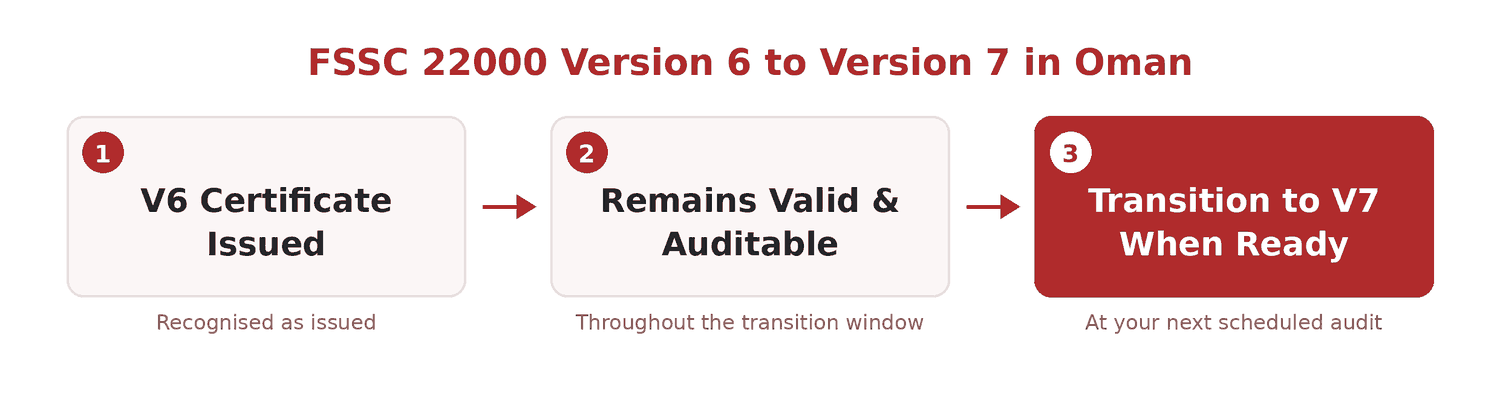
FSSC 22000 Version 6 certificates remain fully valid and auditable in Oman throughout the scheme’s official transition window to FSSC 22000 Version 7. Organisations in Oman holding a current Version 6 certificate do not need to pause shipments, request an emergency audit, or worry about a gap in recognition — FSSC has published a transition timeline designed to move certified sites to Version 7 through their normal audit cycle rather than all at once. This guide explains exactly what stays the same, what changes, and what Omani businesses should do while their certificate transitions, without needing to rely on a specific cutover date.
Key Changes at a Glance
- FSSC 22000 Version 6 certificates stay valid and auditable throughout the official transition window.
- Oman-based sites move to Version 7 through their next scheduled audit, not a new certification cycle.
- Customers and retailers across Oman and the wider GCC continue to accept a valid Version 6 certificate today.
- FSSC has not published one universal cutover date; cascade dates depend on your certification body.
- Version 7 updates PRP references, auditor qualification, sustainability rules and adds a new AI governance clause.
- Waiting until your recertification audit to learn about Version 7 leaves your team less time to prepare.
- Confirming your specific transition date directly with your certification body is the only reliable approach.
Is FSSC 22000 Version 6 Still Valid in Oman?
Yes. During FSSC’s official transition period, Version 6 certificates issued to Omani food manufacturers, packaging producers, storage and distribution operators and other certified sites continue to be valid and fully recognised. Certification bodies operating in Oman keep conducting surveillance and recertification audits against Version 6 up until the point each individual site is due to move over, at which stage the audit switches to the Version 7 requirements instead. There is no automatic expiry triggered simply because a new version of the scheme has been published, and no Omani certificate holder loses recognition purely because Version 7 now exists.
This matters commercially because customers, retailers and trading partners across Oman and the wider GCC continue to accept a currently valid Version 6 certificate as evidence of an active, GFSI-recognised food safety management system during this window. Publishing a new scheme version does not create an automatic gap in recognition for existing certificate holders, and buyers evaluating suppliers in Oman should expect to see a mix of Version 6 and Version 7 certificates in circulation for some time.
In short, an Omani business does not need to treat the arrival of Version 7 as an emergency. The scheme is designed specifically so that certified sites keep operating under a valid certificate while their individual transition is scheduled in the ordinary course of their audit programme.
How the Version 6 to Version 7 Transition Actually Works
FSSC has published a transition timeline that governs how certified and certifying organisations move from Version 6 to Version 7. Rather than every certificate expiring on one fixed calendar date, sites transition at their next scheduled audit — typically a surveillance or recertification audit — at which point the auditor assesses the site’s food safety management system against the Version 7 requirements instead of Version 6. Certification bodies themselves have to complete their own transition first, before they can begin auditing client sites against the new version, which is part of why cascade timing differs from one certification body to another.
Because different sources have described the exact cascade dates and deadlines differently, organisations in Oman should not rely on any specific date they see referenced informally. The reliable path is to confirm the transition timeline that applies to your specific certificate directly on fssc.com or by speaking with your certification body about your own audit calendar, since your certification body will know exactly where your site sits in the overall cascade. Asking this question early costs nothing and removes any guesswork from your planning.
If you want a deeper breakdown of how the wider transition timeline is structured across the region, our FSSC 22000 certification page for Oman covers the full set of Version 7 changes and how certified organisations are moving through them, which is a useful companion read alongside this page.
What Changes Under Version 7 While Your V6 Certificate Stays Valid
Even though your existing Version 6 certificate remains valid in the meantime, it is worth understanding what changes under Version 7 so your Oman-based team is not caught off guard at the next audit. Prerequisite programme references shift from the older ISO/TS 22002-x series toward the newer ISO 22002-x:2025 series of sector standards, and auditor qualification and competence criteria are updated to align with GFSI’s 2024 Benchmarking Requirements.
Version 7 also introduces new Food Loss & Waste management expectations and ‘Save Food Packaging’ design-principle requirements, adds a new requirement that any AI used in certification-related activity be governed by an ethical, fair and compliant framework, and more clearly defines the food chain category structure used to match auditor competence to a site’s activity. Each of these is a genuine content addition rather than a wording tidy-up.
None of these require immediate action from a Version 6 certificate holder in Oman today. But because your certificate will eventually be assessed against all of them at once, understanding the full list now, rather than the week before your audit, gives your team real lead time to make any necessary adjustments calmly.
Mistakes to Avoid During the Transition
The most common mistake is assuming a Version 6 certificate has an expiry date tied to Version 7’s publication — it does not. Your certificate remains valid on its own terms until your next scheduled audit, regardless of when Version 7 was released or how widely it has been discussed online.
A second mistake is treating an unofficial cutover date found online as authoritative. Because sources have described cascade dates differently, the only figures worth acting on for your Oman site are the ones your own certification body confirms for your specific certificate, ideally in writing so there is a clear record.
A third mistake is waiting until the recertification audit itself to start preparing for Version 7’s substantive changes. Reviewing PRP documentation, auditor competence records and sustainability procedures well ahead of time avoids a rushed scramble close to the audit date, and gives your team time to ask your certification body clarifying questions along the way.
Planning Ahead With IAS Gulf
FSSC 22000 remains one of the most widely recognised GFSI-benchmarked food safety certification schemes used by food manufacturers, packaging producers and logistics operators in Oman, and staying certified through the transition simply means continuing to operate your food safety management system as usual while your certification body plans your Version 7 upgrade audit.
IAS Gulf supports certified organisations across Oman with this transition planning. To make sure your team understands the full set of Version 7 requirements before your next audit, explore the FSSC 22000 Lead Auditor and Internal Auditor Training programmes at IAS’s Iraq regional hub, the nearest training centre serving Omani teams, and prepare your audit team before the transition window closes.
Because FSSC 22000 sits within a wider portfolio of GFSI-recognised certifications used across Oman’s food sector, treating your Version 7 transition as a normal planning exercise rather than a crisis keeps your certification programme running smoothly and keeps your team focused on food safety outcomes rather than paperwork deadlines. Building a short internal checklist covering PRP references, auditor qualification awareness, sustainability procedures and AI governance now saves considerable time later.
FSSC 22000 Version 6 vs Version 7: Certificate Validity and Transition at a Glance
| Aspect | Version 6 | Version 7 |
|---|---|---|
| Certificate validity | Version 6 certificates remain valid and auditable as issued | Version 6 stays valid until each site’s next scheduled audit moves it to Version 7 |
| Transition mechanism | Not applicable — standard surveillance / recertification cycle applies | Move to Version 7 happens at the next scheduled surveillance or recertification audit |
| Cutover date | Fixed certificate expiry per original issue date | No single universal date; cascade timing confirmed via your certification body or fssc.com |
| PRP references | ISO/TS 22002-x series | ISO 22002-x:2025 series |
| Auditor qualification | Version 6 competence criteria | Updated to align with GFSI Benchmarking Requirements version 2024 |
| New requirements | No Food Loss & Waste or AI governance clauses | Adds Food Loss & Waste, ‘Save Food Packaging’ and AI governance requirements |
Note: exact FSSC 22000 Version 6 to Version 7 transition and cascade dates should be confirmed directly with your certification body.
About the author
Dr. C.D. Mohana Priya is a molecular geneticist, Associate Professor (Research) at Sri Ramachandra Institute of Higher Education and Research, Chennai, and an ISO 22000:2018 Lead Auditor, ISO 9001:2015 Lead Auditor and ISO 15189:2022 Internal Auditor. With 15+ years spanning laboratory quality management, food-safety systems and management-system training, she brings a scientific, standards-based rigour to FSSC 22000 auditor education.
Frequently Asked Questions
Is FSSC 22000 Version 6 still valid in Oman?
Yes. Version 6 certificates remain valid and auditable throughout the official transition period, and certified sites in Oman do not need to re-certify immediately. Your existing certificate continues to be recognised exactly as before.
What is new in FSSC 22000 Version 7?
Version 7 updates PRP standard references, auditor qualification requirements and food chain category definitions, and adds new sustainability and AI governance requirements not present in Version 6. These changes apply together at your site’s next scheduled audit.
Do I need to be re-certified for FSSC 22000 Version 7?
No separate re-certification cycle is needed. Already-certified sites move to Version 7 through their next scheduled surveillance or recertification audit, with no additional application step.
When exactly does my Oman site need to transition to Version 7?
This depends on your specific certificate and audit schedule. Confirm the exact date with your certification body or on fssc.com rather than relying on unofficial sources, since cascade dates vary by certification body.
Will customers in Oman stop accepting my Version 6 certificate?
No. A currently valid Version 6 certificate continues to be accepted as evidence of an active, GFSI-recognised food safety management system during the transition window, with no gap in recognition.
Where can Omani teams get trained on the Version 7 requirements?
Oman does not have its own dedicated training pages yet, so IAS points Omani teams to the Lead Auditor and Internal Auditor programmes at its Iraq regional hub, both delivered by EAS.


