


Quick answer
- FSSC 22000 layers ISO 22000, a sector-specific ISO 22002-x prerequisite programme, and FSSC’s own additional requirements into a single GFSI-recognised food safety certification.
- FSSC moved from Version 6 to Version 7 in May 2026. V6 audits can still be booked up to 30 April 2027, and every certificate needs to be running on V7 by 30 April 2028.
- IAS certifies Omani food operators under UQAS accreditation, which is the credential buyers outside the Sultanate look for when deciding whether to accept a supplier’s certificate.
- Lead Auditor and Internal Auditor training for Omani teams runs through IAS’s Iraq regional training hub — see ‘Accreditation and Training’ below for why and how that works.
Oman’s food economy leans heavily on what the sea and the land produce close to home. That means a fishing and seafood-processing sector supplying both domestic and export markets, date growing and processing that stretches from the interior to the coast, and a dairy sector expanding to cut reliance on imports. Each of those categories hits the same wall when it tries to sell beyond Oman’s borders: buyers want a GFSI-recognised food safety certificate, and FSSC 22000 is usually the one named. IAS certifies FSSC 22000 for Omani food businesses across fisheries, dates, dairy, and beyond. The sections below cover what the scheme actually requires, what the May 2026 shift to Version 7 changed, and how the certification audit itself proceeds.
What Is FSSC 22000 Certification?
FSSC 22000 is a certification scheme, built from three separate pieces rather than one single document. First is ISO 22000, the international food safety management system standard every certified site has to run. Second is a prerequisite programme drawn from the ISO 22002-x series, matched to the specific part of the food chain being certified. Seafood processing carries different hygiene and operational demands than dairy production or date packing, and the standard reflects that. Third are FSSC’s own Additional Requirements. These fill gaps ISO 22000 leaves: food fraud, food defence, allergen management, and labelling among them. The scheme sits under the Foundation for Food Safety Certification and carries full GFSI benchmark recognition. That’s why retailers and brand owners across the Gulf, Europe, and further afield accept it without demanding a separate site audit of their own.
FSSC 22000 V6 vs. V7: What Actually Changed
Version 7 replaced Version 6 in May 2026, with certified sites given until 30 April 2028 to complete the move. The scheme’s basic shape hasn’t changed — ISO 22000, prerequisite programmes, HACCP-based hazard analysis, and Additional Requirements all remain — but several areas were updated, summarised here.
| Area | FSSC 22000 V6 | FSSC 22000 V7 |
|---|---|---|
| Prerequisite programmes | ISO/TS 22002-x series | New ISO 22002-x:2025 series |
| GFSI benchmarking | Aligned to GFSI Benchmarking Requirements v2020 | Realigned to GFSI Benchmarking Requirements v2024 |
| Food-chain categories | Broader category groupings | More granular category & subcategory structure |
| Culture requirements | Food safety & quality culture required | Strengthened — clearer evidence of senior-management involvement expected |
| Sustainability | Limited, indirect coverage | Formal SDG-aligned requirements: food loss & waste, resource efficiency, packaging design |
| Additional Requirements | Baseline coverage | Strengthened supplier approval, allergen management, food defence, food fraud, equipment management |
Source: FSSC 22000 Version 7 update, Foundation for Food Safety Certification (fssc.com), May 2026.
Sites already holding V6 certification are, in practice, mostly updating documents and evidence to match the new requirements. Very few need to start the FSMS over from zero.
Who Should Certify to FSSC 22000?
Oman’s food value chain covers several categories that regularly seek FSSC 22000, including:
- Fisheries and seafood processing operations, from cold storage through to export packing.
- Date growing, processing, and packing facilities supplying both domestic and export markets.
- Dairy processors and bottling operations, particularly those scaling toward reduced import reliance.
- Food packaging manufacturers producing food-contact materials for the sector.
- Cold-chain storage, distribution, and port-based logistics operators handling perishable product.
- Catering and food-service businesses supplying institutional or retail customers.
Transitioning from V6 to V7: Key Dates
| Milestone | Date |
|---|---|
| FSSC 22000 V7 published | May 2026 |
| Last date V6 audits are permitted | 30 April 2027 |
| V7 upgrade audit window | 1 May 2027 – 30 April 2028 |
| Deadline: every certificate must be on V7 | 30 April 2028 |
An existing V6 certificate keeps working right up until it’s upgraded. There’s no sudden lapse the day V7 became current. IAS’s practical advice for Omani operators, fisheries operations especially, is to run the gap review against V7 outside the peak catch season. That way the paperwork doesn’t compete with the busiest weeks on the processing floor.
The IAS Oman Certification Process, Start to Finish
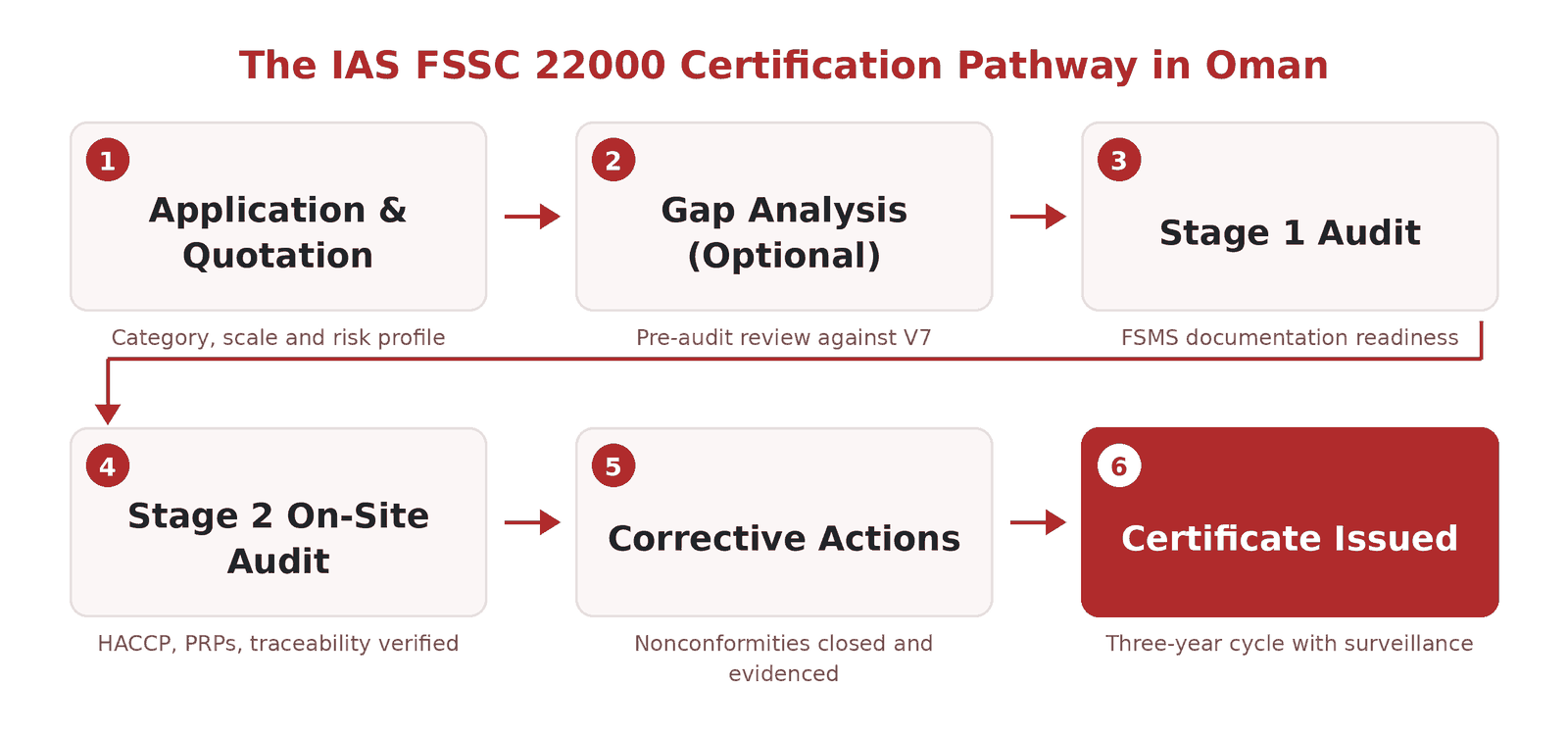
- Application and quotation — IAS looks at the operation’s fisheries, dairy, or date-processing category alongside its scale, then quotes a price tailored to that risk profile.
- Gap analysis (optional) — a pre-audit review against FSSC 22000 V7 that surfaces gaps early enough to fix them.
- Stage 1 audit — a readiness review of the FSMS documentation, carried out before the team schedules the on-site visit.
- Stage 2 audit — the on-site visit itself, where auditors confirm HACCP verification, the prerequisite programme, traceability, and the Additional Requirements are actually being followed, not just written down.
- Corrective actions (where raised) — nonconformities have to be closed and evidenced before IAS will issue a certificate.
- Certificate issued — valid for a three-year cycle, with surveillance visits scheduled throughout to keep it active (see ‘After Certification’ below).
“In seafood and dairy operations, cold-chain records are where I look first — a temperature log with gaps tells me more about the FSMS than the policy binder does,” says Adekoya Oluwatosin, FSSC 22000 v6 Lead Auditor. “Fix the gaps in the log before the auditor arrives, not the language in the policy.”
A processing operation with an established quality system can often reach certification within a few months. A facility building its FSMS from a standing start should plan for longer, especially where seasonal catch or harvest cycles affect when key records can actually be generated. Once IAS has reviewed the gap-analysis findings, it can put a realistic figure on how long certification will actually take.
Documentation You’ll Need for Certification
- Food safety policy, signed and endorsed at top-management level.
- HACCP plan and prerequisite programmes mapped to the ISO 22002-x:2025 series relevant to fisheries, dairy, or date processing.
- Food defence and food fraud vulnerability assessments and mitigation plans.
- Allergen management plan, including cross-contact controls where multiple seafood or dairy product lines share equipment.
- Traceability and recall procedures, supported by actual test records covering a full batch or catch lot.
- Cold-chain monitoring records covering catch-to-processing or farm-to-processing intervals.
- Monitoring and verification logs, internal audit reports, and management-review minutes.
- Evidence of an active food safety and quality culture, given more weight under V7.
Benefits of FSSC 22000 Certification
- Export market access — GFSI-recognised certification is frequently a precondition for selling seafood, dates, or dairy products into GCC, European, and Asian markets.
- Fewer rejected consignments — structured hazard control reduces the risk of contamination or documentation issues holding up an export shipment.
- Regulatory standing — a documented FSMS makes it easier to satisfy Omani regulatory requirements alongside export-market ones.
- Buyer confidence — certification gives seafood, date, and dairy processors a recognised credential that travels with the product to markets the buyer may never personally inspect.
- Sustainability evidence — V7’s food loss and waste and SDG-aligned requirements support fisheries and processors that are increasingly asked about sustainable sourcing.
Accreditation and Training at a Glance
Oman does not yet have a dedicated local Lead Auditor or Internal Auditor training page. Training for Omani teams instead runs through IAS’s nearest regional hub, the Iraq training pages, both delivered by EAS. Certification itself stays organisationally separate from training, as FSSC and GFSI both require of certification bodies. See the FSSC 22000 Lead Auditor Training (regional hub, Iraq) and Internal Auditor Training (regional hub, Iraq) pages.
| Activity | Delivered by | Accredited / Approved by |
|---|---|---|
| FSSC 22000 certification audit | IAS (Integrated Assessment Services) | UQAS (Universal Quality Accreditation Service) |
| FSSC 22000 Lead Auditor training (regional hub, Iraq) | EAS (Empowering Assurance Systems) — IAS’s technical training partner | CQI-IRCA (Approved Training Partner) |
| FSSC 22000 Internal Auditor training (regional hub, Iraq) | EAS — IAS’s technical training partner | EAS’s own in-house training curriculum (CQI-IRCA approval applies to the Lead Auditor course only) |
Verified against IAS’s published accreditation page and EAS’s published accreditation page, August 2026.
After Certification: Surveillance for Oman’s Seasonal Sectors
The certificate is a milestone inside a three-year cycle, not the finish line. Annual surveillance keeps the FSMS honest in the years between certification and recertification, and at least one of those visits shows up without notice. IAS times the recertification audit, matched in scope to the original Stage 2, to land comfortably before the three years run out.
- Fisheries and seafood processors should give IAS visibility into their catch-season calendar when booking surveillance. Production volume and staffing both swing sharply between peak and off-season periods, and a visit timed against the wrong window tells a less accurate story of the FSMS.
- Date processing sites that add a new packing line or a new export destination mid-cycle should notify IAS. An extension audit may be needed to bring the change under certification, rather than waiting for the next scheduled visit.
- Dairy operators expanding herd size, processing capacity, or distribution reach should flag the change at the next surveillance visit, so the certificate’s scope keeps pace with the operation’s actual footprint.
- An unannounced audit can arrive at any point in the cycle without notice. Cold-chain and traceability records need to hold up on an ordinary working day, including during the off-season lull, when staffing and oversight can quietly slip.
Why Certify with IAS?

IAS auditors bring direct exposure to fisheries, dairy, and date-processing operations. The audit reflects the operational reality of Oman’s food sector, not a generic manufacturing checklist. IAS also certifies related standards, including ISO 22000, ISO 9001, and HACCP. Folding more than one scheme into a single site visit means one trip covers what would otherwise take two. For auditor training, IAS’s partner EAS runs the CQI-IRCA approved Lead Auditor course accessible through the regional hub pages linked above.
About the reviewer
Adekoya Oluwatosin has spent eight-plus years in food safety work, spanning packaging, distribution and storage, manufacturing, and catering. That experience backs her standing as an FSSC 22000 Lead Auditor for Version 6, a credential issued by Bureau Veritas Group, alongside her parallel work as a consultant and trainer. More than 22 internal audits carry her name, covering FSSC 22000 and ISO 9001:2015. Over ten organisations have followed her guidance toward certification through FSMS and QMS groundwork, and more than 200 delegates have sat through her Highfield-accredited instruction in HACCP and Food Safety.
Explore More
- FSSC 22000 Lead Auditor Training (Iraq regional hub) — nearest hub for Omani teams, CQI-IRCA approved
- FSSC 22000 Internal Auditor Training (Iraq regional hub) — EAS’s in-house curriculum
- ISO 22000 Certification — the base standard FSSC 22000 is built on
- ISO 9001 Certification — for a combined audit with FSSC 22000
- HACCP Certification — hazard analysis and critical control points
- IAS Accreditation — IAS’s global UQAS accreditation scope
- EAS (Empowering Assurance Systems) — IAS’s training partner for Lead Auditor and Internal Auditor courses
Get Started with FSSC 22000 Certification in Oman
Contact IAS for a tailored FSSC 22000 V7 quotation for your Omani operation, or to plan a V6-to-V7 upgrade ahead of the 30 April 2028 deadline. For Lead Auditor or Internal Auditor training, use the Iraq regional hub links above, delivered by EAS.
Phone: +971 52 873 2160
Contact page: iasiso-gulf.com/OM/contact-us/
Frequently Asked Questions
Does a seafood exporter in Oman need FSSC 22000 specifically, rather than a general food safety certificate?
Buyers who ask for a GFSI-recognised certificate want a scheme benchmarked by the Global Food Safety Initiative. FSSC 22000 qualifies; a generic, non-GFSI food safety certificate typically does not.
Why does Oman use the Iraq training pages instead of a local one?
Oman doesn’t currently have its own dedicated Lead Auditor or Internal Auditor training page, so IAS points Omani teams to its nearest regional training hub, in Iraq, both run by EAS.
Is a V6 FSSC 22000 certificate still valid for an Omani dairy processor?
Yes, until it’s upgraded. V6 audits remain permitted through 30 April 2027, with full V7 adoption required by 30 April 2028.
Should a date-processing facility applying for the first time go for V6 or V7?
V7 — there’s little reason to certify to a version already partway through its own retirement.
How does seasonality affect FSSC 22000 audit scheduling in Oman?
IAS works with each operator to time Stage 1, Stage 2, and surveillance visits around catch or harvest seasons where possible, though unannounced audits can still land at any point in the cycle.
What does FSSC 22000 certification cost for an Omani fisheries operation?
There’s no single published rate: category, site count, and risk profile all factor in, and the quotation itself is worked out once IAS has been through the application.
Can an FSSC 22000 audit be combined with an ISO 9001 audit for an Omani processor?
Yes — ask IAS to align the audit dates so one site visit covers both schemes.
Who accredits IAS to certify FSSC 22000 in Oman?
UQAS (Universal Quality Accreditation Service). Its public register lets buyers verify the accreditation independently.
Is EAS’s Internal Auditor course accredited by CQI-IRCA?
No — only the Lead Auditor course carries CQI-IRCA approval. The Internal Auditor course is EAS’s own in-house curriculum.
How long does FSSC 22000 certification take for a dairy or fisheries operator in Oman?
It comes down to how developed the FSMS already is at the outset. Once IAS has been through the gap-analysis results, it can put a genuine estimate on the table instead of a blanket number.